The federal estate tax exemption is $15 million per person in 2026. So most families think estate tax isn't their problem.
If you live in New York, New Jersey, Connecticut or Pennsylvania, that can be a costly assumption. Each state has its own rules, and New York estate tax starts at less than half the federal number. Here's how each one works, and what to check now.
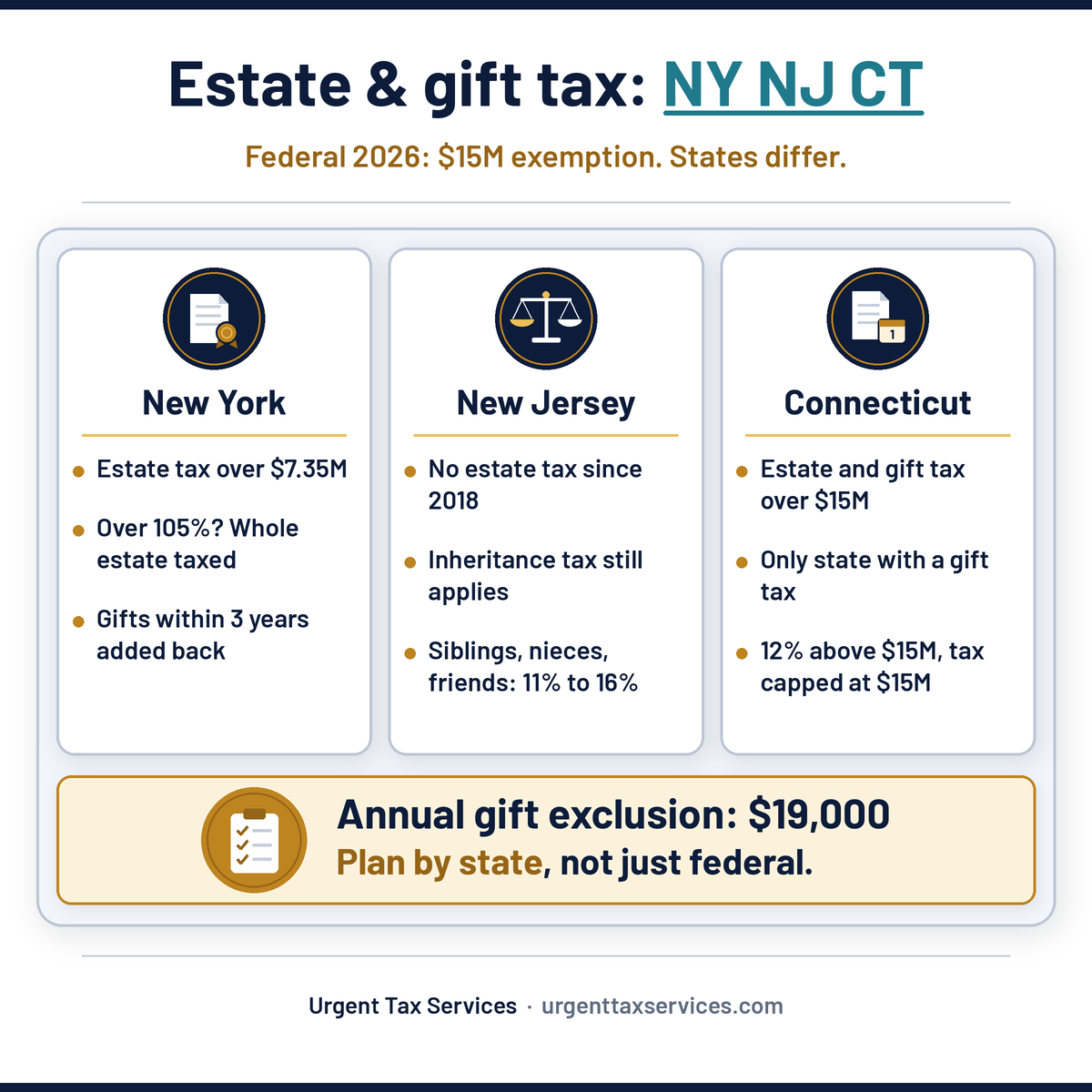
The federal estate tax exemption for 2026, and the basics
Exemption. The 2025 tax law (often called the OBBBA) set the federal estate and gift tax exemption at $15 million per person for 2026. It's adjusted for inflation starting in 2027. The same amount covers lifetime gifts and what you leave at death.
Annual gift exclusion. You can give up to $19,000 per person in 2026 without using any of that exemption. Give more than that to one person and you generally file a federal gift tax return, Form 709. Usually no tax is due. The return just tracks how much exemption you've used.
Portability. When a spouse dies, the unused part of their federal exemption can pass to the surviving spouse. It isn't automatic. The executor has to file a timely, complete estate tax return (Form 706) to make the election, even if no tax is owed.
Why file a gift tax return when no tax is due: the Redstone case
People ask me why they should bother with a Form 709 if they won't owe anything. Here's a case that answers it.
In 1972, Sumner Redstone, who later ran CBS and Viacom, moved stock in his family's company into trusts for his children. His accountants told him it wasn't a taxable gift, so no gift tax return was filed.
In 2013, 41 years later, the IRS sent him a notice for $737,625 in gift tax. He argued the IRS had waited too long. The Tax Court said no (Redstone v. Commissioner, T.C. Memo. 2015-237). When no return is filed, the IRS can assess the tax at any time, even 41 years later. The court ruled the transfer was a gift and upheld the tax. It did throw out the penalties, because he relied in good faith on his accountants.
Filing the return is what starts the clock. Generally, once a Form 709 is filed and the gift is adequately disclosed on it, the IRS has 3 years to assess more tax on that gift. If you're not sure whether a past transfer was a gift, I'd rather look at it now than 41 years from now.
New York estate tax: a lower exclusion and a cliff
New York has an estate tax but no gift tax. For deaths in 2026, the New York basic exclusion amount is $7,350,000.
No portability. New York doesn't let a surviving spouse use the unused exclusion of the spouse who died first. Each spouse gets their own, and if the first one isn't used, it's gone.
The cliff. If the New York taxable estate is up to 5% over the exclusion, the benefit of the exclusion shrinks quickly. Once the estate goes over 105% of the exclusion, the exclusion is gone entirely and the whole estate is taxed, not just the part above it.
For 2026, 105% of $7,350,000 is $7,717,500. A simple example:
- Estate of $7,300,000: under the exclusion. No New York estate tax.
- Estate of $7,500,000: inside the 5% band. Some tax, and it rises fast.
- Estate of $7,800,000: over the cliff. New York tax is figured on the full $7,800,000, which can mean a tax in the hundreds of thousands.
That last $82,500 over the cliff can cost far more than $82,500. That's why planning near the line matters.
The 3-year gift addback. Since New York has no gift tax, people sometimes give assets away late in life. New York adds back taxable gifts made within 3 years of death. According to the Department of Taxation and Finance, this applies to deaths before January 1, 2032. Gifts made while the person lived outside New York, and real or tangible property located outside New York, aren't added back.
New Jersey inheritance tax: no estate tax, but heirs can owe
New Jersey's estate tax was repealed for deaths on or after January 1, 2018. The inheritance tax was not. It depends on who receives the property, not how big the estate is.
- Class A, exempt: spouse, civil union or domestic partner, children, stepchildren, grandchildren and other descendants, parents and grandparents.
- Class C: siblings (including half-siblings) and sons- or daughters-in-law. The first $25,000 is not taxed. Then 11% on the next $1,075,000, 13% on the next $300,000, 14% on the next $300,000, and 16% above $1.7 million.
- Class D: everyone else, including nieces, nephews, cousins and friends. 15% on the first $700,000 and 16% above. A share under $500 isn't taxed.
- Class E, exempt: qualified charities and certain institutions.
Waivers. New Jersey puts a lien on a resident's New Jersey property at death. To release it, banks and brokers generally need a tax waiver before they hand over the money, and real estate needs one before it can be sold or transferred cleanly.
When everything goes to Class A beneficiaries, there's a shortcut. Form L-8 is a self-executing waiver for bank and brokerage accounts. Form L-9 is used to request a waiver for New Jersey real estate. When anything passes to a Class C, D or E beneficiary or to a trust, a full inheritance tax return (Form IT-R) generally has to be filed, even if no tax ends up due. The return and any tax are due within eight months of death, and the waivers come after.
Connecticut gift tax and estate tax
Connecticut is the only state with a gift tax, and it also has an estate tax. For 2026, the exemption matches the federal one at $15 million. It covers lifetime Connecticut taxable gifts made since 2005 and the estate together.
Above $15 million, the tax is 12% of the excess. The total Connecticut estate and gift tax is capped at $15 million.
Gift return. If you're a Connecticut resident and you make gifts over the annual exclusion, you generally file Form CT-706/709 with the Department of Revenue Services, even when no tax is due. Nonresidents file if they gave Connecticut real estate or tangible property. The 2026 return is due April 15, 2027.
Estates. An estate at or under $15 million files Form CT-706 NT with the Probate Court. Over $15 million, the estate files Form CT-706/709 with DRS and a copy with the Probate Court.
Pennsylvania inheritance tax: no estate or gift tax
Pennsylvania has no gift tax, and in practice no estate tax. Its estate tax was tied to a federal credit that ended for deaths after 2004, so there's nothing left for it to collect. What Pennsylvania does have is an inheritance tax. Like New Jersey's, the rate depends on who receives the property. Unlike New Jersey's, children and grandchildren pay it.
- 0%: a surviving spouse, a parent inheriting from a child 21 or younger, and a child 21 or younger inheriting from a parent.
- 4.5%: lineal heirs, such as children, stepchildren, grandchildren, parents and grandparents.
- 12%: brothers and sisters, including half-siblings.
- 15%: everyone else, including nieces, nephews, cousins, brothers- and sisters-in-law, and friends.
- Exempt: qualified charities, exempt institutions and government entities.
There's no large exemption like New York's or Connecticut's. For a resident, the tax reaches Pennsylvania real estate and belongings, plus stocks, bonds and bank accounts wherever they're held. Debts, funeral costs and estate expenses come off first. Property owned jointly by spouses is exempt.
Gifts within one year of death. Because there's no gift tax, a gift made more than a year before death is generally outside the inheritance tax. Gifts made within one year of death are pulled back in, to the extent they're over $3,000 per person for the calendar year. A gift where the person kept an interest, like the right to keep living in the house, can be taxed no matter when it was made.
Due date and discount. The tax is due at death. The return, Form REV-1500, and the payment are due within nine months. Pay within three months of the date of death and you get a 5% discount on what you pay. After nine months, interest runs. An extension to file the return doesn't extend the time to pay.
Live in one state, own property in another
This is common in our area. A Brooklyn family with a house in New Jersey, or a Connecticut couple with a New York condo.
- New York: a nonresident's estate may have to file if it includes New York real estate or tangible property, and the estate is over the New York exclusion.
- New Jersey: a nonresident's New Jersey real estate and tangible property can be subject to inheritance tax, and a waiver is needed to transfer the real estate. Bank accounts and other intangibles of a nonresident don't need a waiver.
- Connecticut: a nonresident who owned Connecticut real estate or tangible property can owe Connecticut estate tax on it if the estate is over $15 million.
- Pennsylvania: a nonresident's Pennsylvania real estate and tangible property is subject to Pennsylvania inheritance tax. A nonresident's stocks, bank accounts and other intangibles are not.
So one family can deal with two or three states' rules. It's worth knowing which ones apply before there's a death in the family.
What to do now
- Add up what you own, roughly, including real estate, retirement accounts and life insurance you control.
- If you're in New York, see how close you are to $7.35 million and the $7,717,500 cliff.
- If you're in New Jersey, look at who your beneficiaries are. Siblings, nieces, nephews and friends change the picture.
- If you're in Connecticut and made gifts over $19,000 to anyone this year, plan for a CT-706/709 by April 15.
- If you're in Pennsylvania, or own property there, look at who inherits. Children pay 4.5%, siblings 12%, and others 15%. Paying within three months saves 5%.
- Note any property you own in another state.
- Keep copies of any gift returns you've filed. They matter later.
- Talk with your estate attorney about wills and trusts, and with a tax professional about the filings.
FAQ
Does New York tax gifts?
No. New York has no gift tax, but taxable gifts made within 3 years of death can be added back to the estate.
Do my children owe New Jersey inheritance tax?
No. Children, grandchildren, spouses and parents are Class A and exempt. The estate may still need a waiver to release accounts or real estate.
I'm under the federal $15 million. Can I ignore state tax?
Not necessarily. New York's exclusion is $7.35 million, New Jersey's inheritance tax can apply to a small estate if it goes to a sibling or a friend, and Pennsylvania's inheritance tax applies even to what children inherit.
Do my children owe Pennsylvania inheritance tax?
Generally yes, at 4.5%. A child 21 or younger inheriting from a parent pays 0%, and so does a surviving spouse.
Does Pennsylvania tax gifts?
No. Pennsylvania has no gift tax, but gifts made within one year of death can be taxed as part of the inheritance, above $3,000 per person.
Do I file a Connecticut gift return if no tax is due?
Generally yes, if you're a Connecticut resident and your gifts to someone went over the annual exclusion.
Does New York portability work like federal?
No. New York doesn't allow portability between spouses.
If I gave a gift years ago and never filed, is it too late for the IRS?
No. When no gift tax return is filed, there's no time limit on assessing the tax. That was the result in the Redstone case.
Related: NY, NJ & CT tax penalty abatement · Is your tax extension valid? · Westchester IRS and NYS tax help
Official sources: NY Tax Department: Estate tax · NJ Division of Taxation: Inheritance tax · CT DRS: Estate and gift tax information · PA Department of Revenue: Inheritance tax
Planning across NY, NJ, CT or PA?
I help individuals, businesses and trusts with tax planning, gift tax returns and the filings that follow, and with tax problems with the IRS, New York, New Jersey, Connecticut and Pennsylvania. We'll look at which rules apply to you.
Solomon Grosinger, Enrolled Agent
I'm licensed by the IRS and have represented taxpayers before the IRS and New York, New Jersey, Connecticut and Pennsylvania tax agencies from Brooklyn since 2017.
General info, not advice for your specific case.