The IRS needs a boss’s signature. New York, New Jersey and Connecticut don’t.
Federal law makes an IRS supervisor approve most audit penalties in writing before they can stick. It's Section 6751(b), and I wrote about it in The IRS needs a boss's signature before it can penalize you.
Clients ask me if the same defense works against New York, New Jersey or Connecticut. I looked. I didn't find a state version in any of the three. No statute, no regulation, no published procedure that makes a supervisor sign off before a state penalty is assessed. None of them adopted the federal rule either.
So with a state penalty, a missing signature isn't your argument. Reasonable cause is. Here's how each state handles it.
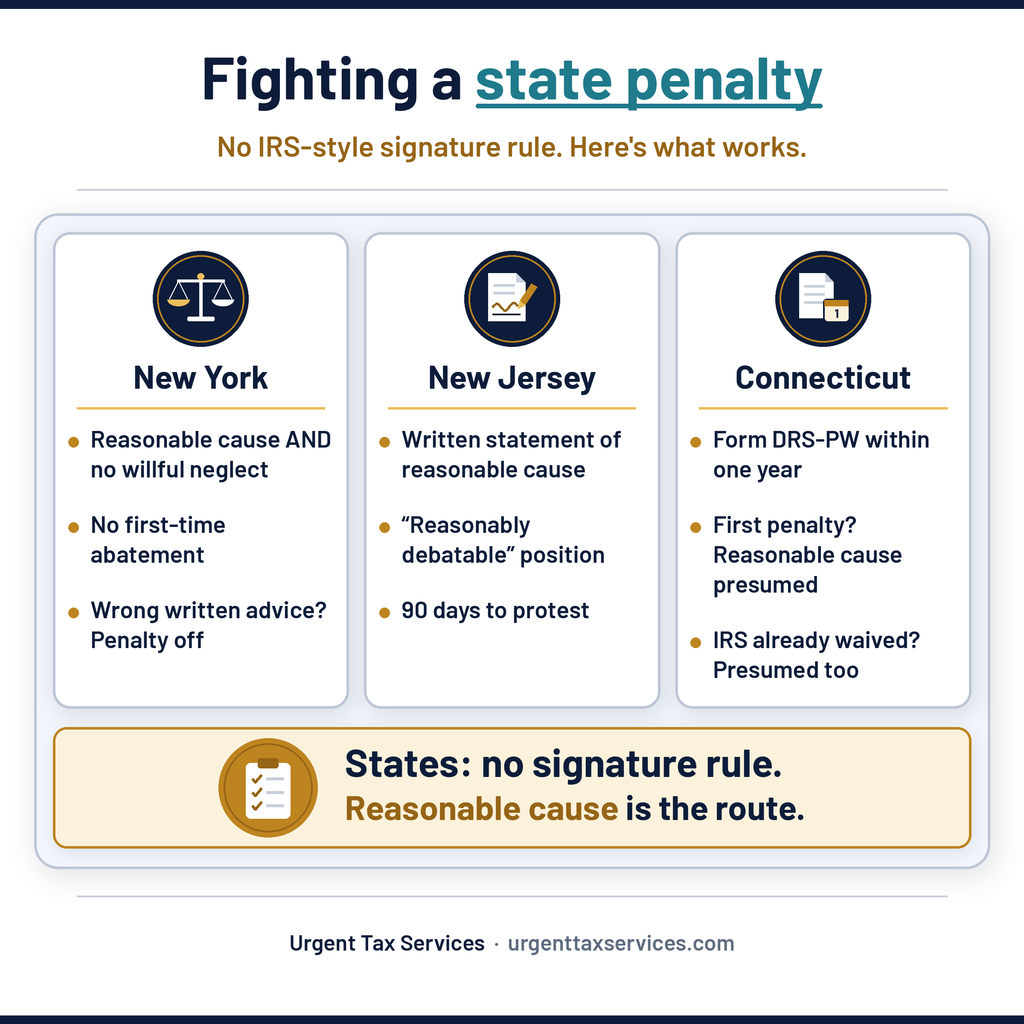
New York: reasonable cause and no willful neglect
The rule is in the regulations, 20 NYCRR 2392.1. A penalty is imposed unless the failure was due to reasonable cause and not due to willful neglect. You need both. Showing you didn't ignore it on purpose isn't enough by itself.
The regulation lists grounds that can qualify:
Death or serious illness, or unavoidable absence
Records destroyed
Being unable to get the information you needed
Anything else that shows you acted like a person of ordinary prudence
Your past filing record counts. For the substantial understatement penalty, the test is reasonable cause and good faith. An honest misunderstanding of the law, reasonable reliance on a professional's advice, or fixing it on an amended return before the state contacts you can all help.
Two things to know:
New York has no first-time abatement program like the IRS's. A clean history helps, but it doesn't win by itself.
Wrong written advice is a strong card. Under Tax Law 3008, if the Tax Department gave you erroneous advice in writing, in answer to your specific written request, the penalty caused by that advice has to be abated.
Practical tips: ask for abatement in writing during the audit, before it closes. Name the specific ground from the regulation and attach your compliance history. If the penalty came on a notice and demand (for example, a balance due on the return you filed), you may have to pay and claim a refund to get a hearing. Penalties in a Notice of Determination can be contested at a conciliation conference or with a petition to the Division of Tax Appeals. Check the deadline on your notice; it's generally 90 days.
New Jersey: a written statement and the "reasonably debatable" point
New Jersey law lets the Director waive penalties if the failure is explained to the Director's satisfaction. The regulation, N.J.A.C. 18:2-2.7, spells out how: you show reasonable cause in a written statement signed under penalties of perjury. Prior compliance counts. The extra penalties added after a state tax amnesty can't be waived.
New Jersey's Taxpayers' Bill of Rights adds one protection: if you reasonably relied on wrong written advice from the Division, penalties and interest are waived.
Courts give the Director a lot of room. A denial generally stands unless it's arbitrary or unreasonable. But there's an important exception. In United Parcel Service v. Director (2014), the state Supreme Court upheld a ruling that refusing to waive penalties was an abuse of discretion where the taxpayer took a "reasonably debatable" position on an unsettled point of law.
So if your penalty came from a real gray area in the law, say so in your statement and explain why your position was reasonable.
Watch the clock. You generally have 90 days from a final assessment to protest to the Division's Conference and Appeals Branch or to file in the Tax Court. Another option is to pay within a year and file a refund claim within 450 days. Miss the 90 days and your choices shrink.
Connecticut: Form DRS-PW within one year
Connecticut uses Form DRS-PW to request a penalty waiver. The deadline is strict: DRS won't consider a request received more than one year after the first notice of the penalty (or the filing date, if you reported the penalty yourself).
The standard is reasonable cause, with the failure not intentional or due to neglect. DRS policy (Policy Statement 2019(3)) presumes reasonable cause when:
It's the first time you've been penalized for that tax (for monthly, quarterly or annual filers)
The IRS already waived the penalty for the same tax type and period
A law signed after the due date caused the problem
DRS error usually qualifies. Preparer error generally doesn't. Interest can't be waived.
A few catches:
Audit penalties don't go on DRS-PW. You fight those by protesting the audit assessment.
Clean up first. DRS generally won't consider a waiver while you have other unfiled returns or unpaid balances, unless they're under protest or on a payment plan.
Larger waivers take more approval. The Commissioner can waive up to $5,000. Above that, a Penalty Review Committee has to approve it.
If the IRS already removed a federal penalty for the same period, include that letter. It's ready-made support.
What works in all three states
Write it down. Every state wants the reason in writing, with dates and documents.
Be specific. "I was busy" doesn't work. "I was hospitalized from March to May, here are the records" might.
Check for written advice from the state. In New York and New Jersey, wrong written advice from the agency is its own route to relief.
Mind the deadlines. 90 days in New Jersey, one year for Connecticut's DRS-PW, and whatever your New York notice says.
Fix what's still open. File missing returns and set up payment on what you owe. A request is stronger when everything else is current.
I can't promise any of this removes a penalty. The request is only as good as the facts and papers behind it.
Short FAQ
Can I argue that a state supervisor didn't approve my penalty? I haven't found any rule in New York, New Jersey or Connecticut that requires that approval, so I wouldn't lead with it. Reasonable cause is the main route.
Does New York forgive a first penalty automatically? No. New York has no first-time abatement program. Connecticut presumes reasonable cause for a first penalty on regular filings.
The IRS removed my penalty. Does the state follow? In Connecticut, an IRS waiver for the same tax type and period creates a presumption. In New York and New Jersey, it's useful support but not automatic.
General info, not advice for your specific case.
Related: The IRS needs a boss's signature before it can penalize you · File even if you can't pay: the penalty math nobody explains · Why a late S-corp return gets a penalty even when no tax is due
Got a state tax penalty notice?
Book a free consultation and we'll look at the notice, the deadline and your reasons. I'll tell you honestly where you stand.