By Solomon Grosinger, IRS Enrolled Agent | Reviewed November 10, 2026
Owners ask me the same December question: what can I still do this year? Some deductions depend on facts that already exist, such as a home office you actually used. Others depend on a move that must happen by December 31, 2026, such as placing equipment in service or adopting a retirement plan.
I cover the 2026 federal rules I see most often, with examples, a checklist, recordkeeping traps, and NY/NJ/CT/PA notes where those states genuinely differ. Dollar limits come from official IRS sources. If a figure is not confirmed, I say so or leave it out. Nothing here is a promise of a set tax result.
For the broader menu, see tax planning and the four general categories of tax planning. Payroll and self-employment tax sit next to these deductions in types of small business taxes.
Small business tax deductions 2026: start with ordinary, necessary, and proof
A business expense is generally deductible when it is ordinary and necessary in your trade or business. "Ordinary" means common and accepted in your field. "Necessary" means helpful and appropriate, not that you could not operate without it. Personal costs stay personal. Mixed-use items, such as a car or a phone, need a reasonable business-use split. [1]
The deduction is only as strong as the record. See how to track business expenses. Close calls, such as mixed travel or a home office that is not exclusive, are in gray-area business deductions. Year-end is a bad time to invent a paper trail after the fact.
Example. You pay $1,200 in December for business-only software. A cash-method taxpayer who is billed and pays in 2026 generally deducts it if it is an ordinary business expense. Paying your home electric bill from the business account does not make that bill deductible.
Timing: "placed in service" is not the same as "ordered"
For Section 179 and bonus depreciation, the usual year-end test is whether qualifying property is placed in service during the tax year. That means it is ready and available for its intended use, not merely ordered, paid for, or sitting in a warehouse. [2]
If you use the cash method, paying an otherwise deductible expense by December 31 can pull the deduction into 2026. That does not override capitalization or inventory rules. A machine that cannot be used until February is not placed in service in 2026 just because you paid in December.
Example. Jordan signs for a $28,000 machine on December 28. It is delivered, installed, and available to use on December 30. That is generally 2026 placed-in-service timing. If it is still on a truck on January 2, 2027, 2026 expensing is usually off the table, even if Jordan paid in full in December.
Section 179: elect to expense qualifying property
Section 179 lets you elect to expense qualifying depreciable business property in the year it is placed in service, instead of spreading the cost over the recovery period. The election is made on Form 4562. [2, 3]
Public Law 119-21, which the IRS often discusses as the Working Families Tax Cuts or OBBBA, raised the Section 179 cap and phaseout for tax years beginning after December 31, 2024, and indexes those amounts after 2025. [3, 4]
For tax years beginning in 2026, Rev. Proc. 2025-32 and Publication 946 state: [2, 4]
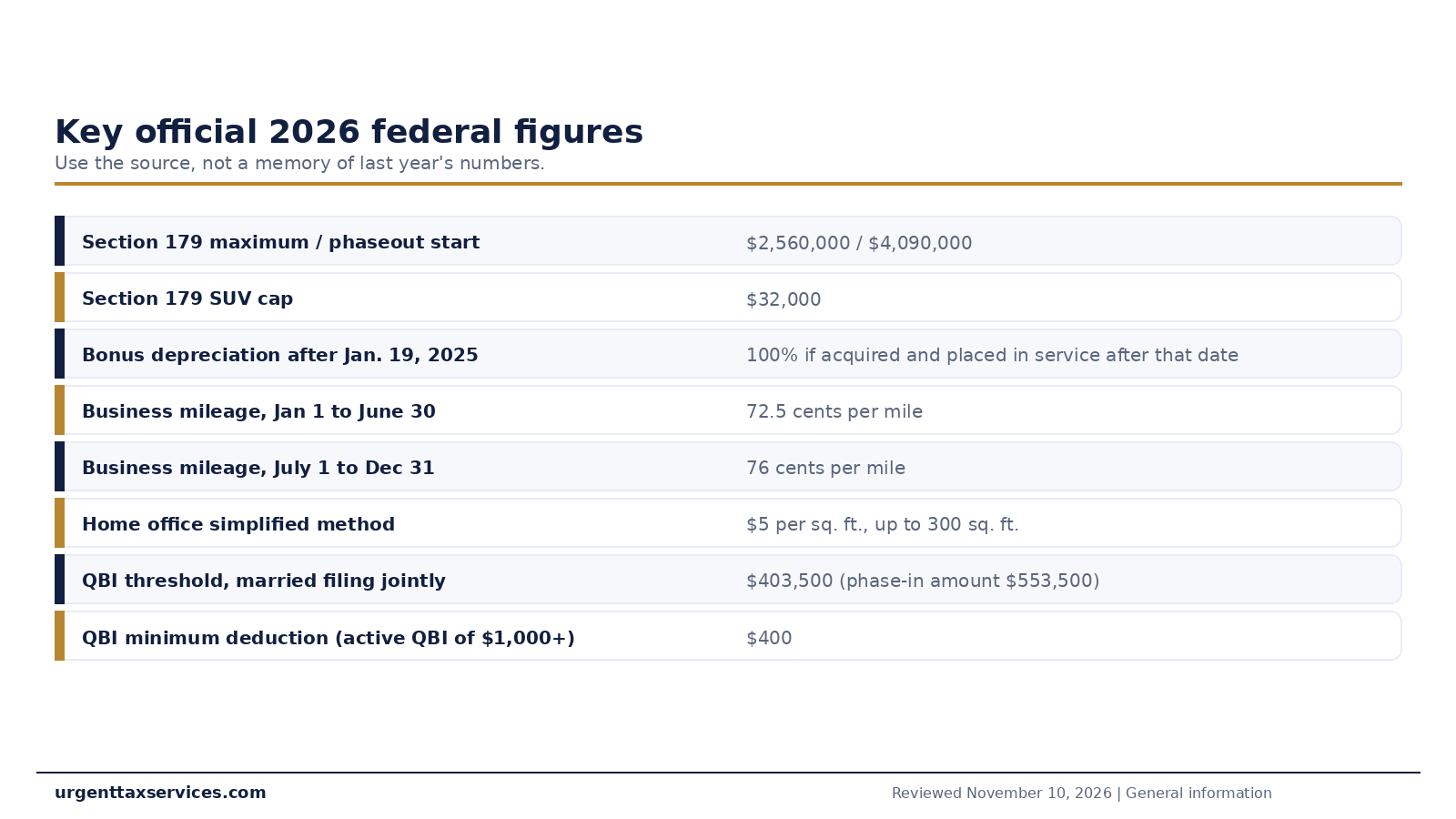
| 2026 Section 179 item | Amount |
|---|---|
| Maximum expense election | $2,560,000 |
| Phaseout starts when Section 179 property placed in service exceeds | $4,090,000 |
| SUV cap (sport utility vehicles, as defined for this limit) | $32,000 |
The deduction is also limited by taxable income from the active trade or business. Unused amounts can often be carried forward. Passenger automobiles have extra annual caps. I am not stating a 2026 luxury-auto first-year figure because I did not confirm a 2026 auto-cap revenue procedure for this draft; check the current Form 4562 instructions. [2]
Example. A contractor places $85,000 of qualifying equipment in service on December 15, 2026, with enough Section 179 business income. The cost is far below the 2026 cap and phaseout, so an $85,000 election may be available, subject to listed-vehicle rules and the state adjustments later in this article.
100% bonus depreciation after January 19, 2025
Bonus depreciation under section 168(k) is a special first-year allowance for qualified property. OBBBA section 70301 made a permanent 100% additional first-year depreciation deduction for qualified property acquired and placed in service after January 19, 2025, and for specified plants planted or grafted after that date. Notice 2026-11 describes the change. [5, 3]
A written binding contract matters. For the effective date, property is generally not treated as acquired after the date that contract is entered into. Property contracted for on or before January 19, 2025, can still fall under the older phasedown percentages (40% for much qualified property placed in service during 2025, and 60% for certain longer-production-period property and certain aircraft) even if you place it in service later. [5]
You may choose Section 179, bonus depreciation, or a combination, depending on the asset and your income. Bonus depreciation has its own used-property and acquisition-date tests. Check Form 4562 and Notice 2026-11 for a specific asset.
Example. In March 2026 you buy and place in service a new qualifying machine with no earlier binding contract. If it is qualified property, 100% bonus may apply. If you signed a binding contract on January 10, 2025, and the machine arrives in November 2026, do not assume 100%. The acquisition-date rule can keep you on the older percentage.
Vehicles and the 2026 standard mileage rates
Business use of a car can be deducted using the standard mileage rate or actual expenses, subject to Topic 510 and Publication 463. To use the standard mileage rate for a car you own, you generally must choose it in the first year the car is available for business use. Claiming Section 179 or special depreciation on the car can block later use of the standard rate. [6, 7]
For 2026, the IRS published two business rates: [8, 9]
| Period | Business standard mileage rate |
|---|---|
| January 1 through June 30, 2026 | 72.5 cents per mile |
| July 1 through December 31, 2026 | 76 cents per mile |
The charity rate remains 14 cents per mile by statute. Medical and certain military moving rates also changed mid-year; those are not the business rate. [8, 9]
Keep a log with date, destination, business purpose, and miles. A total written in January is a weak record.
Example. You have 4,000 documented business miles from January through June and 3,500 from July through December, and you qualify for the standard mileage rate. The illustration is (4,000 x $0.725) + (3,500 x $0.76) = $2,900 + $2,660 = $5,560, plus deductible business parking and tolls. Commuting to a regular office is generally personal.
Home office: exclusive and regular use
The home office deduction is available if you use part of your home exclusively and regularly as your principal place of business, as a place to meet clients in the normal course of business, or in certain separate-structure cases. Employees generally cannot claim a home office deduction as a miscellaneous itemized deduction. [10, 11]
You may use the simplified method or the regular method. The simplified method is $5 per square foot, up to 300 square feet ($1,500 maximum). You cannot take home depreciation in a simplified-method year, and unused amounts do not carry over. The regular method uses actual expenses times the business-use percentage and can include depreciation, with later recapture if you sell the home. You choose a method on a timely original return and cannot switch for that same year later. [10]
Example. A 200-square-foot room used only as your principal place of business can support a simplified deduction of 200 x $5 = $1,000, subject to the gross-income limit. If the same room is also the guest room, exclusive use usually fails.
Self-employed health insurance
If you are self-employed with a net profit, a partner with net earnings from self-employment, or a more-than-2% S corporation shareholder receiving wages, you may be able to deduct medical, dental, and vision insurance, and limited qualified long-term care premiums, for yourself, your spouse, dependents, and a child under age 27 at year-end even if not a dependent. The plan must be established, or treated as established, under your business. [12]
The deduction is claimed on Schedule 1 (Form 1040). Use Form 7206 when the instructions require it (for example, more than one source of self-employment income, Form 2555, or qualified long-term care premiums). You generally cannot deduct premiums for a month you were eligible for a subsidized plan of your employer or your spouse's employer. The deduction cannot exceed earned income from the business that established the plan. Publication 535, which used to hold the worksheet, has been discontinued. [12, 13]
Example. A sole proprietor with $60,000 of net profit pays $9,600 for a policy covering the owner and spouse and is not eligible for a subsidized employer plan. That $9,600 may qualify, subject to Form 7206 limits. If a spouse could have enrolled in a subsidized employer plan, those months may be blocked.
Retirement plans: limits, and which deadlines still matter in December
Retirement contributions are often the largest year-end deduction I review, but the setup deadline depends on the plan. [14, 15]
2026 IRS dollar limits (selected): [16, 17]
| Item | 2026 amount |
|---|---|
| SEP maximum contribution | Lesser of 25% of compensation or $72,000 |
| SEP / defined-contribution compensation cap | $360,000 |
| 401(k) elective deferrals | $24,500 |
| 401(k) catch-up, age 50 or older | $8,000 |
| Higher 401(k) catch-up, ages 60-63 | $11,250 |
| Defined-contribution annual additions limit | $72,000 (catch-up can raise the overall figure) |
| SIMPLE IRA elective deferrals | $17,000 |
| SIMPLE catch-up, age 50 or older | $4,000 |
| Higher SIMPLE catch-up, ages 60-63 | $5,250 |
For SEP plans, you can set up the plan as late as the due date of your income tax return for the year, including extensions, and still make the contribution for that year. [14, 15]
For a SIMPLE IRA, the general setup window is January 1 through October 1. A new employer that came into existence after October 1 may establish a plan as soon as administratively feasible. If you already missed October 1, 2026, a brand-new SIMPLE for calendar year 2026 is generally not a December project. [14, 18]
Qualified plans, including a solo 401(k): to deduct contributions for a year, the plan generally must be adopted by the last day of that year. SECURE 2.0 added a narrow path for a sole proprietor with no employees: a new 401(k) may be adopted after year-end for the first plan year, with elective deferrals paid by the unextended return due date. Nonelective contributions can often be funded later, by the filing due date including extensions, if the plan already exists. Do not treat every 401(k) as if it can be created in March for last year. [14, 19]
Self-employed calculations use net earnings after the deductible half of self-employment tax, and the 25% employer-style limit is applied to that reduced figure. Publication 560 has the worksheets. [14]
Example. You are 52, self-employed, and already have a solo 401(k). You may still be able to defer up to $24,500 plus the $8,000 catch-up, and add a nonelective contribution up to the plan and section 415 limits, if earned income supports it. If you have no plan and you want 2026 deferrals, December is when many owners adopt a solo 401(k). A SEP can still be established later, but it does not allow elective deferrals.
Qualified business income (section 199A)
Eligible owners of sole proprietorships, partnerships, S corporations, and some trusts may deduct up to 20% of qualified business income, plus 20% of qualified REIT dividends and qualified PTP income, subject to a taxable-income limit. Employee wages and C corporation income do not qualify. [20]
OBBBA made the deduction permanent and added, for tax years beginning after 2025, a minimum deduction of $400 if you have at least $1,000 of QBI from qualified trades or businesses in which you materially participate. Those $400 and $1,000 figures will be indexed after 2026. [4, 20, 21]
For 2026, the threshold and phase-in amounts under Rev. Proc. 2025-32 are: [4]
| Filing status | Threshold | Phase-in range amount |
|---|---|---|
| Married filing jointly | $403,500 | $553,500 |
| Married filing separately | $201,775 | $276,775 |
| All other returns | $201,750 | $276,750 |
Below the threshold, specified service trade or business (SSTB) limits and the W-2 wage and property limits generally do not apply in the same way they do above it. Above the threshold, those limits phase in. Use Form 8995 or 8995-A. [20, 22]
Year-end income timing, retirement contributions, and depreciation elections can move you relative to the threshold. That is planning, not a reason to delay reporting income you have already earned.
Example. A married couple filing jointly has 2026 taxable income (before the QBI deduction) of $320,000 and $200,000 of QBI from a non-SSTB shop in which they materially participate. They are under the $403,500 threshold. A 20% QBI component of $40,000 may be available, limited to 20% of taxable income minus net capital gain. If taxable income were $500,000 from a specified service business, the SSTB phase-in could reduce or eliminate the deduction.
De minimis safe harbor for small-dollar property
Under the tangible property regulations, you may elect a de minimis safe harbor to deduct amounts paid to acquire or produce tangible property that you deduct in your books, up to $2,500 per invoice or item if you do not have an applicable financial statement, or $5,000 if you do. Inventory and land are out. Attach a statement titled "Section 1.263(a)-1(f) de minimis safe harbor election" to a timely original return, including extensions. The election applies to all qualifying amounts for that year. [23]
The safe harbor is an administrative convenience. Amounts over the threshold are not automatically capitalized. They are still tested under the normal repair, materials, and capitalization rules. [23]
Example. You have no applicable financial statement. You buy five $400 tools and a $2,200 workbench, each on its own invoice, and you expense them in your books. If you make the election, those invoices may fit the $2,500 safe harbor. A $6,000 machine on one invoice does not.
Accountable plans for employee reimbursements
If you have employees, including a spouse or child who is a real employee, reimbursements should run through an accountable plan. The arrangement must have a business connection, require substantiation within a reasonable time, and require return of excess advances within a reasonable time. Accountable-plan payments are generally excluded from wages. A nonaccountable plan is treated as wages. [7, 24]
Example. A flat $300 "mileage" payment with no log and no return of unused amounts is generally not an accountable plan. The $300 belongs in wages. A written policy that reimburses documented business miles at the IRS rate, with timely logs and return of excess advances, is the structure I want to see before year-end.
Common mistakes and audit red flags
These are substantiation problems I see when a deduction is questioned, not a prediction about your return.
- No contemporaneous mileage log. A reconstructed annual total, with no dates or purposes, is a frequent weak point. [6, 7]
- Home office that is not exclusive. A desk in a shared bedroom usually fails exclusive use. [10]
- Equipment that was not placed in service. A December invoice is not the same as a machine ready to use. [2]
- Personal or entertainment costs treated as fully deductible. Qualifying business meals are generally limited to 50%. Entertainment is generally nondeductible. [7]
- Missing 274(d) details for travel, gifts, and listed property. Amount, time, place, and business purpose are the usual elements. [7]
- Reimbursements without an accountable plan. A monthly allowance with no receipts becomes wages. [7, 24]
- Ignoring mid-year mileage rates. Using 72.5 cents after June 30 understates the second-half rate; using 76 cents before July overstates it. [8, 9]
- Assuming a state return follows 100% bonus or the federal 179 cap. Several nearby states do not.
- A new SIMPLE plan started in December. The usual setup cutoff is October 1. [18]
- Thin records after a big year-end purchase. Keep the invoice, proof of payment, delivery or installation evidence, business-use percentage, and Form 4562 workpapers. [2, 7]
State notes for New York, New Jersey, Connecticut, and Pennsylvania
Federal deductions do not always flow straight onto a resident state return. Confirm the current state forms, because 2026 booklets may still change after this review.
New York. New York generally does not follow federal bonus depreciation under IRC section 168(k) for property placed in service on or after June 1, 2003 (with limited zone exceptions). You add back federal 168(k) depreciation and subtract New York depreciation computed as if that special allowance did not apply, using Form IT-398 and Form IT-225 codes A-209 and S-213. [25] The 2026-2027 budget also decoupled from accelerated depreciation for qualified production property under section 168(n) for years beginning on or after January 1, 2025. [26]
New Jersey. New Jersey decoupled from federal bonus depreciation and from later federal Section 179 calculations for Gross Income Tax. Worksheet GIT-DEP is used to compute the New Jersey figures. For GIT purposes, the maximum Section 179 deduction is $25,000. The federal 50% special depreciation allowance is not allowed. Unused New Jersey Section 179 amounts cannot be carried forward. [27, 28]
Connecticut. On the latest official Form CT-1040 instructions available at this review (2025 instructions, Rev. 12/25), you add back 100% of section 168(k) bonus depreciation deducted in federal AGI and 80% of the federal Section 179 deduction. In each of the next four years you may subtract 25% of those amounts previously added back. [29] Confirm the 2026 booklet when it is issued.
Pennsylvania. For PA personal income tax, bonus depreciation is not allowed. For tax years beginning on or after January 1, 2023, Pennsylvania incorporates the federal Section 179 limits and definitions, subject to PA net-profit limits and carryovers in PIT Bulletin 2023-02. Pennsylvania does not allow the section 199A deduction. Owner contributions to the owner's own retirement plan are not a PA business expense, though contributions for employees can be. PA also does not allow the deductible half of self-employment tax. Meals and entertainment that meet PA's ordinary, necessary, and reasonable standard may be allowed in full for PA even when federal law limits or disallows them. [30, 31]
Example. You place $100,000 of qualified equipment in service in 2026 and claim 100% federal bonus. New York generally requires an addback and New York depreciation instead. New Jersey GIT may limit you to $25,000 of Section 179 and no federal-style bonus. Connecticut may add back the bonus and 80% of any federal 179, then allow a 25% recovery over later years. Pennsylvania allows no bonus, though a federal-limit Section 179 election may still apply against PA net profits. The federal and state returns will not match.
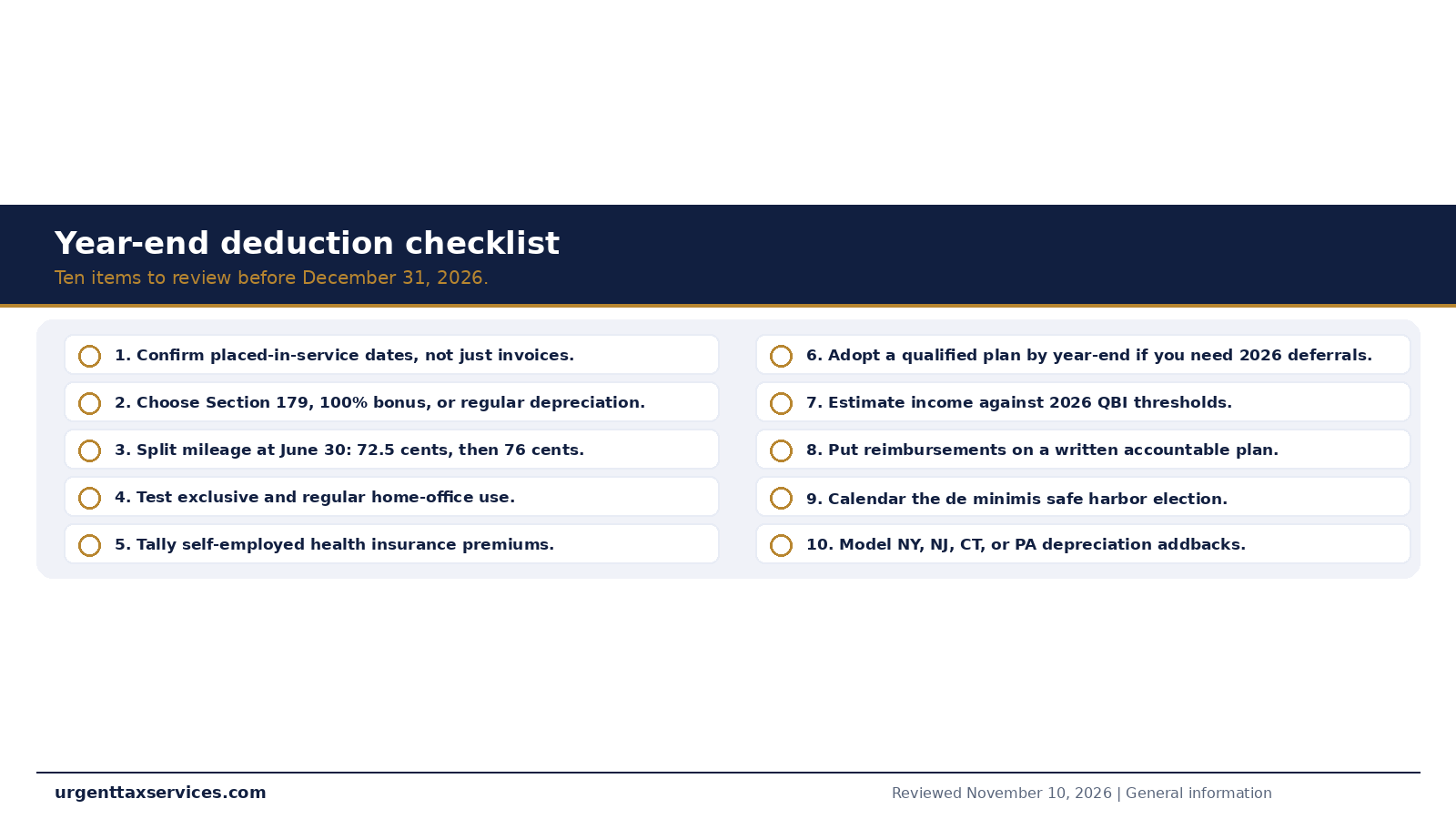
Year-end action checklist
- List assets ordered, in transit, or already in use, and mark the actual placed-in-service date.
- Decide whether Section 179, 100% bonus (if the acquisition-date test is met), regular depreciation, or the de minimis safe harbor fits each item.
- Recalculate business miles with the 72.5-cent rate through June 30 and the 76-cent rate starting July 1, if you use the standard mileage rate.
- Confirm exclusive and regular home-office use, then choose simplified or regular method.
- Tally self-employed health insurance premiums and check spouse-employer eligibility.
- If you want a 2026 solo 401(k) or other qualified plan, review adoption timing before December 31 (SEP can wait until the filing deadline, including extensions; a new SIMPLE is generally too late after October 1).
- Estimate taxable income against the 2026 QBI thresholds before you lock in income and deduction timing.
- Put employee reimbursements on a written accountable plan and collect missing substantiation now.
- Attach or calendar the de minimis safe harbor election if you will use it on the 2026 return.
- Model New York, New Jersey, Connecticut, or Pennsylvania modifications before you assume the federal deduction is the state deduction.
My bottom line
The useful 2026 moves are the ones you can still finish by December 31, or the ones with a later but real deadline, such as a SEP. 100% bonus depreciation and the higher Section 179 caps are useful federal tools, and they still have placed-in-service, acquisition-date, and state-addback conditions. Records made during the year beat a reconstructed story in April.
I help owners look at the federal election, the state adjustment, and the paperwork together before they spend money just to "get a deduction."
Sources
[1] IRS, Deducting Business Expenses
[2] Publication 946, How to Depreciate Property (2026 Section 179 limits in What's New)
[3] IRS, Working Families Tax Cuts - Businesses
[5] Notice 2026-11, Interim Guidance on Additional First Year Depreciation under section 168(k)
[6] Topic no. 510, Business use of car
[7] Publication 463, Travel, Gift, and Car Expenses
[8] IRS, Standard mileage rates
[9] Notice 2026-10 and Announcement 2026-11 (mid-year revision)
[10] IRS, Simplified option for home office deduction
[11] Topic no. 509, Business use of home
[12] Instructions for Form 7206, Self-Employed Health Insurance Deduction
[13] IRS, Guide to business expense resources (Publication 535 discontinued)
[14] Publication 560, Retirement Plans for Small Business
[15] IRS, Simplified Employee Pension plan (SEP)
[16] IRS, COLA increases for dollar limitations on benefits and contributions
[17] IRS newsroom, 401(k) limit increases to $24,500 for 2026
[18] IRS, Retirement Plans FAQs regarding SIMPLE IRA Plans
[19] IRS, Deductibility of employer contributions to a 401(k) plan made after the end of the tax year
[20] IRS, Qualified business income deduction
[21] IRS, Understanding the Working Families Tax Cuts: Business Tax Provisions
[22] 2026 Instructions for Form 8995 (draft / current IRS posting)
[23] IRS, Tangible property final regulations
[24] Topic no. 514, Employee business expenses (accountable plan discussion in Pub. 463, ch. 6)
[25] New York Form IT-225-I instructions, codes A-209 and S-213
[26] NYS DTF Notice N-26-1, Reporting certain depreciation and R&E deductions
[27] NJ Division of Taxation, NJ Decoupled from Federal Depreciation
[28] NJ Worksheet GIT-DEP, Depreciation Adjustment Worksheet
[29] Form CT-1040 Instructions (Rev. 12/25), Lines 36, 36a, 48a, and 25% Section 179 recovery
[30] Pennsylvania DOR, PA Treatment for Tax Cuts and Jobs Act, One Big Beautiful Bill Act
[31] PA PIT Guide, Net Income (Loss) from the Operation of a Business; PIT Bulletin 2023-02
Message me if you want help reviewing 2026 year-end deduction elections before December 31.
I help with IRS, New York, New Jersey, Connecticut and Pennsylvania tax problems.
General info, not advice for your specific case.