Is the IRS forced to accept an amended tax return? No.
"The tax deadline is next week and I can't get some of my 1099s or other income documents. What are my options?"
Many clients ask me some version of this every spring.
Filing late can trigger penalties. Knowingly filing with the wrong income amounts is against the law. So one option is to file using your best estimate of income and expenses, and then file an amended return as soon as the real numbers come in.
That plan only works if the IRS accepts the amended return. And here's something most people don't know. The IRS doesn't have to.
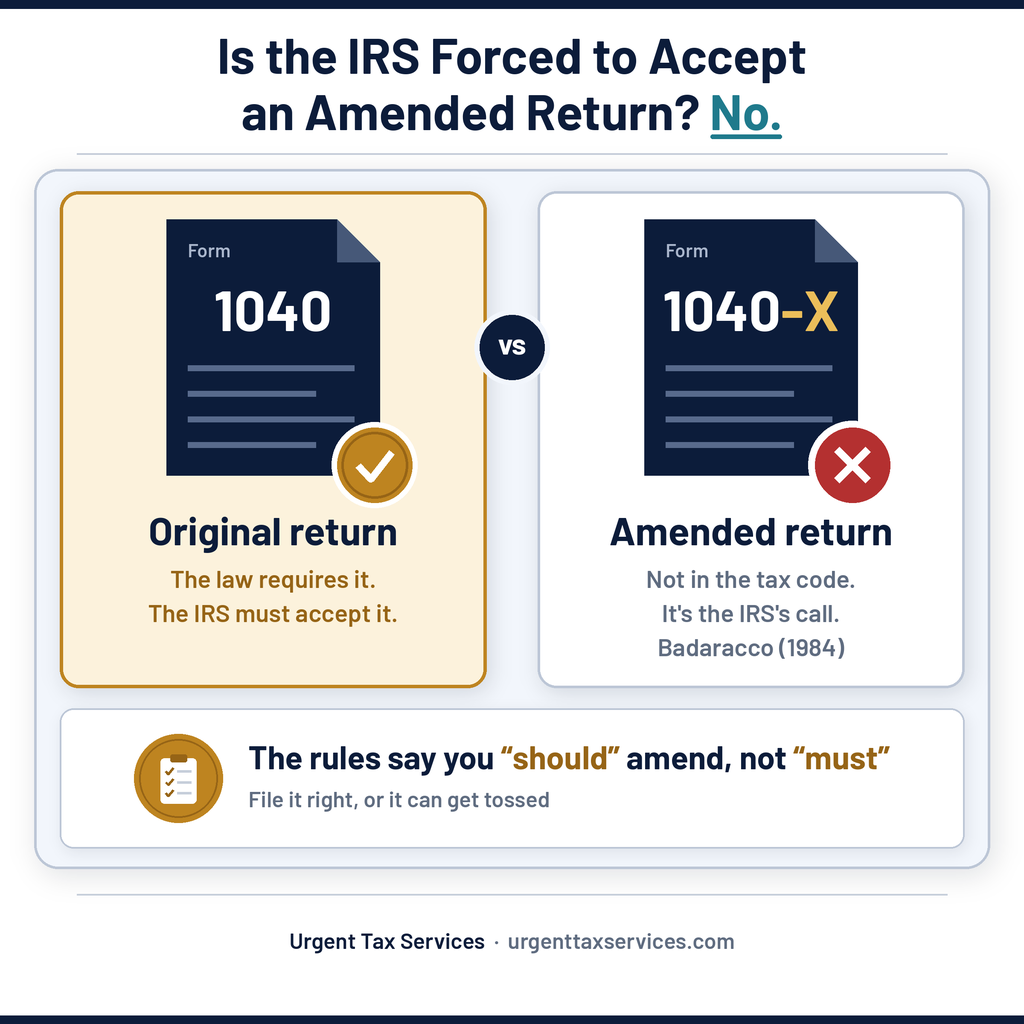
Original return vs. amended return
The law requires you to file an original return, like a Form 1040, if your income is over the filing threshold. A return that meets the basic requirements counts as filed, and the IRS processes it.
An amended return, like a Form 1040-X, is different. The words "amended return" don't appear anywhere in the tax code.
The Supreme Court said it plainly in Badaracco v. Commissioner (1984). The tax code doesn't provide for filing an amended return, or for the IRS accepting one. An amended return is "a creature of administrative origin and grace." In other words, it exists because the IRS chooses to allow it.
So does the IRS process amended returns?
Usually, yes. The IRS has long accepted amended returns that fix clear errors or plain mistakes. Its general policy is to process amended returns that are valid, timely, complete and processable.
But courts have said that how the IRS treats an amended return is up to the IRS. If the IRS refuses one, a court will only step in if the IRS abused its discretion. That's a high bar.
Why an amended return can get rejected or not processed
These are the common reasons:
Wrong form or missing pieces. The wrong form was used, or required schedules and documents aren't attached.
No change to the tax. If the change doesn't affect what you owe or what you're owed, there may be nothing to process. The IRS also fixes simple math errors on its own, so you generally don't need to amend for those.
The year is already under audit. An amended return filed during an exam generally goes to the examiner and gets handled as part of the audit, not on its own.
It's too late. Once the time limit passes, certain changes can't be made anymore. A late refund claim can be denied even if you're right.
The refund deadline
If your amended return asks for money back, it's a claim for refund, and the clock matters. Generally, you have 3 years from when you filed the original return, or 2 years from when you paid the tax, whichever is later. A return filed early is treated as filed on the due date.
Miss that window and the money can be gone, no matter how much it is.
If the IRS denies a refund claim, or doesn't act on it within 6 months, you can generally take it to court.
Do you have to amend when you find a mistake?
The regulations say that if you find income you should have reported in a prior year, you "should" file an amended return and pay the extra tax, as long as you're still within the time limit. The same goes for a deduction you shouldn't have taken.
Notice the word. "Should," not "must."
That doesn't mean you ignore the mistake. The IRS often finds missing income on its own through 1099 matching, and then you're paying the tax plus interest, and possibly penalties. An amended return that reports the extra tax before the IRS contacts you about that year can help you avoid the 20% accuracy-related penalty.
So think it through before you file, and file it right. A sloppy amended return can get tossed.
Back to the missing 1099s
If the deadline is close and your documents aren't in, here's how I'd think about it:
An extension may be the cleaner choice. Form 4868 gives individuals until October 15 to file. It's more time to file, not more time to pay, so put a good-faith estimate on it and pay what you can by the April deadline.
The late-filing penalty only applies when tax is owed. If you're due a refund, there's no late-filing penalty. But don't wait too long, or the refund itself can be lost.
If you file on estimates, use real records. Bank statements, invoices and last year's 1099s. You have to report the income even if a 1099 never shows up. Keep notes showing how you got each number.
Amend as soon as the real numbers come in. If you owe more, pay it with the amended return. Interest runs from the original due date.
Short FAQ
Does the IRS have to accept an amended tax return? No. The tax code doesn't provide for amended returns. The IRS generally processes ones that are complete, timely and fix a real error, but it's the IRS's call.
How long do I have to file an amended return for a refund? Generally 3 years from when you filed the original return, or 2 years from when you paid the tax, whichever is later.
Can I file my taxes with estimates and amend later? Sometimes that's the best option when documents are missing. Base the estimates on real records and amend as soon as you have the correct numbers. An extension is often worth considering first.
Should I file an amended return if I'm being audited? Talk to someone first. During an audit, an amended return generally goes to the examiner and becomes part of the audit.
Found a mistake on a past return?
Book a free 30-minute call to go over your case. For a quick question, you can call (718) 510-3166. I'll tell you honestly what I see.
General info, not advice for your specific case.