Audited over a low S corp salary while your friend wasn’t? Here’s what’s going on.
"My friend pays himself a very low salary from his S corp, and the IRS ignored it. Mine got audited, and now I owe penalties and interest. How is that fair?"
A potential client said this to me after a reasonable compensation audit. I understand the frustration. But the answer changes what you do next.
Why the IRS audited you and not your friend
The rule is the same for both of you. The odds of being looked at are not.
The IRS examines only a small share of returns. Some are picked by computer scoring or mismatched forms. Some start with a different issue, and the salary question comes up once the examiner is inside the books.
So your friend hasn't been approved. He just hasn't been looked at yet. The IRS generally has 3 years after a payroll return is filed to assess more tax, and if an S corp never filed payroll returns at all, that clock may never start.
And "other people do it too" isn't a defense in an audit. The examiner only looks at your numbers.
What "reasonable compensation" means for an S corp owner
If you work in your own S corp, you're its employee. Pay for your work is wages, and wages carry Social Security and Medicare tax. Distributions don't.
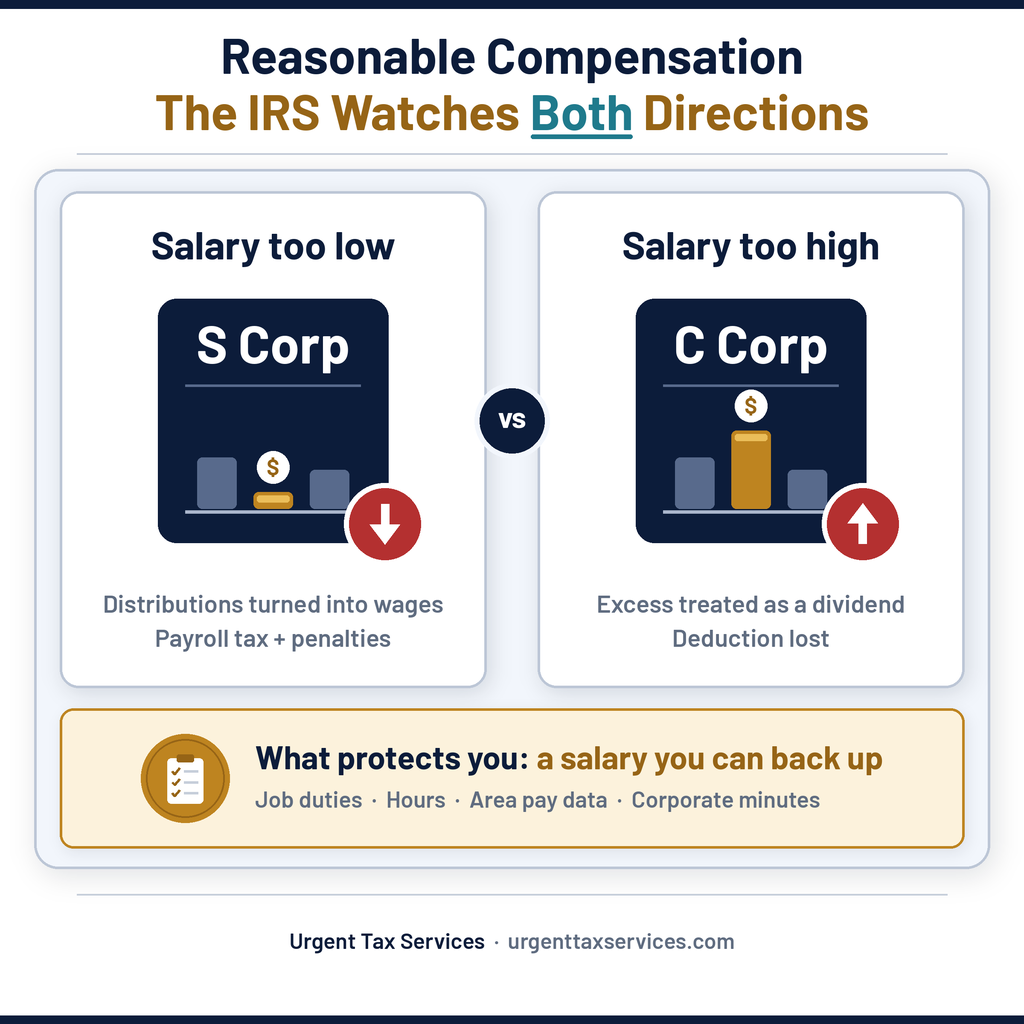
That's the whole reason the issue exists. A small salary and big distributions cut payroll tax. The IRS expects the salary to reflect what the business would have to pay someone else to do your job. Profit beyond that can come out as distributions.
There's no formula. You may have heard that 60% salary and 40% distributions is "safe." That's a myth. It's not an IRS rule, and it isn't in the tax code.
What actually happens in the audit
The examiner, sometimes with an IRS valuation specialist, builds a number for what your work was worth, using salary surveys, pay data for your area, your hours and experience, and how the business did.
Then part of your distributions gets treated as wages. That one change creates a bill:
Payroll tax. The employer and employee share of Social Security and Medicare, roughly 15.3% combined up to the Social Security wage base, plus federal unemployment tax.
Penalties. Usually for not depositing the payroll tax on time, and for late payroll returns if none were filed.
Interest on all of it.
Your income tax usually doesn't change much, because the S corp profit was already taxed on your personal return. The real cost is the payroll tax and what's piled on top of it.
If the business can't pay that bill, it becomes a payroll tax debt, and in some cases that can turn into a personal problem for the owner.
Two cases that show how it plays out
David E. Watson, P.C. v. United States (8th Cir. 2012). Watson was an experienced CPA. His S corp paid him a $24,000 salary in 2002 and 2003 while it took in about $200,000 a year from his accounting firm, most of which went to him as distributions. The IRS expert valued his work at $91,044 a year. The court agreed, so $67,044 a year was treated as wages, with payroll tax, penalties and interest. His argument that he only intended to pay himself $24,000 didn't work.
Sean McAlary Ltd. (T.C. Summ. Op. 2013-62). McAlary was a real estate broker and the only owner of his S corp. In 2006 he took $240,000 out and paid himself no wages. The IRS said reasonable pay was $100,755. The Tax Court set it at $83,200 instead, about $40 an hour, because of his limited experience and the modest size of the business. The court also upheld the late-filing and late-deposit penalties. Relying on his accountant didn't save him, because there was no evidence he had checked the accountant's qualifications. (Summary opinions can't be cited as precedent, but the reasoning is useful.)
Two lessons. The IRS doesn't have to call every dollar wages. It picks a number. And that number can be challenged, as McAlary showed.
The C corp version is the opposite problem
In a C corp, the IRS worries your salary is too high.
Salary is deductible to the corporation. Dividends aren't. The tax code allows a deduction only for a "reasonable allowance" for pay for services actually performed. Pay above that can be treated as a disguised dividend. The company loses the deduction, and you still pay tax on the money as a dividend.
Courts look at the same kind of facts, and some also ask whether an outside investor would be satisfied with the company's return after your pay. Big salaries, bonuses that don't match the results, and years with no dividends are what draw attention.
Already under audit or holding a notice? What I'd do
Don't panic, and don't miss a deadline. Missing a response date costs you options.
Don't accept the examiner's number as fact. It's an estimate built from surveys. Push back with your real duties, hours and experience, local pay data for the actual job, and how much of the profit came from employees, equipment or capital rather than your own labor.
Gather your records. Payroll returns, W-2s, distributions, corporate minutes, and anything showing how you set your pay and what you actually do.
Know that records carry the weight. The rule that can shift the burden of proof to the IRS applies to income tax, not payroll tax. So assume you'll need to back up your number yourself.
Ask about the penalties. Reasonable cause or first-time abatement may remove some of them. And if you agree to the adjustment during the exam and pay it in full when you sign, the payroll tax can sometimes be corrected without interest. That option isn't available if the underreporting was knowing.
Know your appeal options. If you disagree, you can generally ask for a review by the IRS Independent Office of Appeals. If you took no W-2 salary at all, the IRS generally issues a notice that lets you petition the Tax Court, with a 90-day deadline. If you took some salary and the fight is over how much, the court route usually means paying first and suing for a refund.
Fix the current year now. The examiner can look at later years too.
Setting your pay going forward
Ask what it would cost to replace you. Break your week into roles, like sales, management, the technical work and the books. Each role has a market rate.
Use real pay data for your area. Save a copy of what you used, with the date.
Put it in writing. Approve your salary in the corporate minutes and run it through payroll.
Review it every year. A business that doubled in size probably needs a raise for the owner.
Don't pair big distributions with a token salary, or none, while you're working in a profitable S corp. That's the pattern in both cases above.
Short FAQ
Can the IRS reclassify S corp distributions as wages? Yes. If your salary was too low for the work you did, the IRS can treat part of your distributions as wages and charge payroll tax, penalties and interest.
Is there a safe percentage, like 60/40? No. That's a rule of thumb, not an IRS rule. Reasonable pay depends on your job, your hours and what the market pays for that work.
Does my friend's low salary help my case? No. What helps is real pay data for the job you actually do.
My S corp barely made money. Does this still apply? The issue usually comes up when money is coming out of the business. If you're taking distributions, expect the question of whether some of it was really pay.
Facing a reasonable compensation audit?
Book a free 30-minute call to go over your case. For a quick question, you can call (718) 510-3166. I'll tell you honestly what I see.
General info, not advice for your specific case.