It's Thursday night. Payroll is tomorrow.
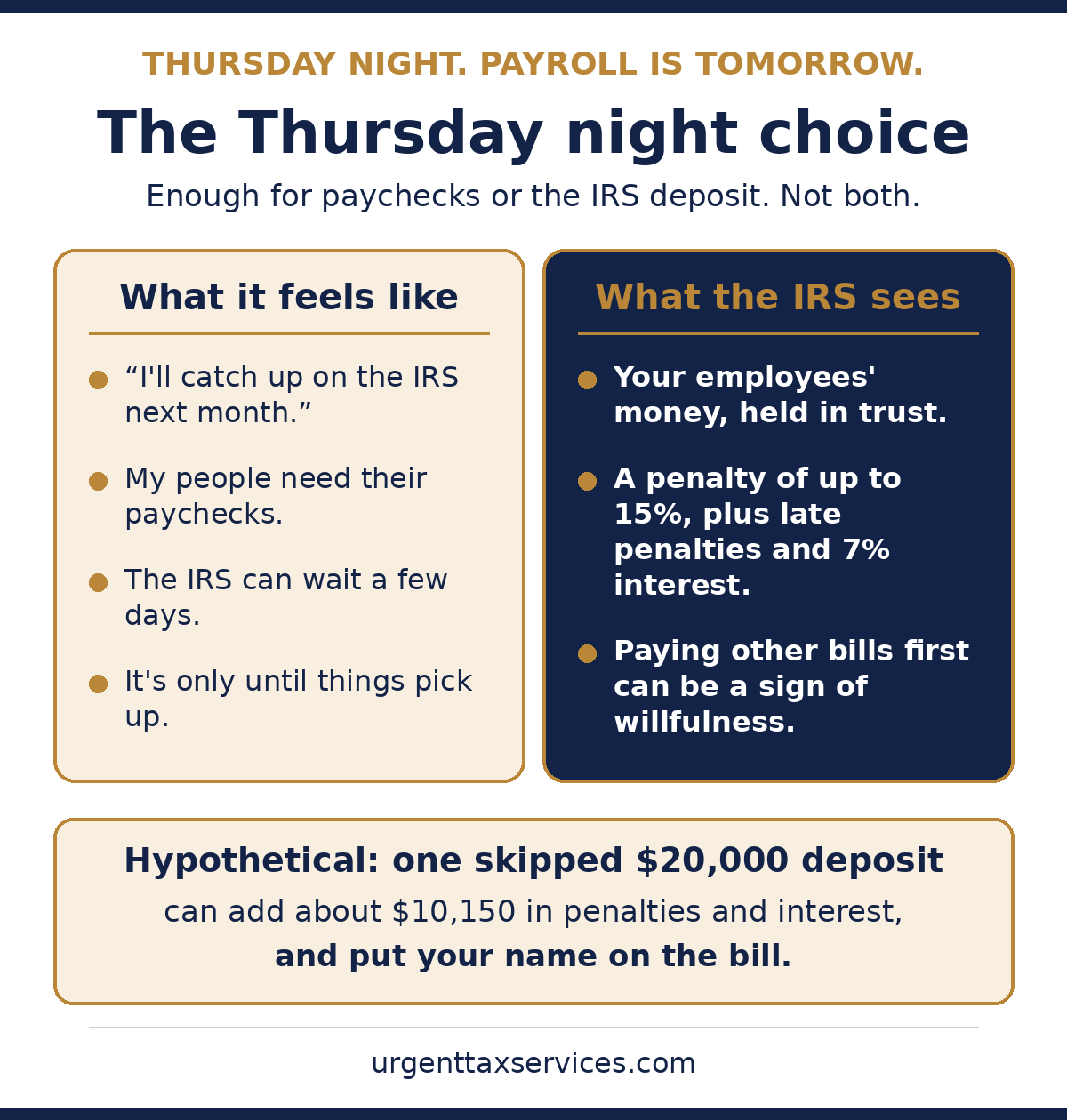
You've checked the bank balance three times. The number doesn't change. There's enough to cover the paychecks, or enough to make the IRS payroll deposit. Not both.
You think about the people who work for you. They have rent due and families at home, and they're counting on that direct deposit in the morning.
So you do what almost every owner in that spot does. You pay your people, and you tell yourself, "I'll catch up on the IRS next month."
It feels like the decent choice. To the IRS, it looks like something else. Here's what that one skipped deposit can really cost, and what you can still do about it.
It was never your money to borrow
When you run payroll, part of every paycheck stays behind: the federal income tax you withheld and the employee's share of Social Security and Medicare. The IRS calls these trust fund taxes. The law says you hold them in trust for the government (IRC 7501). They belong to your employees' tax accounts from the moment you withhold them.
That's why the IRS doesn't see a late deposit as a business that got a little behind. It sees an employer that held onto someone else's money.
Your own share of Social Security and Medicare isn't a trust fund tax, but it's still due on the same deposit. And the deadline comes fast. Most small employers deposit monthly, by the 15th of the next month. Larger ones deposit semiweekly: wages paid on a Friday are generally due the following Wednesday. Either way, the deposit has to be made electronically.
The late payroll tax deposit penalty clock starts the next day
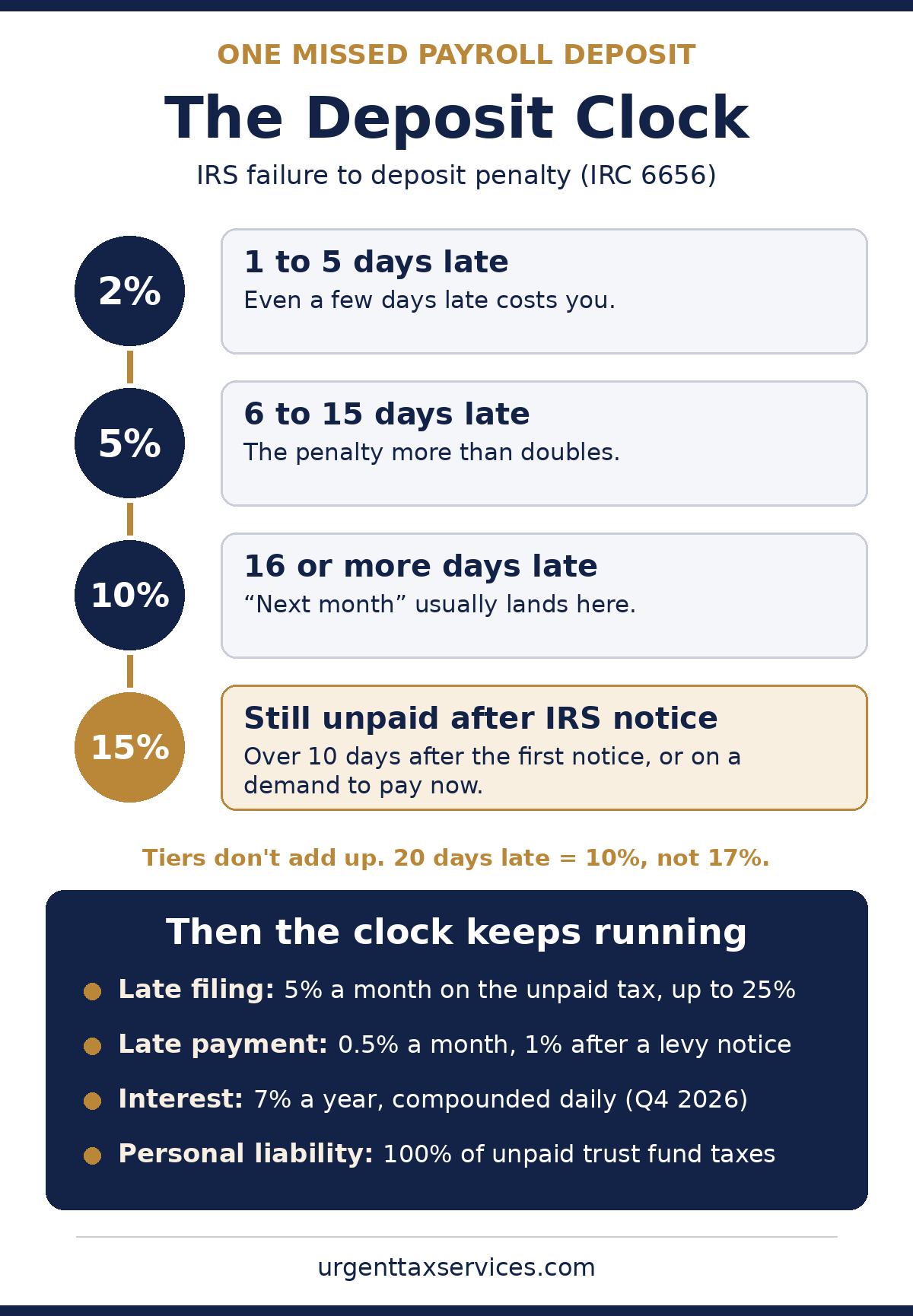
The failure to deposit penalty (IRC 6656) is based on how many calendar days late the deposit is:
- 1 to 5 days late: 2% of the late amount
- 6 to 15 days late: 5%
- 16 or more days late: 10%
- Still unpaid more than 10 days after the IRS's first notice, or on the day you get a notice demanding immediate payment, whichever comes first: 15%
The tiers don't add up. A deposit that's 20 days late costs 10%, not 2% plus 5% plus 10%. But "next month" is usually more than 15 days, so the most common result of "I'll catch up later" is already the 10% tier. Sending the money straight to the IRS or with your return instead of depositing it can cost 10% too.
And the deposit penalty is only the first layer.
- Late filing. If the quarterly Form 941 isn't filed on time, the failure to file penalty is generally 5% of the unpaid tax for each month or part of a month it's late, up to 25%. In a month when the late payment penalty also applies, the late filing penalty drops to 4.5%, so it maxes out after 5 months.
- Late payment. The failure to pay penalty is 0.5% of the unpaid tax for each month or part of a month, up to 25%. If the bill is still unpaid 10 days after the IRS sends its notice of intent to levy, it jumps to 1% a month.
- Interest. For October through December 2026, the IRS rate on unpaid tax is 7% a year, compounded daily. The rate is reset every quarter, and the IRS charges interest on penalties too.
What it adds up to: a $20,000 example
This example is hypothetical. It isn't a client's case.
Say a business skips one $20,000 payroll deposit. Things get busy, so the quarter's Form 941 goes in 5 months late. Nothing gets paid until a full year after the 941 was due. The business doesn't qualify for the automatic relief described below, and the interest rate stays at 7% the whole time.
| Item | Amount |
|---|---|
| Deposit penalty, 15% (still unpaid 10 days after the first IRS notice) | $3,000 |
| Late filing penalty, 4.5% x 5 months = 22.5% | $4,500 |
| Late payment penalty, 0.5% x 12 months = 6% | $1,200 |
| Interest on the $20,000 for one year at 7%, compounded daily | about $1,450 |
| Added cost of one skipped deposit | about $10,150 |
That's roughly $30,150 for a $20,000 deposit, more than half again on top. And it's a conservative number. It leaves out interest on the penalties, and it assumes the late payment penalty never jumps to 1% a month after a levy notice.
"Next month" turned a $20,000 problem into a $30,000 problem. And that's still just the business's bill.
When it becomes your personal problem
If the IRS can't collect the trust fund taxes from the business right away, it can go after the people behind it. The trust fund recovery penalty (IRC 6672) equals 100% of the unpaid trust fund tax, and the IRS can assess it against anyone who was responsible for paying it and acted willfully. That can include owners, officers, check signers, and even a bookkeeper who decides which bills get paid. The business doesn't have to close first.
Willful doesn't mean evil. The IRS says it means you knew, or should have known, the taxes weren't being paid and you ignored it or were plainly indifferent. The IRS also says that using available money to pay other creditors when the business can't pay its employment taxes is a sign of willfulness. That Thursday night choice is exactly what it has in mind.
Once it's assessed, the IRS can file a lien and levy your personal assets. I explain how the IRS decides who's responsible, and how to fight a proposed assessment, in Business payroll tax debt: when it becomes your personal problem.
Can the penalties be removed?
Automatic relief for a clean record. Starting in summer 2026, the IRS is replacing First Time Abate with a new program called Automatic Exemption from Penalty (AEP). It covers Form 941 and the other employment tax returns, starting with 2026 quarters. If your business filed and paid on time for the prior 12 consecutive quarters, the IRS won't assess the failure to file, failure to pay or failure to deposit penalty when your original return is processed. You don't have to ask. You get a letter saying relief was applied.
There are conditions. The IRS can't have waived your deposit penalty four or more times in the prior 12 quarters, and the penalty can't be for avoiding the electronic payment system. AEP doesn't touch the tax or the interest on it, and it only works after the return is filed, which is one more reason to file on time even when you can't pay. For 2025 quarters and earlier, you can still ask for First Time Abate.
Reasonable cause, and why "I ran out of money" usually fails. If you don't qualify for automatic relief, you can ask for relief based on reasonable cause. The IRS wants to see that you used ordinary business care and prudence and still couldn't comply. A fire, a disaster, a serious illness or records you couldn't get can qualify. But the IRS says plainly that lack of funds, by itself, isn't reasonable cause for failing to pay or deposit. Its manual adds that ordinary business care includes planning for business obligations when reasonably foreseeable events happen. A slow month usually counts as foreseeable. And in most cases, the money was there. It just went to payroll.
When you do pay, tell the IRS where it goes
Two short rules can save real money:
- Late deposits. When you get a deposit penalty notice, you generally have 90 days from the notice date to tell the IRS how to apply your deposits within that return period, which can lower the penalty (Rev. Proc. 2001-58). It doesn't always help, and it doesn't move money between quarters.
- Payments on a balance. Under IRS Policy Statement 5-14, an undesignated payment on a payroll account generally goes to the non-trust fund portion first. A voluntary payment designated in writing to the trust fund portion of a specific quarter can reduce what the responsible people can be personally charged.
I walk through how to word it in I owe multiple tax debts. Which one should I pay first?
The states hold you personally liable too
Your state income tax withholding is trust money as well, and every state I work in can make the responsible people pay it personally:
- New York. A person required to collect and pay over withholding tax who willfully fails to do it is liable for a penalty equal to the unpaid tax (Tax Law 685(g)). That includes officers, employees, LLC members and managers who were under a duty to do it (Tax Law 685(n)).
- New Jersey. The Division of Taxation treats Gross Income Withholding Tax as a trust fund tax and says a responsible person, an officer or employee with the duty to collect and remit it, may be held personally liable (N.J.S.A. 54A:9-6(f) and (l)). It looks at factors like check signing, control over which creditors get paid, and knowing the tax wasn't remitted.
- Connecticut. A person required to collect and pay over Connecticut income tax withholding who willfully fails to do it is liable for a penalty equal to the unpaid tax, including related penalties and interest (Conn. Gen. Stat. 12-736(a)).
- Pennsylvania. Withheld personal income tax is a trust fund for the Commonwealth (72 P.S. 7320.1). The Department of Revenue says an employee or representative with a duty to pay the tax, an officer, director or partner, or anyone who receives the money may be held personally liable, and a willful failure brings a penalty equal to the unpaid tax.
So one bad quarter can mean a federal problem and a state problem, each with your name on it.
If you're behind on payroll taxes, this week
- Find out exactly which deposits were missed, and for which quarters.
- Make the late deposit as soon as you can. Every tier you avoid is money saved.
- File every Form 941 on time, even if you can't pay it in full.
- Don't fund the business with this week's withholding again.
- When you pay, put the quarter and "trust fund portion" in writing.
- Open every IRS and state notice the day it arrives and note the date. The 15% tier and other deadlines run from those dates.
- Check your state withholding deposits too.
- Get help before a revenue officer calls or a personal liability letter arrives.
Short FAQ
How much is the IRS penalty for a late payroll deposit?
2% if it's 1 to 5 days late, 5% at 6 to 15 days, 10% at 16 days or more, and 15% if it's still unpaid more than 10 days after the IRS's first notice.
Will the IRS remove the penalty if I have a clean record?
Possibly. Under the new Automatic Exemption from Penalty, starting with 2026 quarters, a business that filed and paid on time for the prior 12 quarters generally won't be assessed the penalty at all, if it meets the other conditions.
Is not having the money a good excuse?
Not by itself. The IRS says lack of funds alone isn't reasonable cause, though other facts that show you used reasonable care can help.
Can I be personally liable for my company's payroll taxes?
Yes. The IRS can assess the trust fund recovery penalty against responsible people who acted willfully, and New York, New Jersey, Connecticut and Pennsylvania have their own rules for state withholding.
Related: Business payroll tax debt: when it becomes your personal problem · Which IRS debt to pay first · IRS penalties and supervisor approval
Sources
- IRS: Failure to Deposit Penalty: 2%, 5%, 10% and 15% tiers, tiers not cumulative (IRC 6656)
- IRS Publication 15 (2026), Employer's Tax Guide: monthly and semiweekly deposit schedules, deposit penalty table including the 10% rate for amounts paid directly to the IRS, 90-day deposit designation, trust fund recovery penalty
- IRS: Failure to File Penalty: 5% a month up to 25%, reduced by the failure to pay penalty (IRC 6651(a)(1), 6651(c)(1))
- IRS: Failure to Pay Penalty: 0.5% a month up to 25%, 1% after a notice of intent to levy (IRC 6651(a)(2), 6651(d))
- IRS news release IR-2026-98 and Rev. Rul. 2026-15: 7% underpayment rate for Oct. 1 to Dec. 31, 2026, compounded daily (IRC 6621, 6622)
- IRS: Employment taxes and the Trust Fund Recovery Penalty: responsible persons, willfulness, paying other creditors (IRC 6672, 7501)
- IRS: Administrative penalty relief and IRS Tax Tip 2026-59: Automatic Exemption from Penalty, eligible returns, 12 quarter history, business conditions
- IRS: Penalty relief for reasonable cause (lack of funds) and IRM 20.1.1.3.2 (ordinary business care and prudence)
- Rev. Proc. 2001-58 (deposit designation); IRS Policy Statement 5-14 (IRM 1.2.1) and IRM 5.1.2.9 (payment designation)
- New York Tax Law 685(g) and 685(n), as quoted by the NYS Tax Appeals Tribunal
- NJ Division of Taxation: Responsible Persons; N.J.S.A. 54A:9-6(f) and (l), as quoted in Gill v. Director (N.J. Tax Ct. 2023)
- Conn. Gen. Stat. 12-736
- PA Department of Revenue: Personal Income Tax Guide, Personal Responsibility; 72 P.S. 7320.1
If you skipped a payroll deposit and the penalties are piling up, message me.
I help with IRS, New York, New Jersey, Connecticut and Pennsylvania tax problems.
General info, not advice for your specific case.