The IRS needs a boss’s signature before it can penalize you
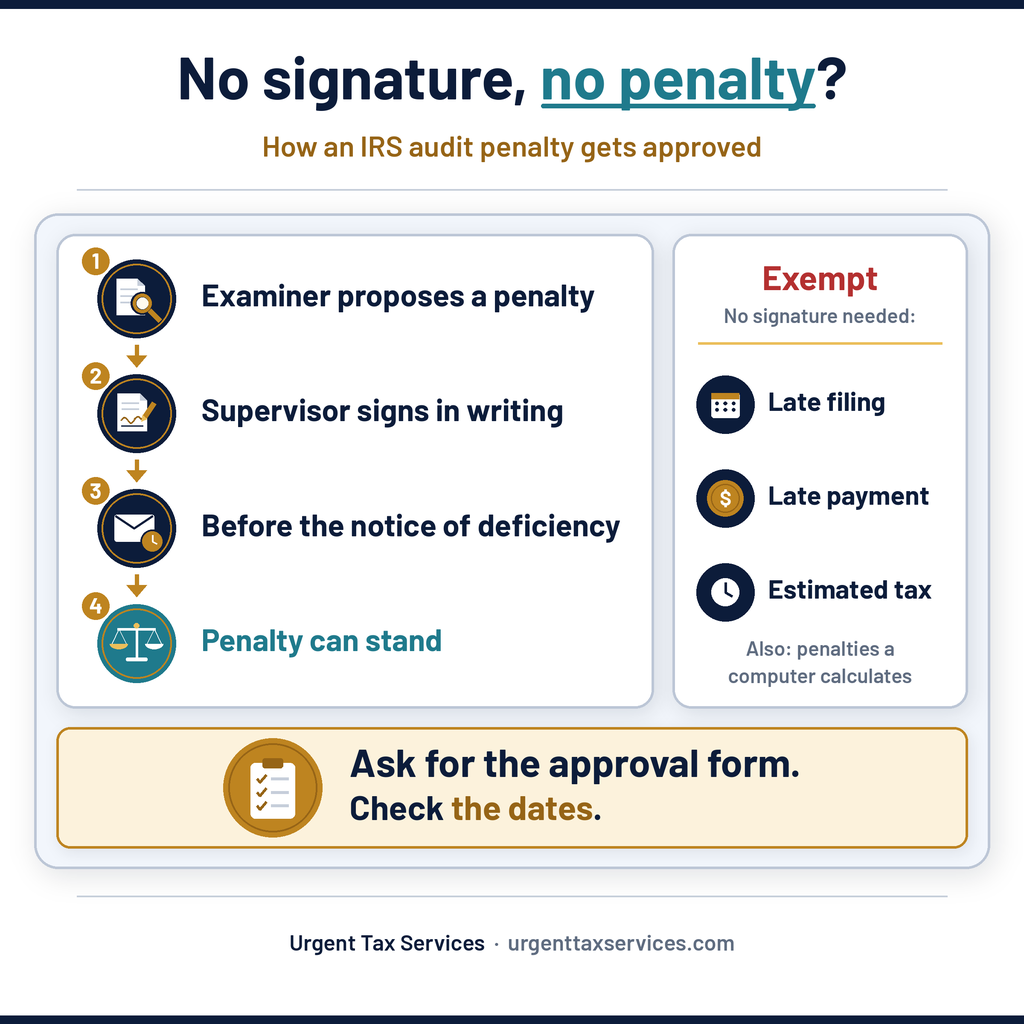
Most people don't know this: for most audit penalties, the IRS needs a supervisor's written approval before the penalty can stick. No timely signature, no penalty.
The rule has been in the tax code since 1998. It's Section 6751(b). For years it was mostly a Tax Court fight about timing. This summer it got sharper for anyone in New York or Connecticut.
What Section 6751(b) requires
The law says no penalty can be assessed unless the "initial determination" of the penalty is personally approved in writing by the immediate supervisor of the person who made it. A higher-level official the IRS designates can sign instead.
In plain terms: the examiner who decides you owe a penalty can't impose it alone. A boss has to sign off, on paper, in time.
If you're an individual in Tax Court, the IRS has to come forward with proof of that approval as part of its penalty case. That's part of its burden of production under Section 7491(c). Corporations and partnerships don't get that head start, but they can still raise the issue themselves.
Which penalties need a signature, and which don't
Covered (examples):
The 20% accuracy-related penalty (negligence, substantial understatement)
The 75% civil fraud penalty
The trust fund recovery penalty on unpaid payroll taxes
Many assessable penalties, like certain information return penalties
Not covered:
Failure to file and failure to pay (Section 6651)
Estimated tax penalties (Sections 6654 and 6655)
Penalties calculated automatically by computer
That last list surprises people. If your notice is for filing late or paying late, the missing-signature argument won't help. Those penalties need a different approach, usually reasonable cause or first-time abatement.
When the signature has to happen
This was the big fight. The Tax Court said for years that approval had to come before the first formal written communication of the penalty, usually the 30-day letter. Five federal appeals courts set a later deadline: the Second, Fifth, Ninth, Tenth and Eleventh Circuits. In general, approval is on time if it comes while the supervisor can still decide, which in practice means by the notice of deficiency. In April 2026, the Supreme Court declined to take up the question.
The IRS settled it for itself with final regulations issued in December 2024. They apply to penalties assessed on or after December 23, 2024:
Penalties you can take to Tax Court: approval by the date the notice of deficiency is mailed.
Penalties first raised in Tax Court: approval by the time the IRS asks the court to impose them.
Penalties that skip Tax Court review (including ones you agree to): approval any time before assessment.
Under those rules, an approval signed after the 30-day letter but before the notice of deficiency counts. But a signature that comes too late, or never comes, or comes from the wrong person still sinks the penalty. And a missing approval can't be fixed after the fact.
Besicorp: no lien or levy without verified approval
On June 29, 2026, the Second Circuit decided Besicorp Group v. Commissioner. The Second Circuit covers New York, Connecticut and Vermont.
At a collection due process hearing, IRS Appeals has to verify that the legal requirements for the assessment were met. The court held that includes the 6751(b) approval. That's true even if the penalty was already decided in Tax Court.
In Besicorp, Appeals didn't verify the approval and the IRS didn't show one. So the IRS couldn't use a lien or levy to collect those penalties. The court was careful about the limits: the penalties weren't erased, and the IRS can still go to court to collect them. It also left open whether the same bar reaches the tax itself.
Still, a lien or levy is how the IRS usually collects. Taking those tools off the table matters.
Where you live changes the answer
New York and Connecticut (Second Circuit): the most favorable law on this. Approval is due by the notice of deficiency, and Besicorp applies at collection hearings.
New Jersey (Third Circuit): the Third Circuit hasn't ruled on the timing question, and Besicorp isn't binding there. The final regulations will usually control. It's still worth checking the dates.
What I do with this in practice
Don't ignore a CP2000 penalty. A CP2000 penalty is usually computer-generated, so no signature is needed. But under the regulations, if you contest it in writing and an IRS employee considers your response, it's no longer automatic. Now a supervisor has to approve it. Asking for more time doesn't count as contesting.
Don't sign the audit report just to be done. Clients ask me whether they should sign and move on. Signing the exam report (Form 4549 or 870) makes it an agreed assessment. Then the approval only has to come before assessment, and you give up the timing argument. Sign when you actually agree, not because you're tired.
Ask for the approval form. At the audit, in Appeals or at a collection hearing, ask in writing for the penalty approval (the IRS uses a penalty approval form or lead sheet; Form 4183 for the trust fund recovery penalty). Check:
Who signed it. Was it the examiner's immediate supervisor?
When. Compare the date to the notice of deficiency and your other letters.
Which penalties. Does it cover every penalty you were charged?
Know what loses. Arguing that the supervisor didn't review the file carefully enough doesn't work. In 2025, the Tax Court held a signature is enough. The winning arguments are no approval, late approval, or the wrong signer.
Congress may change the rule
Two bills are moving. Neither is law.
House: H.R. 5346 passed the House in December 2025. It would require approval before any written communication of the penalty to you, which is earlier than today's rule.
Senate: this fall the Senate passed a broader IRS bill, the Taxpayer Assistance and Service Act. The version its committee approved had its own take on this rule, tied to notices that open Appeals or court review.
If either becomes law, the details will matter. For now, the 2024 regulations and your circuit's cases control.
Short FAQ
Does a late-filing penalty need a supervisor's signature? No. Failure-to-file, failure-to-pay and estimated tax penalties are exempt.
If the approval is missing, is the penalty gone? In Tax Court, a penalty without timely approval generally can't stand. At a collection hearing in New York or Connecticut, Besicorp blocks a lien or levy for those penalties, but the IRS can still sue to collect.
Can the IRS sign the form later to fix it? No. A missing approval can't be fixed after the fact.
General info, not advice for your specific case.
Related: The IRS needs a boss's signature. New York, New Jersey and Connecticut don't. · Shifting the burden of proof to the IRS: why messy books don't qualify · IRS lien vs. levy: a claim on your stuff vs. taking your money
Got an IRS penalty notice or audit report?
Book a free consultation and we'll go over your notice and the dates. I'll tell you honestly where you stand.