"My business is all cash. I don't pay any income tax."
A pizza shop owner in New Jersey told me that when I stopped in to talk about year-end tax planning. Then he spelled it out: "We deduct all our expenses, but very little income goes on the books. Most customers pay cash."
He said it like it was a secret. Like he had found the one door the IRS can't open.
I don't say this to scare anyone. I say it because I've seen what happens when that door opens. Years of thinking nobody will know turn into one bill with interest and penalties on top, and the owner who felt safe is suddenly wondering whether the business can survive. That's a much harder conversation than the one I'd rather have with you now.
It isn't a secret. The IRS doesn't need his cash register to figure out what he sold. It has a written playbook for his exact kind of business, and it has had one for decades.
Here's what that playbook says, what it can cost you, and where the IRS's numbers can be challenged.
The IRS wrote a cash business IRS audit guide about your shop
The IRS publishes Audit Technique Guides that teach its examiners how specific industries really work. One covers cash intensive businesses as a group. Another, from the 1990s, is all about pizza restaurants.
The pizza guide grew out of an IRS project in its Providence District. The examiners there wrote that skimming receipts and understating purchases in the pizza industry is "not unusual." They noted that many shops paid workers off the books and paid suppliers in cash with no invoices. They even wrote that pizza owners are a close community that quickly shares what the IRS is asking about.
So if you think you know a trick the IRS doesn't, assume it's already written down.
It starts with simple questions
Before an examiner rebuilds anything, the IRS manual requires what it calls minimum income probes. In plain words, the examiner checks whether the income you reported makes sense. For a business, that includes:
- Does your income support how you live? Your reported income is compared with your spending, your house, your cars.
- An interview. How much cash do you keep on hand? What share of your sales is cash and what share is card? Who counts the drawer at night?
- A tour of the shop. The examiner watches how orders are taken and how people pay.
- Your bank accounts, business and personal.
- Your own history. This year is compared with the years before and after. The manual treats a change of 5 percent or more as worth asking about.
- Your industry. Your gross profit is compared with what similar businesses report.
The IRS retail guide also tells examiners to compare the sales on your sales tax returns with the gross receipts on your income tax return, and to check your card and cash mix against your bank deposits. A shop that is "all cash" on paper but takes cards at the counter gives itself away fast.
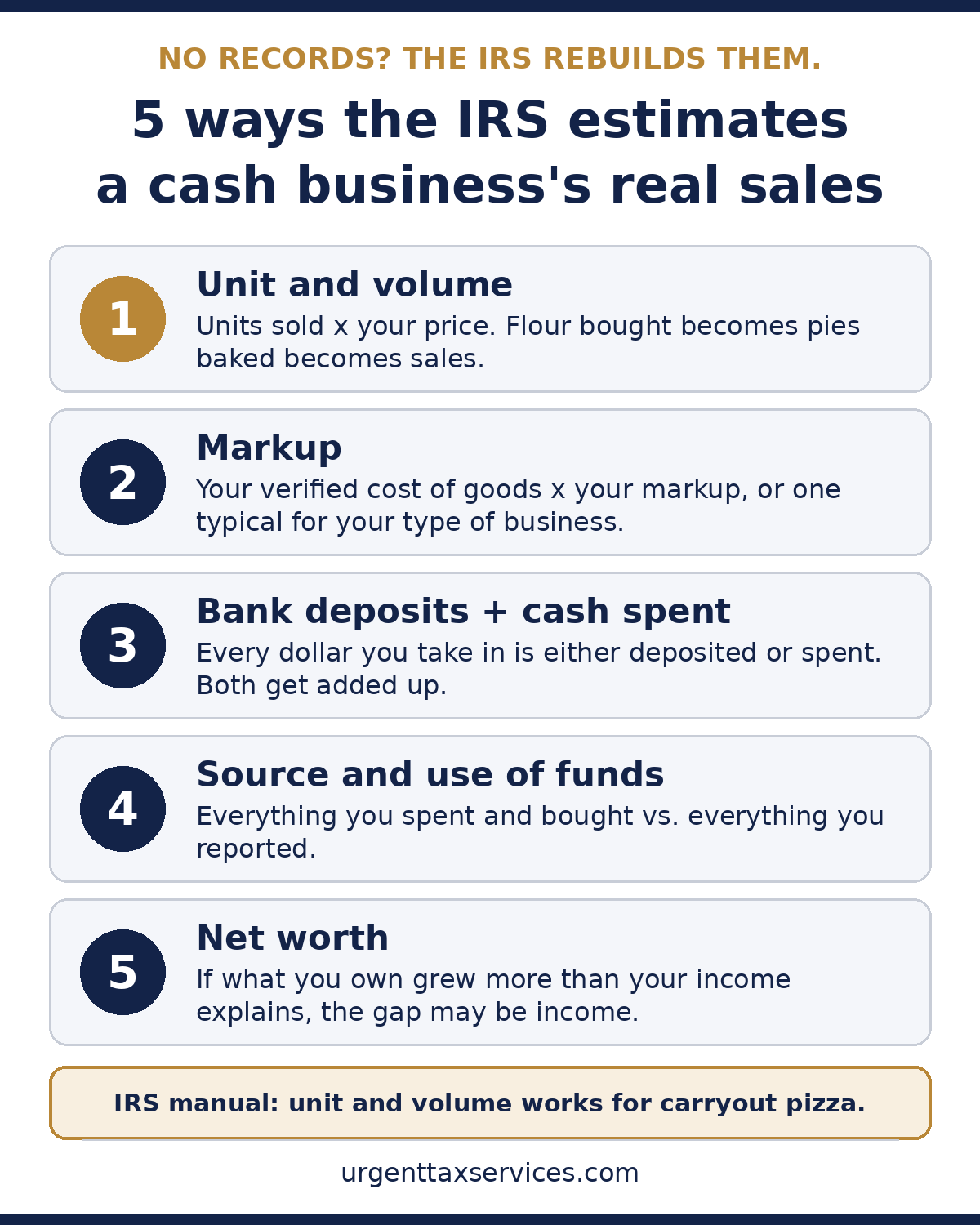
How the IRS rebuilds your sales without your register
If your records don't hold up, the examiner can reconstruct your income with what the IRS calls indirect methods. The tax law allows this when your own method doesn't clearly reflect your income (IRC 446(b)). The main ones:
- Unit and volume. Count how many units you sold and multiply by your price. The IRS manual says this method has worked well for carryout pizza businesses. In Maltese v. Commissioner, the IRS won by figuring how many pizza crusts come out of 100 pounds of flour and multiplying by the average pizza price.
- Markup. Take your verified cost of goods and apply a markup. The IRS uses your own markup if it's known, or one typical for your type of business.
- Bank deposits and cash spent. Money you take in is either deposited or spent. The IRS adds up both.
- Source and use of funds. Everything you spent and bought is compared with everything you reported.
- Net worth. If what you own grew by more than your reported income can explain, the gap may be treated as income.
For a pizza shop, the guide walks the examiner through it step by step. Get the supplier invoices, from the supplier if needed. Total the flour, sauce and cheese. Figure how much of each goes into one pie, in that project even by buying pizzas and having them weighed at a lab. Then count the pizza boxes you bought to see whether they back up the number of pies.
Paying a supplier in cash doesn't erase the trail either. The guide tells examiners to ask for the owner's own copies of cash invoices and count those ingredients too.
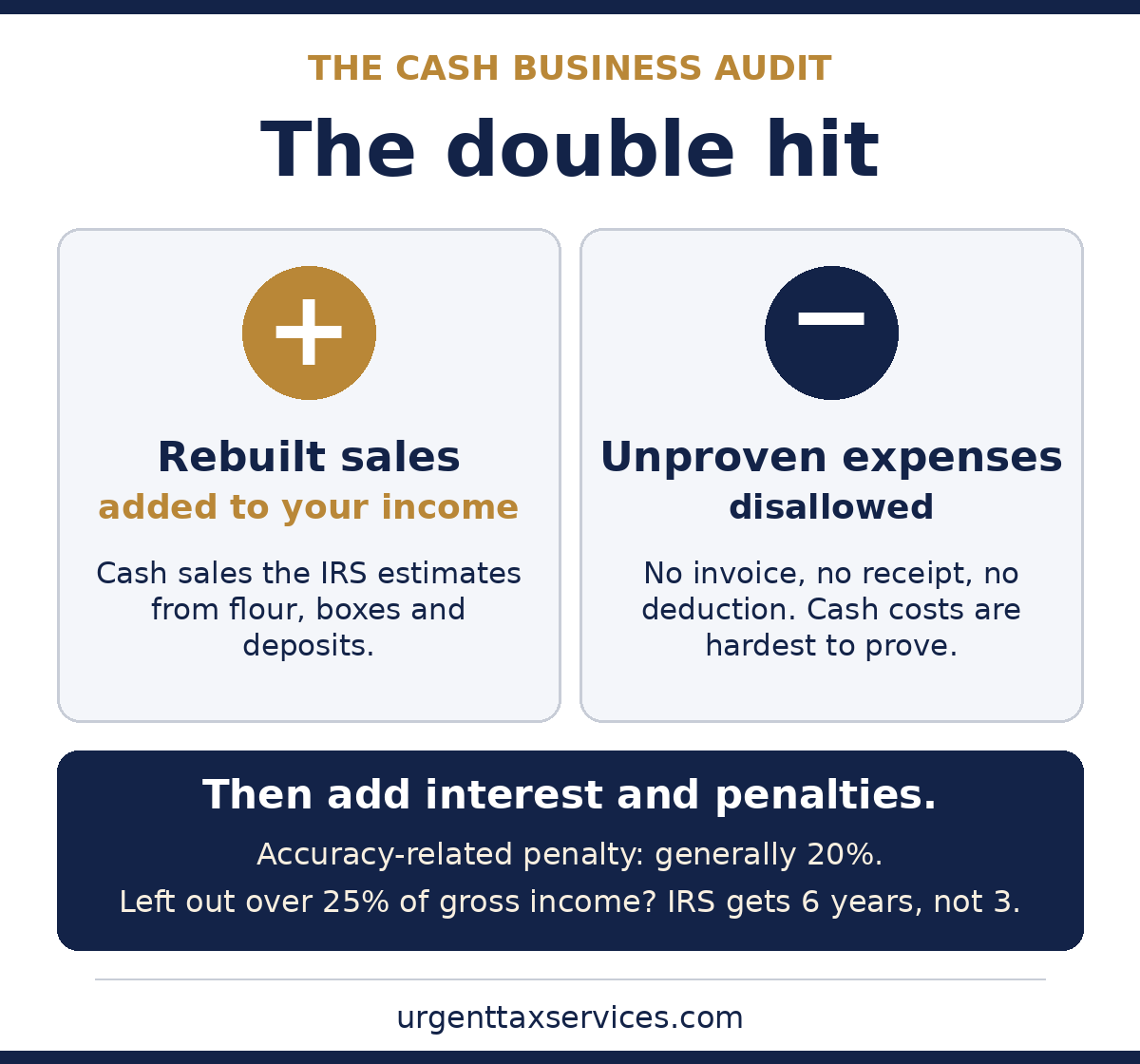
The double hit: hidden sales and lost deductions
This is the part the pizza owner never thought about.
Every deduction on your return has to be backed up with records. That's the rule with or without an audit. The IRS says your books must show your gross income as well as your deductions, and that you need supporting documents like invoices, receipts, deposit slips and canceled checks.
Cash businesses tend to pay cash for things. Cash to a helper. Cash for supplies. Cash with no receipt. The pizza guide even describes an owner who left more than $50,000 of purchases off the books so the profit margin would look normal while sales were missing.
So when the IRS rebuilds your sales, two things can happen at once:
- The rebuilt sales are added to your income.
- Expenses you can't prove can be disallowed.
You pay tax on money you thought nobody could see, and you lose deductions you were counting on. On top of that come interest and penalties. The accuracy-related penalty alone is generally 20% of the underpayment it applies to.
And the clock is longer than most people think. If you leave out more than 25% of the gross income shown on a return, the IRS generally has 6 years to assess more tax instead of 3.
The IRS's case has limits too
None of this means the examiner can just guess. Rebuilt numbers are estimates, and estimates can be challenged.
- The IRS needs a reason first. It can't use financial status techniques to find unreported income unless it has a reasonable indication that unreported income is likely (IRC 7602(e)).
- Industry averages alone are weak. If the IRS rebuilds an item of income solely from statistics about unrelated taxpayers, the IRS carries the burden of proof on that item in court (IRC 7491(b)).
- The math has to be fair. The pizza guide told examiners to allow reasonable spoilage (the Providence project allowed 10 percent), to use the menu prices for the year being audited, and to price pies at the cheapest plain cheese pizza.
- Not every deposit is income. Loans, gifts and transfers between your own accounts come out of the count, if you can document them.
This is where the details win or lose the case. How many pies a bag of flour really makes in your kitchen, how much you really throw out, what you really charged that year. Those are facts, and you know them better than the examiner does.
What I tell cash business owners before year end
- Ring up every sale, cash or card.
- Deposit your receipts and keep the register reports.
- Get an invoice for every purchase, especially the ones you pay in cash.
- Pay workers through payroll or with proper paperwork, not cash in an envelope.
- Make sure your sales tax returns and income tax returns tell the same story.
- If you borrow money or get a gift, keep the paper that proves it.
- If past years have problems, get advice before the IRS contacts you, so you know your options.
Short FAQ
Can the IRS tax me on cash sales it can't see?
Yes. When records are missing or unreliable, the IRS can rebuild income with indirect methods such as unit and volume, markup or bank deposits.
Is there really an IRS audit guide for pizza restaurants?
Yes. The IRS published a Pizza Restaurants Audit Techniques Guide in the 1990s, and today's IRS manual still names carryout pizza businesses as a place where the unit and volume method works.
If the IRS finds unreported income, do I lose my deductions?
Not automatically. But any expense you can't back up with records can be disallowed, and cash expenses are often the hardest to prove.
How far back can the IRS go?
Generally 3 years after you file. It's 6 years if you left out more than 25% of the gross income shown on the return.
Related: Shifting the burden of proof to the IRS · IRS Appeals vs. Tax Court: who has to prove it · IRS penalties and supervisor approval
Sources
- IRM 4.10.4, Examination of Income: minimum income probes (4.10.4.2.3), business ratio analysis and the 5 percent test (4.10.4.2.3.8), formal indirect methods (4.10.4.5), bank deposits (4.10.4.5.4), markup (4.10.4.5.5), unit and volume, carryout pizza and Maltese v. Commissioner, T.C. Memo. 1988-322 (4.10.4.5.6)
- IRS Publication 5495, Retail Industry Audit Technique Guide (3-2021): cash versus card mix, sales tax return comparison, indirect methods
- IRS Cash Intensive Businesses Audit Techniques Guide (April 2010)
- IRS Market Segment Specialization Program, Pizza Restaurants Audit Techniques Guide (training 3149-106, 1990s): Providence project, ingredient markup, box count, lab testing, 10 percent spoilage, cash invoices
- IRS Publication 583, Starting a Business and Keeping Records: books and supporting documents, 3 and 6 year periods
- IRS: Accuracy-related penalty (20%)
- Internal Revenue Code sections 446(b), 6001, 6501(e), 7491(b) and 7602(e)
If you own a cash business and want to clean this up before the IRS finds it, message me.
I help with IRS, New York, New Jersey, Connecticut and Pennsylvania tax problems.
General info, not advice for your specific case.