Every married couple answers this question every year, usually without thinking about it: do we file one joint return, or two separate ones? For most couples, filing jointly costs less. But the joint return comes with a string attached. When you both sign it, each of you is on the hook for the entire tax on it, including tax on income only your spouse earned.
So the real question isn't only "which way is cheaper?" It's also "what am I signing up for?" This guide walks through married filing jointly vs separately with the 2026 numbers (the return you file in 2027), the situations where a separate return can make sense, the tax breaks you give up when you file separately, how to switch after you file, and how New York, New Jersey, Connecticut and Pennsylvania handle a married couple's filing status.
The short answer: filing jointly is usually cheaper, because many credits and deductions shrink or disappear on a separate return. Filing separately can make sense when your spouse has tax debt or other problems you don't want attached to your refund, when you don't trust what your spouse is reporting, when an income-driven student loan payment is based on joint income, or when large medical bills belong to the lower earner. Run the return both ways before you decide.
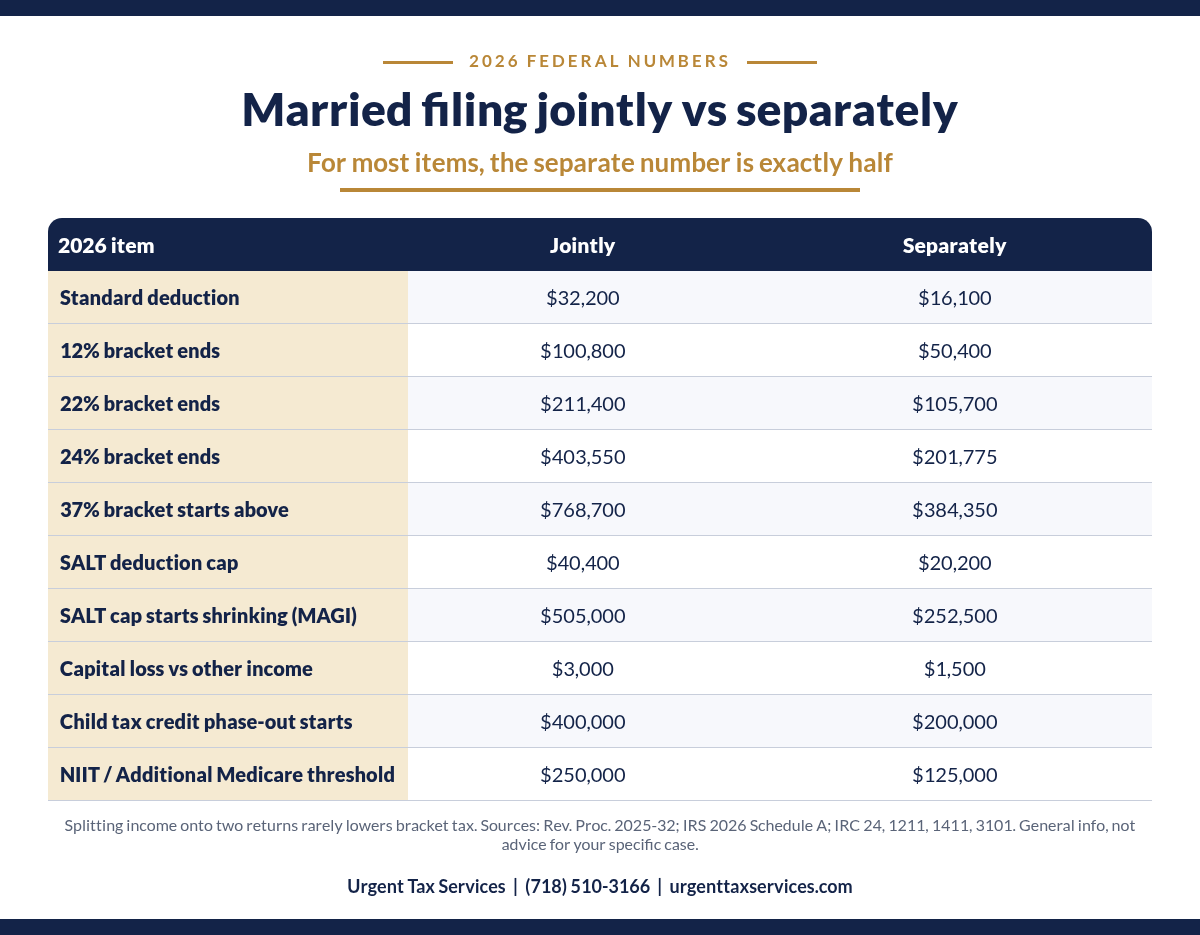
Married filing jointly vs separately: the 2026 numbers
Here is how the main 2026 federal figures line up. Notice the pattern: for most items, the married filing separately number is exactly half of the joint number.
| 2026 item | Married filing jointly | Married filing separately |
|---|---|---|
| Standard deduction | $32,200 | $16,100 |
| 10% bracket | Up to $24,800 | Up to $12,400 |
| 12% bracket | Up to $100,800 | Up to $50,400 |
| 22% bracket | Up to $211,400 | Up to $105,700 |
| 24% bracket | Up to $403,550 | Up to $201,775 |
| 32% bracket | Up to $512,450 | Up to $256,225 |
| 35% bracket | Up to $768,700 | Up to $384,350 |
| 37% bracket | Over $768,700 | Over $384,350 |
| SALT deduction cap (state and local taxes) | $40,400, reduced above $505,000 of modified AGI, not below $10,000 | $20,200, reduced above $252,500, not below $5,000 |
| Capital loss you can deduct against other income | $3,000 | $1,500 |
| Child tax credit phase-out starts | $400,000 | $200,000 |
| Net investment income tax and Additional Medicare Tax thresholds | $250,000 | $125,000 |
| AMT exemption | $140,200 | $70,100 |
Because the separate brackets are exactly half the joint brackets all the way up, splitting your income onto two returns almost never lowers the tax from the brackets alone. If filing separately saves money, it's usually because of something else: a deduction with an income floor, a payment plan that looks at your income, or protection from your spouse's tax problems.
What you sign up for with a joint return
The tax code says that on a joint return, the tax is computed on your combined income and "the liability with respect to the tax shall be joint and several" (IRC 6013(d)(3)). In plain English: the IRS can collect the full balance from either of you. That includes tax from an audit years later, penalties and interest, and it doesn't matter who earned the income, who kept the books, or what your divorce agreement says.
I wrote more about this in joint return liability and separate accounts. If you already signed joint returns and your spouse's income or deductions caused a bill, there are three kinds of relief: innocent spouse relief, separation of liability relief and equitable relief, all requested on Form 8857. See innocent spouse relief for how they work and the deadlines.
A separate return gives you something a joint return can't: you are responsible only for the tax on your own return.
When married filing separately can make sense
Your spouse owes back taxes or other debts
If your spouse owes the IRS from years before you married, or owes past-due child support, a federal student loan, state tax or certain other government debts, a joint refund can be taken to pay that debt. This is called a refund offset. Filing separately keeps your refund on your own return.
Filing separately isn't the only answer. If you file jointly and the refund is taken for a debt that belongs only to your spouse, you can file Form 8379, Injured Spouse Allocation, to get back your share of the refund. Injured spouse relief is about refunds taken for your spouse's separate debt. Innocent spouse relief is about tax owed on the joint return itself. They are different forms for different problems.
You don't trust what your spouse is reporting
If your spouse runs a cash business, won't show you the numbers, or has a history of filing problems, signing a joint return means signing for numbers you can't verify. A separate return limits what you're responsible for to your own income and deductions. Innocent spouse relief exists, but it's a request the IRS decides on, not an automatic right, and it's much easier to avoid the problem than to unwind it.
Income-driven student loan payments
Federal Student Aid says that under its income-driven plans, the Repayment Assistance Plan (RAP), Income-Based Repayment (IBR), Pay As You Earn (PAYE) and Income-Contingent Repayment (ICR), a married borrower who files a joint return generally has the payment figured on joint income, while a borrower who files separately has it figured on individual income. (ICR uses joint income if both spouses are on ICR.) For loans first disbursed on or after July 1, 2026, RAP is the only income-driven plan.
The trade-off: a lower monthly loan payment against a higher tax bill, plus the loss of the student loan interest deduction, the EITC and the dependent care credit on a separate return. Compare the annual loan savings with the extra tax before you decide.
Large medical bills and one lower earner
Medical expenses are deductible only to the extent they exceed 7.5% of adjusted gross income (AGI). On a joint return, that floor is 7.5% of your combined AGI. On a separate return, it's 7.5% of only your AGI.
Simple arithmetic, not a full return: say one spouse has $40,000 of AGI and $12,000 of medical bills, and the other has $120,000. Jointly, the floor is 7.5% of $160,000, or $12,000, so none of the medical bills count. Separately, the lower earner's floor is $3,000, so $9,000 counts. But that only helps if the lower earner's total itemized deductions beat the $16,100 separate standard deduction, and if one spouse itemizes, the other must itemize too. You have to run both returns.
Uneven high incomes and the SALT cap
For 2026 the state and local tax deduction is capped at $40,400 on a joint return, and the cap shrinks by 30% of modified AGI over $505,000, but not below $10,000. At $600,000 of joint modified AGI, the 2026 cap is $11,900. On separate returns, each spouse gets a $20,200 cap that starts shrinking at $252,500. When one spouse earns well above the threshold and the other is far below it, separate returns can sometimes keep more of the SALT deduction for the lower earner, but only for taxes that spouse actually paid, and only after weighing everything else filing separately costs.
You're separated, or your spouse won't cooperate
You can't file a joint return without your spouse's signature. If you're married on December 31 and you file without your spouse, your filing status is married filing separately, unless you qualify as "considered unmarried." Under IRC 7703(b), that generally means you file separately, paid more than half the cost of keeping up a home that was the main home of your child for more than half the year, and your spouse didn't live in that home during the last 6 months of the year. If you qualify, you may be able to file as head of household, which has a bigger standard deduction ($24,150 for 2026) and better brackets than married filing separately.
What married filing separately costs you
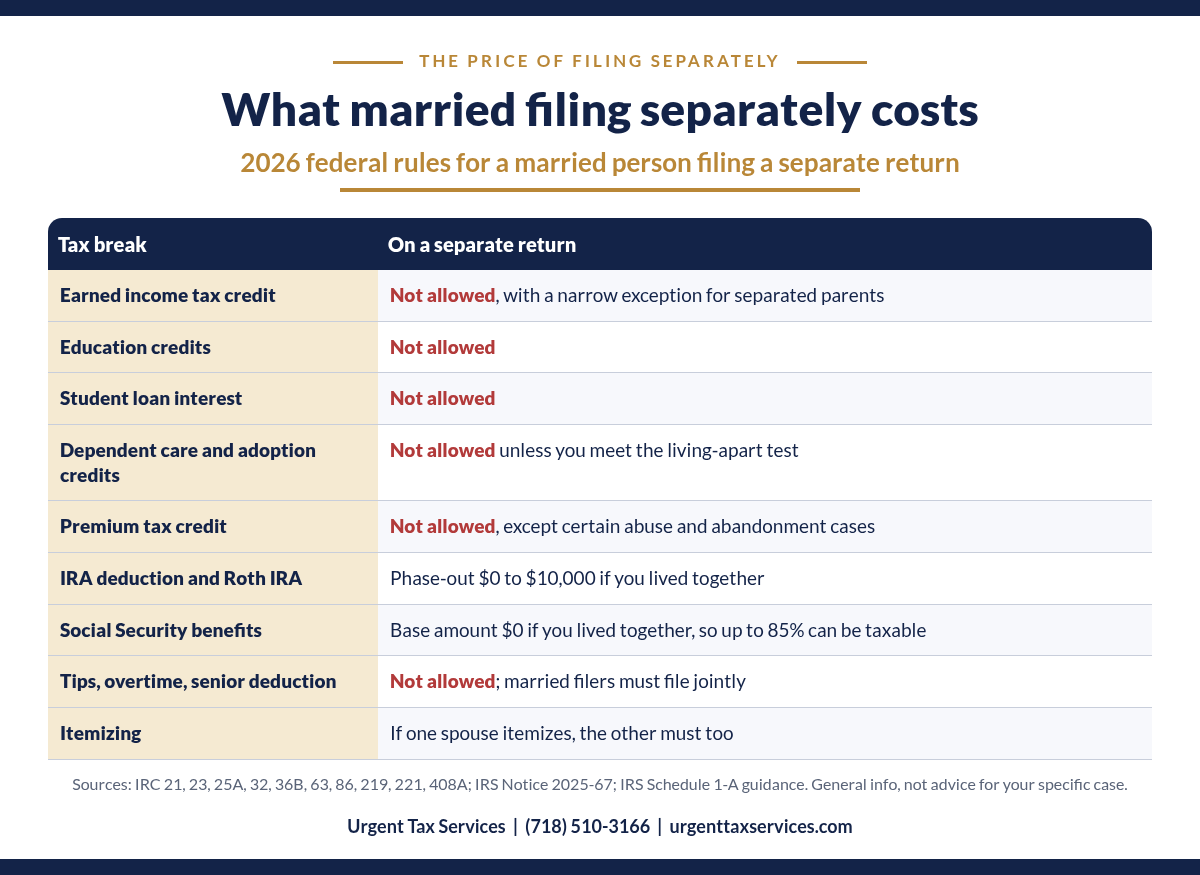
This is where most couples lose money by filing separately. The following list covers the 2026 federal rules for a married person filing a separate return.
| Tax break | On a joint return | On a separate return |
|---|---|---|
| Earned income tax credit (EITC) | Allowed if you qualify | Not allowed, unless you lived with a qualifying child for more than half the year and either lived apart from your spouse for the last 6 months or have a written separation agreement or decree and don't live together at year end |
| American opportunity and lifetime learning credits | Allowed if you qualify | Not allowed |
| Student loan interest deduction | Allowed; 2026 phase-out $175,000 to $205,000 | Not allowed |
| Child and dependent care credit (up to 50% of expenses starting 2026) | Allowed if you qualify | Not allowed, unless you meet the living-apart test |
| Adoption credit | Allowed if you qualify | Not allowed, unless you meet the living-apart test |
| Premium tax credit (Marketplace insurance) | Allowed if you qualify | Not allowed, with exceptions for certain victims of domestic abuse and spousal abandonment |
| Deduction for a traditional IRA contribution if you're covered by a workplace plan | 2026 phase-out $129,000 to $149,000 | Phase-out $0 to $10,000, so it's mostly gone (unless you lived apart all year) |
| Roth IRA contribution | 2026 phase-out $242,000 to $252,000 | Phase-out $0 to $10,000 (unless you lived apart all year) |
| Social Security benefits | Base amount $32,000 before benefits start to become taxable | Base amount $0 if you lived with your spouse at any time during the year, so up to 85% of benefits can be taxable |
| Standard deduction vs itemizing | Your choice | If one spouse itemizes, the other must itemize too (the standard deduction drops to zero) |
| Tips, overtime and the senior deduction (up to $6,000 per person 65 or older) | Allowed if you qualify | Not allowed; married filers must file jointly |
| Dependent care FSA through work | $7,500 per household | $3,750 each |
The new car loan interest deduction is one of the few recent breaks that the IRS instructions don't limit to joint filers. The tips, overtime and senior deductions are. If any of the breaks above apply to you, filing separately often costs more than it saves.
Can you change your filing status after you file?
This one-way rule catches people:
- Separate to joint: generally yes. Under IRC 6013(b), if you filed separate returns, you and your spouse can switch to a joint return by amending (Form 1040-X) within 3 years from the original due date of the return, not counting extensions. The election is blocked in some situations, such as after either spouse received a notice of deficiency and filed a Tax Court petition for that year.
- Joint to separate: generally no, once the deadline passes. Treasury regulations say that once a joint return has been filed, separate returns can't be made after the filing deadline has passed. Before the due date, you can still file separate returns to replace the joint one. (An executor of a deceased spouse's estate has a narrow exception.)
Practical takeaway: if you're unsure, filing separately keeps both options open for up to 3 years. Filing jointly is a decision you live with once the deadline passes.
Married filing status in New York, New Jersey, Connecticut and Pennsylvania
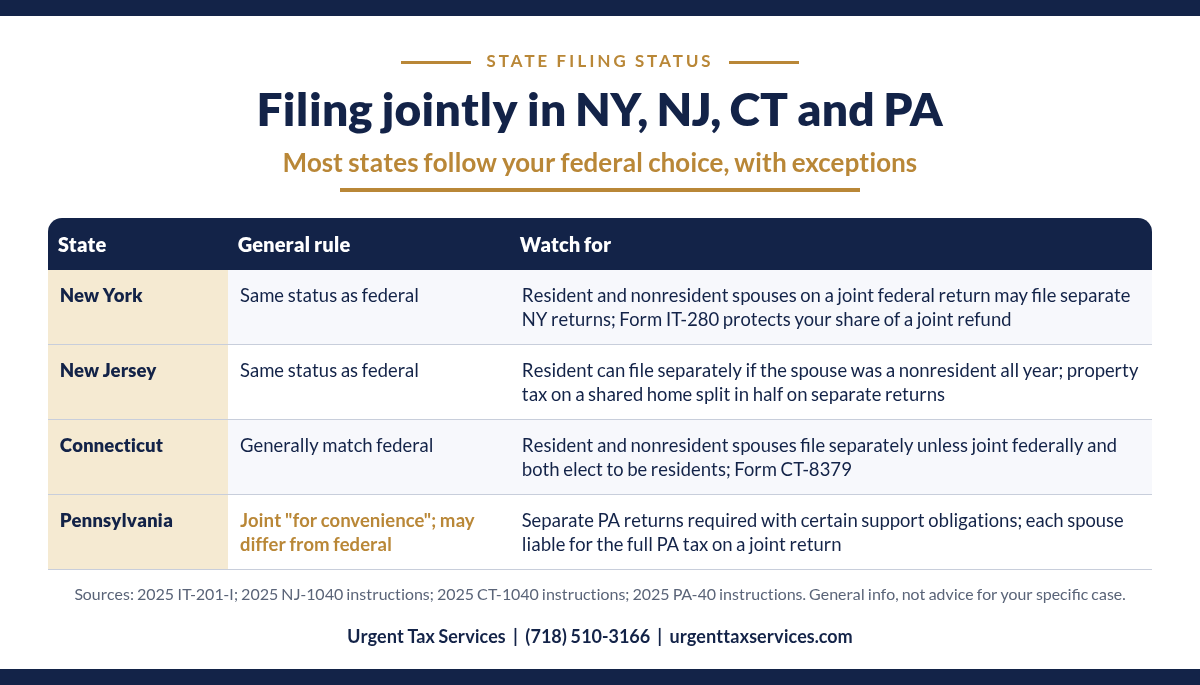
| State | General rule | Exceptions and things to watch |
|---|---|---|
| New York | Use the same filing status as your federal return. | If you file jointly federally and one spouse is a NY resident and the other a nonresident or part-year resident, you can file separate NY returns or a joint NY return as if both were residents. Limited exceptions if a spouse's whereabouts are unknown or a spouse refuses to sign. To protect your share of a joint refund from your spouse's debt, file Form IT-280 with the original return. |
| New Jersey | Use the same filing status as your federal return. | If one spouse was a nonresident all year and the other a NJ resident for any part of the year, the resident can file a separate NJ return. On separate returns for a shared main home, each spouse claims only half of the property taxes. |
| Connecticut | Generally match your federal filing status. | If one spouse is a CT resident and the other a nonresident, each must file married filing separately unless you file jointly federally and elect to be treated as both CT residents. Form CT-8379 is the nonobligated spouse claim. |
| Pennsylvania | A joint PA return is allowed "for convenience," and the instructions note you may file jointly federally but have to file separately for PA. | Each spouse is separately liable for the full PA tax on a joint return. Separate PA returns are required if either spouse is individually liable for child or spousal support or certain court-ordered obligations, or if one spouse is a resident and the other isn't (unless both elect to file as residents). PA income and losses can't offset between spouses. Tax Forgiveness uses joint eligibility income even on separate returns. |
Two state points worth noticing. First, state earned income credits in New York, New Jersey and Connecticut are figured from the federal EITC (New Jersey and Connecticut use 40% of the federal credit), so losing the federal EITC by filing separately usually means losing the state credit too. Second, Pennsylvania's Tax Forgiveness credit looks at both spouses' income no matter how you file, so the PA instructions say there's no advantage to filing separately for that credit.
If a state tax bill or penalty came out of a filing status mix-up, see state tax penalty abatement in New York, New Jersey and Connecticut.
Decision checklist: should we file jointly or separately?
- Does either of us owe back federal or state tax, child support, a defaulted federal student loan or another government debt? If yes, compare filing separately with filing jointly plus Form 8379 (or IT-280 in New York, CT-8379 in Connecticut).
- Do I know and trust every number on my spouse's side of the return? If not, think hard before signing jointly.
- Is either of us on, or planning to use, an income-driven student loan plan? Get the payment both ways from the Federal Student Aid loan simulator.
- Would we lose the EITC, education credits, the student loan interest deduction, the dependent care credit or the premium tax credit by filing separately?
- Are either of us collecting Social Security, or 65 or older and counting on the senior deduction?
- Do we contribute to IRAs or Roth IRAs, or get tips or overtime pay?
- Does the lower earner have large medical bills, or do we have very uneven incomes above the SALT phase-down?
- Will one of us itemize? If so, the other has to itemize too.
- Do we live in different states, or did either of us move this year?
- Have we run the return both ways and compared the total federal and state tax?
FAQ: married filing jointly vs separately
Is it better to file jointly or separately?
For most couples, filing jointly costs less because many credits and deductions are reduced or not allowed on a separate return, and the separate brackets are exactly half the joint ones. Separate returns can make sense to protect yourself from a spouse's tax problems, to lower an income-driven student loan payment, or in some medical-expense and SALT situations. Run it both ways.
If I file separately, am I responsible for my spouse's tax debt?
Not for tax on your spouse's separate return. On a joint return, both spouses are liable for the full tax. Separate returns don't erase joint returns you already filed for earlier years.
Can we file separately one year and jointly the next?
Yes. You choose your filing status each year.
We filed separately. Can we amend to file jointly?
Generally yes, within 3 years of the original due date, by filing Form 1040-X, with some exceptions once the IRS has issued a notice of deficiency and a Tax Court case is filed.
We filed jointly. Can we amend to file separately?
Not after the filing deadline has passed. Before the due date, separate returns can replace a joint one.
What's the difference between injured spouse and innocent spouse relief?
Injured spouse (Form 8379) gets back your share of a joint refund that was taken for your spouse's separate debt. Innocent spouse (Form 8857) asks to be relieved of tax on a joint return that your spouse caused.
Can I file as head of household instead of married filing separately?
Possibly, if you're considered unmarried: you paid more than half the cost of a home that was your child's main home for more than half the year, and your spouse didn't live there during the last 6 months of the year.
Do I have to use the same filing status on my New York, New Jersey or Connecticut return?
Generally yes, with exceptions when one spouse is a nonresident or part-year resident. Pennsylvania lets married couples file jointly or separately on the PA return, with some situations that require separate PA returns.
Related: Joint return liability · Innocent spouse relief · 2026 tax guide · Tax planning · Offer in compromise
If you're deciding whether to file jointly, your spouse has an IRS balance, or a joint refund was taken for your spouse's debt, message me, call (718) 510-3166, or book a free consultation.
I help with IRS, New York, New Jersey, Connecticut and Pennsylvania tax problems.
General info, not advice for your specific case.