"We have accepted the offer in compromise you signed and dated on 08/01/2023."
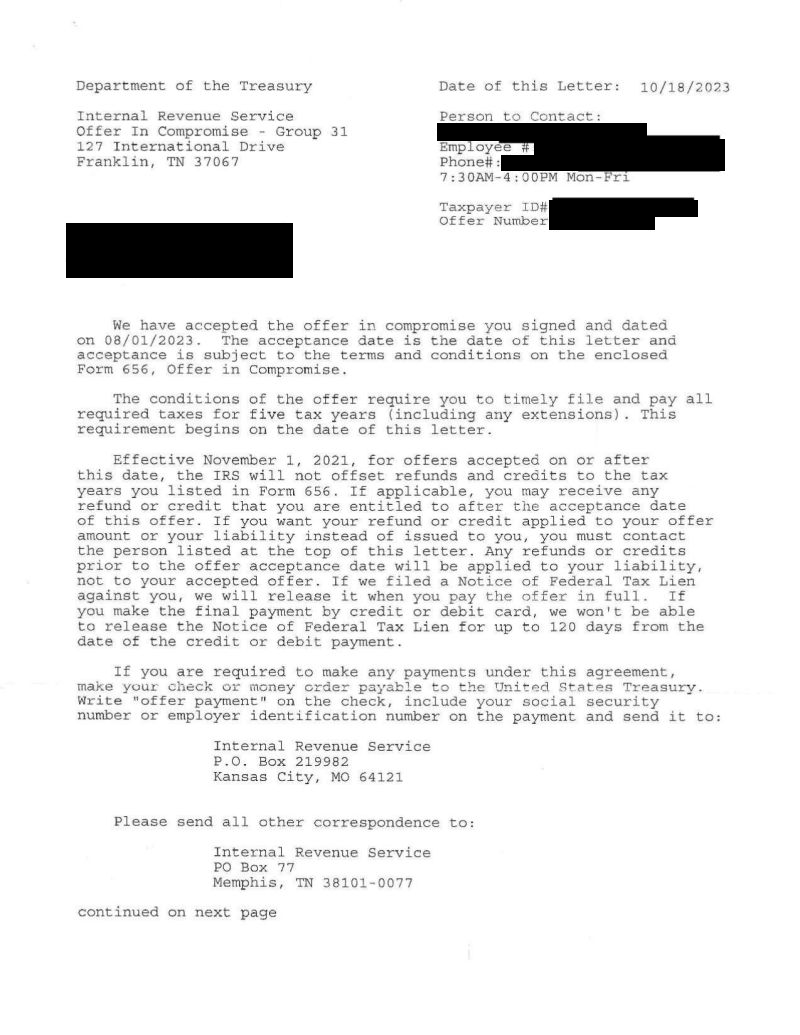
A real acceptance letter from one of my cases. Personal details removed. Past results don't predict yours.
That's the first line of an IRS letter one of my clients got on October 18, 2023. It came from the IRS Offer in Compromise unit. A copy came to me, because I was the client's representative.
I got that client's IRS debt of about $1.7 million, including penalties and interest, settled for $1,000.
Every case is different. That result came from that client's own income, assets and circumstances, and yours will depend on yours.
If you've never owed the IRS more than you could pay, it's hard to explain what a line like that means. You stop opening the mail. Your stomach drops when the phone shows a number you don't know. You lie awake doing math that never works out. The debt keeps growing every day, even on the days you don't look at it.
Then one letter says the fight is over.
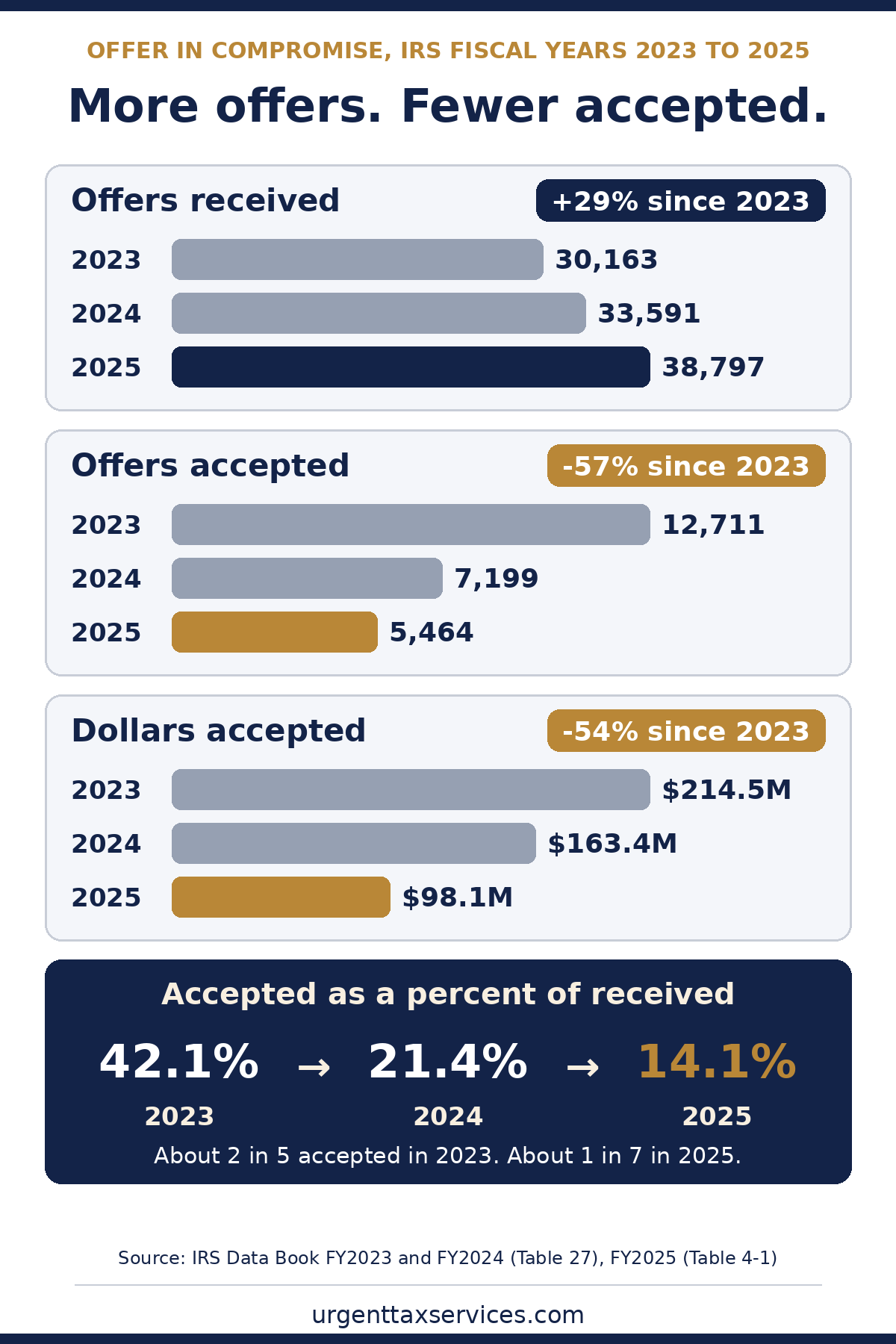
I want you to see that letter is real. I also want you to see the other side, the one the TV ads skip. In the IRS's 2025 fiscal year, people sent in 38,797 offers. The IRS accepted 5,464. For every offer it accepted that year, it received about seven. Just two years earlier, in 2023, it was about two out of every five.
And the odds just got worse. So let's clear out the myths, one at a time, before you spend money and months on an offer that was never going to work.
Offer in Compromise myths start with the odds, which are getting worse
Here are the IRS's own numbers, from the IRS Data Book, for the last three fiscal years:
| Fiscal year | Offers received | Offers accepted | Dollars accepted | Accepted vs. received |
|---|---|---|---|---|
| 2023 | 30,163 | 12,711 | $214.5 million | 42.1% |
| 2024 | 33,591 | 7,199 | $163.4 million | 21.4% |
| 2025 | 38,797 | 5,464 | $98.1 million | 14.1% |
Look at what changed from 2023 to 2025:
- Offers received: up 8,634, or about 29%.
- Offers accepted: down 7,247, or about 57%. Fewer than half as many.
- Dollars accepted: down $116.4 million, or about 54%.
- Accepted vs. received: from 42.1% to 21.4% to 14.1%. In two years, it fell by two thirds.
In 2023, the IRS accepted about 2 offers for every 5 it received. In 2025, it was about 1 for every 7. More people are knocking. Far fewer doors are opening.
One caution about these numbers: the offers the IRS accepts in a year aren't always the same offers it received that year, since many take months. So treat those percents as a picture of the odds, not a precise acceptance rate.
What it tells me is simple. An offer that's thrown together, with missing pages, sloppy numbers or unfiled returns, has far less room for error than it did two years ago. Preparation matters more now, not less.
Myth 1: "Everyone can settle for pennies on the dollar"
This is the line the ads love. The IRS itself warns about companies that promise "pennies on the dollar." It's on the IRS's 2026 Dirty Dozen list of scams.
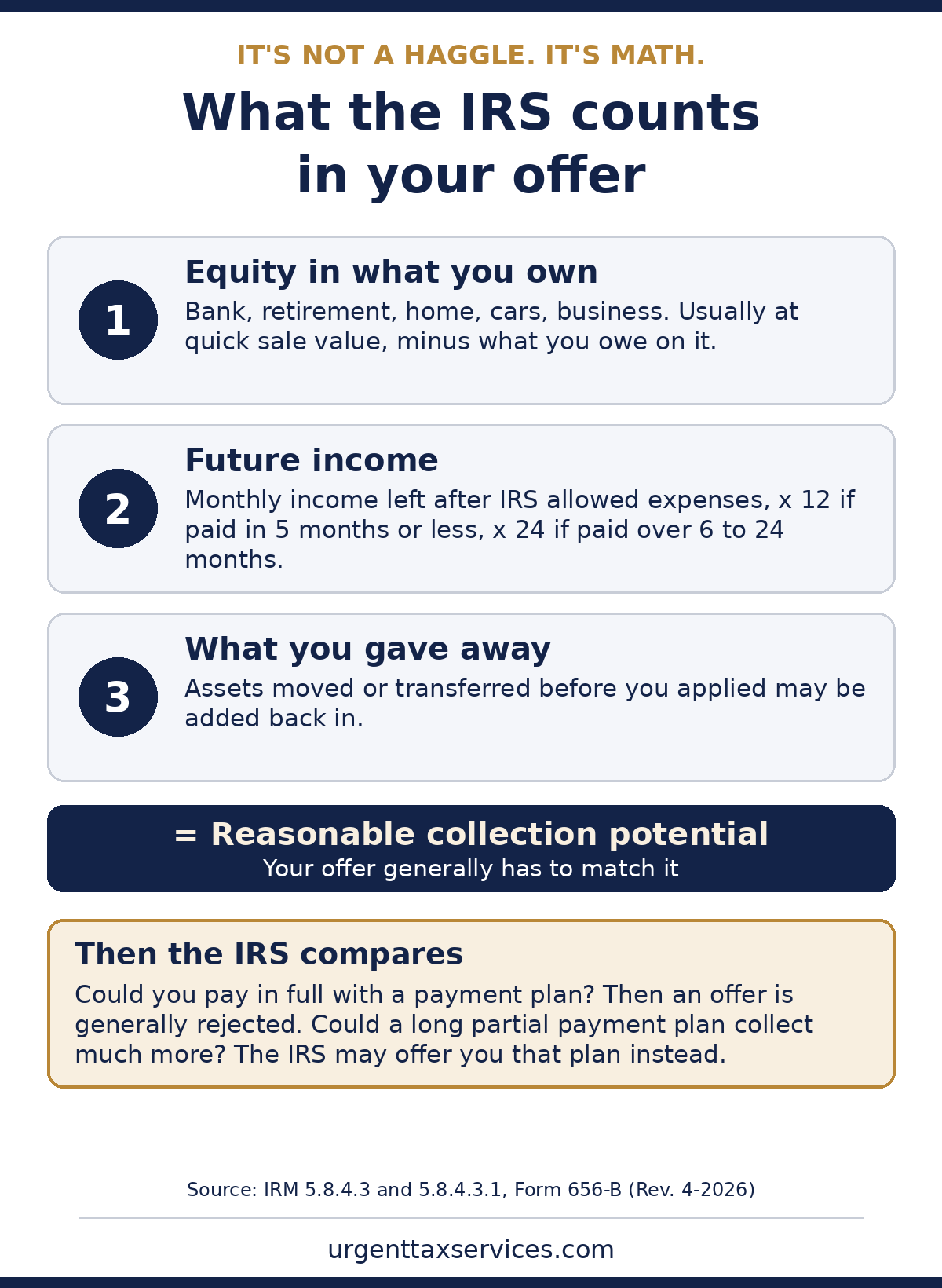
The truth is that an offer isn't a haggle. It's math. The IRS figures what it calls your reasonable collection potential. In plain words, that's what the IRS believes it could collect from you, and the offer generally has to match it. It's built mostly from two things:
- Equity in what you own. Bank accounts, retirement accounts, real estate, cars, a business. Usually valued at what it would bring in a quick sale, minus what you owe on it.
- Future income. What's left of your monthly income after the IRS's allowed living expenses, times 12 if you pay the offer in 5 months or less, or times 24 if you pay over 6 to 24 months.
So for someone with little equity and little left over each month, the offer can be a small fraction of the debt. For someone with a paid-off house, the offer may be close to the whole thing. The same program, two very different results.
In the case behind the letter at the top, the IRS accepted $1,000 on a debt of about $1.7 million. Someone else with the same debt but more equity or more income left over each month would get a very different answer.
Myth 2: "Only the rich or the totally broke qualify"
Neither. The question isn't how much you make. It's whether the IRS can collect the full debt from you before its collection time runs out, which is generally 10 years from when the tax was assessed.
A person with a good salary and a very large tax debt can qualify. A person with a modest income and a small debt usually won't, because a payment plan can pay it off. The IRS form says it plainly: generally, the IRS won't accept an offer if you can pay in full through a payment plan, your equity, or both.
The IRS also looks past the numbers. Its manual tells examiners to weigh your age, health, marital status, number and ages of dependents, education, work history and job situation when judging what you'll be able to pay in the future.
And there's a third door most people never hear about. Even if you could pay in full, the IRS can consider an offer under "effective tax administration" when paying would cause real economic hardship, or when exceptional circumstances would make full collection unfair.
Myth 3: "If I explain my situation, the IRS will forgive it"
I wish it worked that way. A heartfelt letter doesn't settle a tax debt. Paperwork does.
An offer means Form 656 plus a full financial statement, Form 433-A (OIC) for individuals or 433-B (OIC) for businesses, with bank statements, pay stubs, loan balances and the rest. By signing Form 656 you also allow the IRS to contact third parties and pull your credit report. The IRS checks what you tell it.
Your story still matters. Hardship and special circumstances are part of the review. But they have to be backed up, and they work on top of the numbers, not in place of them.
Myth 4: "Once it's filed, I can stop filing and paying"
This one quietly kills offers. Before the IRS will even consider yours, you must have filed every required return, made this year's estimated payments, and, if you have employees, made your federal tax deposits for the current quarter and the two before it.
Then it keeps going. While the offer is pending you must keep filing and paying on time. If you chose monthly payments, you must keep making them during the review. Miss one and the IRS can return your offer, and a returned offer can't be appealed.
Two more things people don't expect. Penalties and interest keep adding up while the IRS reviews the offer. And if you were already on a payment plan, you don't have to make those payments while the offer is considered, but the plan comes back only if the offer isn't accepted and you haven't run up new tax debt.
Myth 5: "Once I apply, the IRS can't touch me"
Partly true, and the part that isn't true can hurt. The IRS generally can't levy while your offer is pending. But "pending" starts when an IRS official signs off on it, not when you mail it. The IRS can levy up to that point and keep what it took.
It can also file a Notice of Federal Tax Lien while it reviews the offer. It can keep refunds for returns assessed before the offer is accepted. And the 10-year collection clock stops while the offer is pending, for 30 days after a rejection, and during an appeal. A failed offer gives the IRS more time, not less.
Myth 6: "If they say no, I get my money back"
Generally, no. The application fee is $205. With a lump sum offer, you send 20% of the offer amount up front. With a monthly payment offer, you pay each month while the IRS reviews it. Form 656 says those payments won't be returned even if you withdraw, or the IRS rejects or returns the offer. They go toward your tax debt.
The exception: if you qualify under the IRS's low-income guidelines, you don't send the fee or any payments while the offer is reviewed.
This is why I run the numbers before anyone signs anything. That money is gone either way. It should only go out with an offer that has a real chance.
Myth 7: "A denial is the end"
It isn't, but how it ends matters.
- Rejected. You can ask the IRS Independent Office of Appeals to review it. You have 30 days from the rejection letter, generally on Form 13711. Miss the 30 days and you give up that hearing.
- Returned. If the IRS returns the offer because something was missing, like an unfiled return, a missed payment or documents you didn't send, there's no appeal. You fix the problem and start over.
- A better fit instead. The IRS manual says that when a long partial payment plan would collect a lot more than your offer, the IRS should give you a chance to withdraw the offer and set up that plan before rejecting it.
One warning. Sending the same offer again with nothing changed can be returned as filed "solely to delay collection." A new offer needs a real change: lower income, a lost asset, new expenses, or circumstances that weren't considered the first time.
Myth 8: "Move the money first, then apply"
People think if the house is in a relative's name, or the savings are gone, the offer will look better. The IRS manual says the value of assets transferred or given away before the offer may be added back into the amount you're expected to offer.
And Form 656 says that if you give false information or hide assets, the IRS can reopen the offer and even terminate it, which brings back the full debt with penalties and interest. Honest numbers are the only kind that hold up.
Myth 9: "The companies on TV can get a deal nobody else can"
The IRS has a name for the worst of them: Offer in Compromise "mills." In its warnings, the IRS says these companies charge steep fees, make false claims of guaranteed settlements, and push people into offers they don't qualify for. Those mills show up year after year on the IRS Dirty Dozen list.
The IRS also says the deal is between you and the IRS. A qualified person gets the same deal whether they apply themselves or through anyone else. The IRS has a free Pre-Qualifier tool at IRS.gov/OICtool.
Good help is worth it. The forms are long, the rules are strict, and one missed estimated payment can sink a year of work. But good help sounds like "let me look at your numbers first," not "we'll get you pennies on the dollar." If someone promises you a result before seeing your bank statements, walk away.
Myth 10: "Accepted means I'm done"
Look at what that acceptance letter my client got also said. The offer was accepted "subject to the terms and conditions" of Form 656. The client had to file and pay all required taxes on time for five tax years. And the IRS would release any lien it had filed only when the offer was paid in full.
The second page spelled out what happens if the terms aren't kept. The IRS can default the offer, and then the original tax, with all penalties and interest, comes back due immediately. It can sue or levy for it.
A few more strings come with acceptance:
- Refunds for returns assessed before the acceptance date can be kept and applied to the debt.
- You can't file an amended return for the years in the offer.
- For those five years you can't get a payment plan or a new offer.
- Basic information about accepted offers, like the name, city, amount owed and offer terms, is open to public inspection for one year.
And the IRS is only one creditor. New York, New Jersey, Connecticut and Pennsylvania each run their own programs, with their own rules. I had a client who came to me owing $647,000. The IRS settled. New York State didn't. An IRS acceptance doesn't bind your state.
Who actually looks at your offer
An offer usually starts at one of the IRS's central offer units, in Brookhaven or Memphis, where an Offer Examiner works it by mail and phone. But the IRS manual lists situations where the case may be sent to an Offer Specialist in a local field office instead (IRM 5.8.4.5.1). In plain words, that happens when the case needs more digging than a central unit can do, for example:
- A running business that has to be valued, a company sitting on large retained earnings, or unusual assets.
- Several related companies, offshore activity, or arrangements that make income hard to trace.
- Questions about who really owns property, such as assets held in someone else's name or moved to another person or company.
- Complicated financial statements that need an accountant's eye to find the real income.
- Information that has to be gathered in person, other returns that may still need to be filed, a case already in Tax Court, an international taxpayer, a high-profile taxpayer, or prior voluntary disclosure.
Under the current manual, if a central unit hasn't flagged a case for transfer within 12 months of receiving it, it generally keeps the case. A field review usually means more questions and more documents, so if your finances look anything like that list, expect it and prepare for it.
Two more things from the manual are worth knowing. The IRS can reject an offer on public policy grounds even when the amount is acceptable, if accepting it would hurt fair tax administration. And if the IRS doesn't decide on an offer within 24 months of receiving it, not counting time a rejection is in appeal, the law treats it as accepted (IRC 7122(f)). Don't plan on that one. It's a backstop, not a strategy.
What made the difference in the one I showed you
The offer in that letter, $1,000 on a debt of about $1.7 million including penalties and interest, was signed August 1, 2023 and accepted October 18, 2023. There's no secret phrase behind a result like that. The IRS made its decision on a complete file that showed what the client could and couldn't pay.
I can't promise any particular result, and past results don't predict yours. What I can tell you is what I check before I file any offer:
My checklist before any offer goes in
- Every required return is filed, and this year's estimated payments are current.
- If there are employees, payroll deposits are current for this quarter and the two before it.
- The offer amount matches the math: equity plus future income, not a guess.
- Every number on Form 433-A (OIC) or 433-B (OIC) has a document behind it.
- Nothing was moved or given away that the IRS will add back.
- A partial payment plan or currently not collectible status was compared first.
- The state debt has its own plan, so the IRS deal isn't undone by NY, NJ, CT or PA.
- You know you can keep five years of perfect filing and paying.
Short FAQ
How many offers in compromise does the IRS accept?
In fiscal year 2025 the IRS received 38,797 offers and accepted 5,464, worth $98.1 million, about 14.1% of the number received. In 2024 it was 7,199 of 33,591 (21.4%), and in 2023 it was 12,711 of 30,163 (42.1%).
Can the IRS levy my bank account while my offer is pending?
Generally not after the offer is officially pending. But it can levy before that point and keep the money, and it can file a lien during the review.
Do I get my offer payments back if it's rejected?
Generally no. The fee and payments are applied to your tax debt, unless you qualified for the low-income waiver and didn't send any.
Can I appeal a rejected offer?
Yes, within 30 days of the rejection letter. A returned offer can't be appealed.
What happens if I miss a tax payment after my offer is accepted?
For five years after acceptance, missing a filing or payment can put the offer in default, and the original debt with penalties and interest can come back.
Related: Offer in Compromise: what it really takes · IRS payment plan vs. a loan · File even if you can't pay · IRS collections while you appeal
Sources
- IRS Data Book, Collections, activities, penalties and appeals: FY 2025 offers (Table 4-1), FY 2024 offers (2024 Data Book, Table 27) and FY 2023 offers (2023 Data Book, Table 27, revised). Percents are offers accepted divided by offers received in the same year. The 2024 vs. 2025 comparison was also presented in an Offer in Compromise seminar by the American Society of Tax Problem Solvers.
- Form 656-B, Offer in Compromise Booklet (Form 656 Rev. 4-2026): eligibility, refunds, levies, fees and payments, appeal rights, offer terms, five-year compliance, public inspection
- IRM 5.8.4, Offer in Compromise Investigation: doubt as to collectibility and reasonable collection potential (5.8.4.3), components of collectibility (5.8.4.3.1), field transfer reasons (5.8.4.5.1), offers submitted solely to delay (5.8.4.7.1)
- IRM 5.8.7.7.2, Public Policy Rejection, and Policy Statement P-5-89
- IRS Dirty Dozen 2026 and IR-2024-243, IRS warning on Offer in Compromise "mills"
- Internal Revenue Code sections 6331(k) and 7122, including 7122(f) (24-month deemed acceptance)
- IRS SB Letter 5483, Offer in Compromise acceptance letter dated 10/18/2023 (client identifiers removed)
If you owe the IRS more than you can pay and want an honest look at whether an offer fits, message me.
I help with IRS, New York, New Jersey, Connecticut and Pennsylvania tax problems.
General info, not advice for your specific case.