Tax planning works a lot like a diet.
Everyone wants the result. Few people want the daily work.
On a diet, you log meals as you eat them. You can't lose 20 pounds the night before the wedding. Taxes work the same way. You keep the right tax deduction records, in the right form, before you file. Fixing it in April, or after the IRS calls, is usually too late.
The courts are strict about this. Some of the cases below involve real gifts and real expenses that nobody doubted. The deduction was still zero.
The tax deduction records the law requires
Charity gifts of $250 or more. Under IRC section 170(f)(8), you need a written acknowledgment from the charity. It must state the amount (or describe the property) and whether you got any goods or services in return. You must have it by the date you file, or the due date with extensions if earlier. Without it, the law says no deduction is allowed.
Property gifts. Noncash gifts over $500 need Form 8283. Gifts of property over $5,000 generally need a qualified appraisal by a qualified appraiser, and Form 8283 has to be filled out completely. Over $500,000, the appraisal is attached to the return.
Car, travel and gifts. Under IRC section 274(d), cars and travel need adequate records: the amount (miles), the date and place, and the business purpose. The court can't estimate these expenses for you.
The biggest cases where the IRS denied a deduction
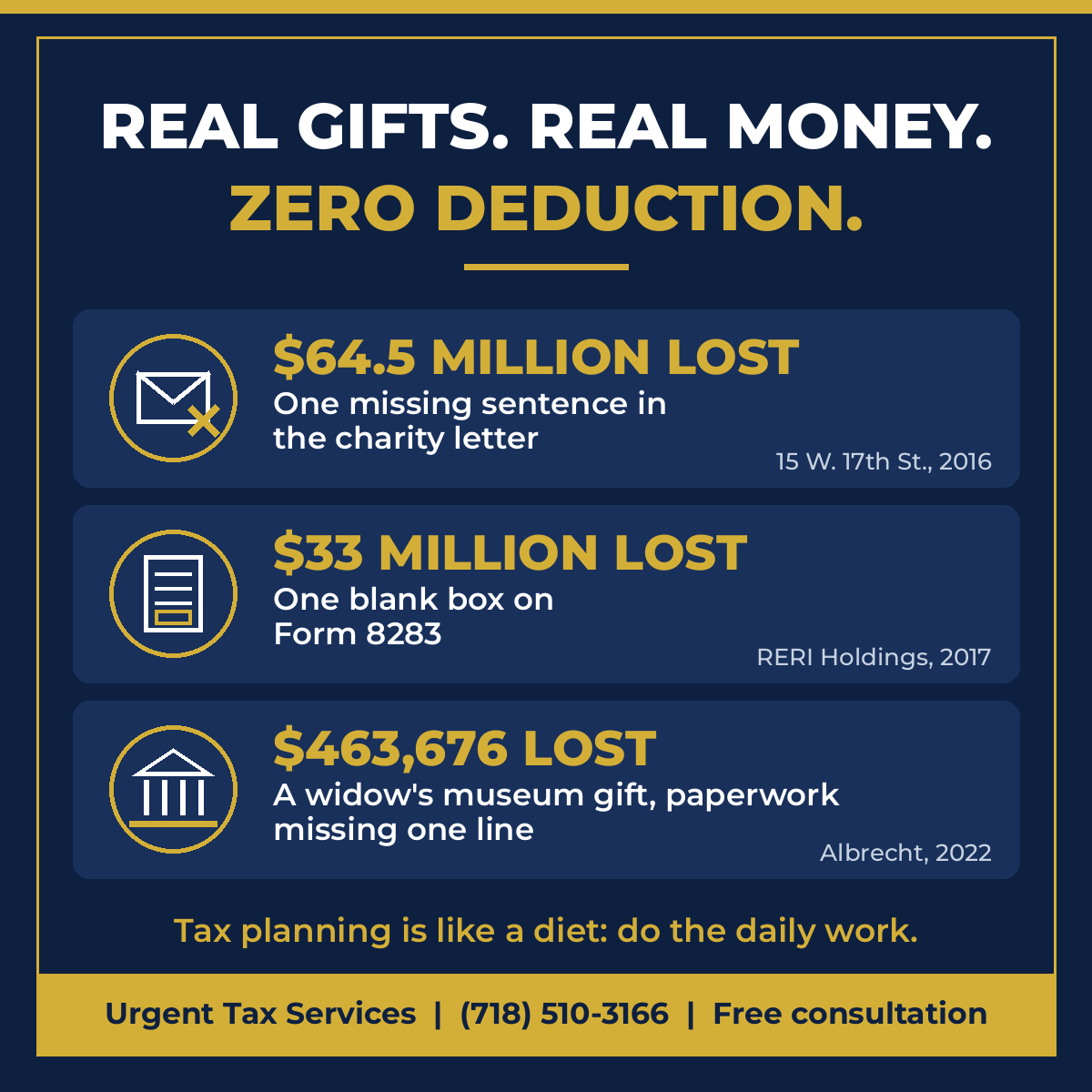
$64.5 million: one missing sentence
In 15 W. 17th St. LLC v. Commissioner, 147 T.C. 557 (2016), the owner of a Manhattan building claimed a $64.5 million deduction for a conservation easement.
The charity's paperwork never said that nothing was given in return. The charity later filed an amended return trying to fix it. The Tax Court said that was not enough. The deduction was denied.
$33 million: one blank box
In RERI Holdings I, LLC v. Commissioner, 149 T.C. 1 (2017), the taxpayer claimed a $33 million deduction for donated property. On Form 8283, it left the "cost or adjusted basis" box blank.
That basis was about $2.95 million, paid 17 months earlier. The court said leaving it out kept the IRS from seeing the problem and denied the deduction. The D.C. Circuit affirmed in 2019.
$20.7 million: no qualified appraisal
In Oconee Landing Property, LLC v. Commissioner, T.C. Memo. 2024-25, a $20.7 million easement deduction was denied. The court found there was no qualified appraisal.
About $18.5 million: he appraised it himself
In Mohamed v. Commissioner, T.C. Memo. 2012-152, a real estate broker gave property to a charitable trust and did the appraisals himself. As the donor, he could not be a qualified appraiser.
The court said the property may well have been worth more than he claimed. It said it was sympathetic. It still denied the deduction of roughly $18.5 million.
$463,676: a widow's museum gift
This is the one that stays with me.
In Albrecht v. Commissioner, T.C. Memo. 2022-53, a widow gave about 120 pieces of Native American jewelry and art to a museum. Nobody questioned the value.
She lost the whole $463,676 deduction anyway. The museum's paperwork didn't say whether she got anything in return. The museum confirmed it later, but by then it was too late.
$22,517: a family and their church
You don't need millions for this rule to hurt.
In Durden v. Commissioner, T.C. Memo. 2012-140, a couple gave $22,517 to their church by check. The church's letter left out the sentence about goods or services. The corrected letter came after they filed. The deduction was denied.
A bank statement shows you paid. It doesn't show what you got back.
$17,978: the court believed him, and still said no
Car expenses work the same way.
In Houchin v. Commissioner, T.C. Summary Opinion 2014-29, the court said it believed the taxpayer drove for business. It still denied $17,978 of truck expenses. His log had miles but not where he went or why. He filled in the places about two years later, and the court found that was a guess. (Summary opinions can't be cited as precedent, but the lesson is the same one the Tax Court applies under section 274(d).)
My checklist: acknowledgment letters, Form 8283 and a mileage log
Get the charity letter before you file, for any gift of $250 or more. Check that it says whether you received anything in return.
For property over $5,000, use an independent qualified appraiser. Not yourself, and not anyone tied to the gift.
Fill out every line of Form 8283, including cost basis. "See attached" is not a safe answer.
Keep a mileage log as you drive: date, place, business purpose and miles. Not at year end.
Keep receipts with a short note on why you spent the money.
Keep records at least 3 years after filing, and longer in many cases.
FAQ
What does a charitable contribution acknowledgment letter need to say?
For a gift of $250 or more, the charity's written acknowledgment must state the amount, or describe the property, and say whether you got any goods or services in return. You need it by the date you file.
Is a bank statement enough for a $250 donation?
No. A bank statement shows you paid. It doesn't show what you got back, which is why the Durden family lost their deduction.
Can I appraise property I donate myself?
No. For property over $5,000, use an independent qualified appraiser. As the donor, you can't be one.
What does the IRS require in a mileage log?
The date, the place, the business purpose and the miles, written as you drive. A log filled in later can be treated as a guess.
How long should I keep tax deduction records?
At least 3 years after filing, and longer in many cases.
Related: Shifting the burden of proof to the IRS · Hobby loss audit: what the IRS looks for · IRS Appeals vs. Tax Court: who has to prove it · Record Retention Guide: how long to keep tax records
Official sources: IRS Publication 526: Charitable contributions · IRS: About Form 8283 · IRS Publication 463: Travel, gift and car expenses
Need help?
I help individuals, businesses and trusts with IRS, New York, New Jersey, Connecticut and Pennsylvania tax issues. If you want your 2026 records in shape before year end, or the IRS is already questioning a deduction, book a free consultation to go over your case.
Solomon Grosinger, Enrolled Agent
I'm licensed by the IRS and have represented taxpayers before the IRS and New York, New Jersey, Connecticut and Pennsylvania tax agencies from Brooklyn since 2017.
General info, not advice for your specific case.