Who has to show proof for a tax bill? IRS Appeals vs. Tax Court
Who has to show proof for a tax bill, the IRS or the taxpayer?
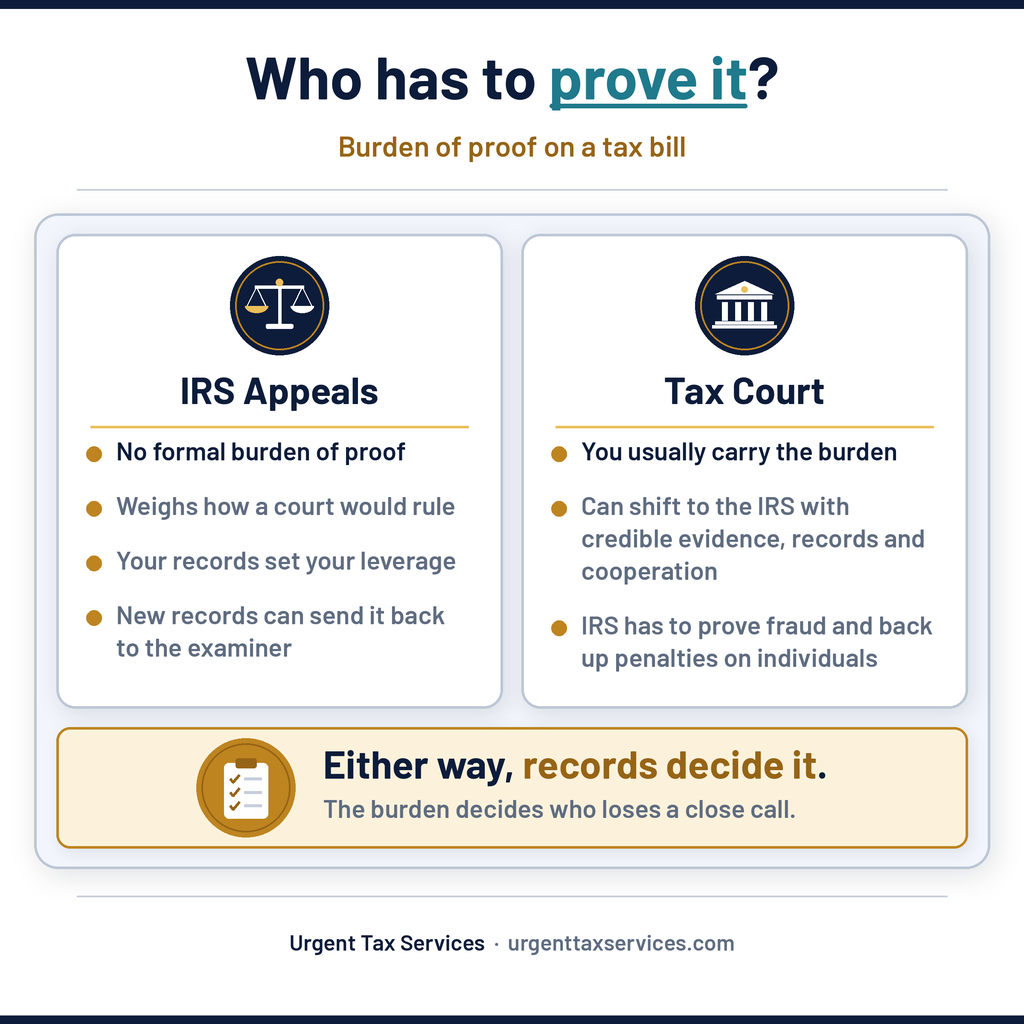
A few months ago, a friend asked me this while she was getting ready to file in Tax Court. Clients ask me too, usually right after an audit report shows up. The honest answer is that it depends on where the fight is. In Tax Court, it's usually you. In IRS Appeals, nobody formally carries it, but it still shapes the deal you can get.
I covered the rules for shifting the burden to the IRS in Shifting the burden of proof to the IRS: why messy books don't qualify. This article is about how the burden actually plays out in the two places most disputes end up.
In Tax Court, you start with the burden
When the IRS sends a notice of deficiency, its numbers are presumed correct. The Supreme Court said so in Welch v. Helvering back in 1933, and Tax Court Rule 142(a) puts the burden of proof on the taxpayer unless a law or the Court says otherwise.
That means you have to show the IRS got it wrong. Not just say it. Show it, with documents and testimony a judge can rely on.
You can shift the burden to the IRS on a factual issue under Section 7491. The conditions are strict: credible evidence, the substantiation and records the law requires, and cooperation with reasonable IRS requests during the audit. A partnership, corporation or trust with a net worth over $7 million, or more than 500 employees, can't use it. And it only covers income, estate and gift tax, not payroll tax.
Where the IRS carries the load in Tax Court
There are real exceptions, and they matter:
Fraud. If the IRS says you committed civil fraud, for example to charge the 75% fraud penalty, it has to prove it by clear and convincing evidence. That's a higher bar than the usual "more likely than not."
Penalties on individuals. Under Section 7491(c), the IRS has to come forward first with evidence that a penalty applies, including written supervisory approval where the law requires it. Once it does, you still have to prove a defense like reasonable cause. This covers individuals only. The Tax Court made that clear in Higbee v. Commissioner (2001). A corporation or partnership doesn't get it.
New issues the IRS raises in court. If the IRS raises a new matter in its answer, or asks for more tax than the notice showed, it carries the burden on that part.
Income built from statistics. If the IRS reconstructs an individual's income solely from statistics about other taxpayers, it bears the burden on that item.
Unreported income with nothing behind it. Some federal appeals courts, including the Ninth Circuit in Weimerskirch (1979), won't presume the IRS is right on unreported income unless it shows some evidence tying you to the income. Courts don't all apply this the same way.
One more thing about the burden in court. It mostly decides close calls. If the evidence is evenly balanced, whoever has the burden loses. If one side's evidence is clearly stronger, the burden rarely changes the result.
In IRS Appeals, there's no formal burden
The IRS Independent Office of Appeals isn't a court. It's a settlement office, separate from the examiner who audited you. An Appeals officer doesn't rule that one side "met its burden." The officer looks at what would likely happen if the case went to court and tries to settle on that basis. The IRS calls this the hazards of litigation.
The IRS's own manual gives a simple example. If the hazards point to about 60% for the government and 40% for the taxpayer, the tax can be settled 60/40.
So where does the burden show up? In those percentages. If you'd carry the burden in court and your records are thin, the IRS's risk of losing is low, and the officer will see it that way. If your records are clean and complete, or it's an issue where the IRS would carry the burden, the IRS's risk goes up. That's your leverage.
A few more things I tell clients about Appeals:
Cooperation goes in the file. When a case doesn't settle, Appeals is supposed to note how well you cooperated, because IRS lawyers need that for the burden question at trial.
Penalties stand on their own. Appeals settles each penalty on its own merits and hazards. It doesn't trade a penalty away to settle a different issue.
Appeals generally won't raise new issues. Its job is to resolve what's in dispute, not to keep auditing you.
The catch: new evidence can send you back to the examiner
This one surprises people. If you bring Appeals documents you never gave the examiner, and they need real review or checking, Appeals can send the case back to the examiner to look at them. That generally happens when at least 210 days are left before the IRS's deadline to assess. With less time than that, Appeals will usually ask you to extend the deadline. If you won't, it can decline to consider the new material.
Either way, you lose time and some control. The lesson is simple. Give the examiner your best records the first time. Don't save them for Appeals.
Most Tax Court cases go through Appeals anyway
Filing in Tax Court doesn't mean skipping Appeals. Under IRS procedures, IRS lawyers generally send new Tax Court cases to Appeals for a chance to settle, unless Appeals already issued the notice of deficiency or you ask to skip it.
So many cases get both: an Appeals officer weighing the court odds, with a real trial date behind it. That's when the burden of proof stops being theory.
Watch the clock, too. You generally have 90 days from the date on a notice of deficiency to petition the Tax Court, or 150 days if it's addressed to you outside the U.S. Miss it, and you lose the chance to fight in Tax Court before paying.
What I'd do if you disagree with an audit result
Organize your records by issue. Each adjustment needs its own proof.
Answer the examiner on time, and keep copies of everything you send.
Give the examiner your strongest documents now, not later.
Know your letter. A 30-day letter means you can file a protest with Appeals. A notice of deficiency means the 90-day Tax Court clock is running.
Be honest about which issues your records can carry. That's how Appeals will look at it too.
Short FAQ
Does the IRS have to prove I owe the tax? Usually not in Tax Court. The IRS's numbers are presumed correct, and you have to show they're wrong. Fraud and some unreported income cases are exceptions.
Is there a burden of proof in IRS Appeals? Not formally. The Appeals officer weighs how a court would likely rule, and that includes who would carry the burden there.
Does the IRS have to prove penalties? For individuals in court, the IRS has to come forward with evidence that the penalty applies. Then you have to prove any defense, like reasonable cause. Businesses don't get that rule.
Should I hold back documents for Appeals? No. New documents can send the case back to the examiner and cost you time.
General info, not advice for your specific case.
Related: Shifting the burden of proof to the IRS: why messy books don't qualify · Does collection stop while you appeal? · Audited over a low S corp salary?
Got an audit result you disagree with?
Book a free 30-minute call to go over your case. For a quick question, you can call (718) 510-3166. I'll tell you honestly where you stand.