If you sell on Amazon, Etsy, eBay or another online marketplace, or you take payments through an app, you have probably heard a lot about Form 1099-K. The rules changed several times over the last few years, and then changed again in 2025. A lot of sellers are now confused about whether they will get one, what the number on it means, and what happens if they don't get one at all.
I'm Solomon Grosinger, an IRS Enrolled Agent. This guide is for people who sell goods online as a side business or a full business. It covers the 1099-K threshold for 2026, why the 1099-K amount is usually bigger than your actual income, where your sales go on your return, self-employment and estimated tax, what to do with a wrong form, and how New York, New Jersey, Connecticut and Pennsylvania fit in.
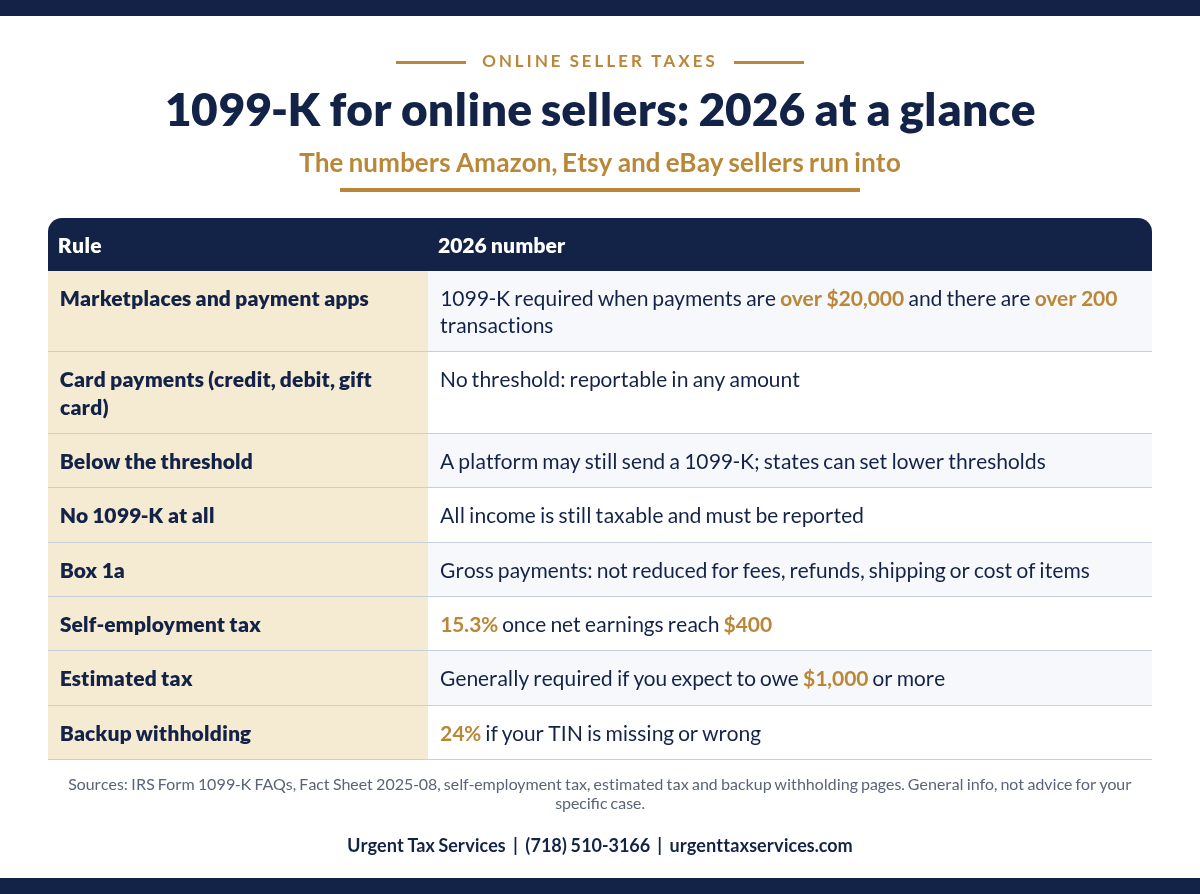
The short version: for 2026, a marketplace or payment app generally only has to send you a 1099-K if you were paid more than $20,000 and had more than 200 transactions. That's the rule again after a 2025 law change. But the form is only a reporting tool. Your online sales profit is taxable whether or not you get a 1099-K, and the gross number on the form is not your income. You start with it, then subtract refunds, fees, shipping, the cost of what you sold and your other business expenses.
What a 1099-K is and who sends it
Form 1099-K is an information return. It reports payments you received for selling goods or services through two kinds of payment systems:
- Payment cards: credit cards, debit cards and stored-value cards such as gift cards. If you run card sales through a merchant processor, those are payment card transactions.
- Third party settlement organizations (TPSOs): payment apps and online marketplaces that pay you for goods or services. When Amazon, Etsy or eBay collects money from your buyers and pays it out to you, the marketplace is generally the one that reports it.
The IRS gets a copy, and so do you. The main number is box 1a, the gross amount of reportable payment transactions for the year. The form also shows the number of transactions, monthly amounts, any federal income tax withheld in box 4, and state information.
You should not get a 1099-K for things you bought. It's only for payments you received for selling goods or providing services.
The 1099-K threshold for 2026: what changed in 2025
This is where most of the confusion comes from. The American Rescue Plan Act of 2021 lowered the threshold for payment apps and marketplaces to more than $600 a year, with no transaction count. The IRS then delayed that change through a series of transition notices (Notices 2023-10, 2023-74 and 2024-85).
In 2025, the One Big Beautiful Bill Act (OBBB) retroactively reinstated the old threshold. According to the IRS, a TPSO isn't required to file a Form 1099-K unless the gross payments to you exceed $20,000 and the number of transactions exceeds 200.
| Payment type | When a 1099-K is required | Notes |
|---|---|---|
| Online marketplaces and payment apps (TPSOs) | Gross payments over $20,000 and more than 200 transactions in the year | Both tests have to be met. OBBB restored this rule retroactively, replacing the $600 rule from 2021. |
| Payment card transactions (credit, debit, gift card) | Any amount | No minimum. Merchant processors report card sales of any size. |
| TPSO did backup withholding | Required even below the threshold | The TPSO has to file a 1099-K and send you a copy. |
| State rules | Can be lower | The IRS notes your state may have a lower reporting threshold, so you could get a 1099-K below the federal numbers. |
Two more points from the IRS that sellers often miss. First, a marketplace can send you a 1099-K even if you're under the threshold. Getting one doesn't mean you did anything wrong. Second, if you take card payments directly, for example at a craft fair through a card reader, there is no threshold for those card transactions.
No 1099-K doesn't mean no tax
The threshold controls when the marketplace has to file a form. It does not decide whether your income is taxable or whether you have to file a return. The IRS says it plainly: all income, no matter the amount, is taxable unless the tax law says it isn't, even if you don't get a Form 1099-K. That includes cash, property and services you receive.
So if you sold $14,000 of products on Etsy in 2026 over 150 orders, you probably won't get a 1099-K from Etsy under the federal rule. You still report the sales and your expenses on your return. The difference is only that the IRS doesn't get a form telling it about the sales.
Why your 1099-K number is bigger than your income
Box 1a is the gross amount. The IRS says it doesn't include adjustments for fees, credits, refunds, shipping, cash equivalents or discounts, and it doesn't account for what you paid for the items you sold. You use the 1099-K together with your own records to figure your real income.
For a business seller, the path from the 1099-K to taxable profit usually looks like this on Schedule C:
- Line 1, gross receipts: start with your total sales. Check that it includes everything reported on your 1099-Ks, plus sales that weren't reported on any form.
- Line 2, returns and allowances: refunds you gave buyers.
- Line 4, cost of goods sold: what the products you actually sold cost you, figured in Part III. An upcoming article of mine on inventory will explain why that isn't the same as everything you bought this year.
- Expenses: marketplace and payment processing fees, advertising, shipping and postage you paid, packaging, software and other ordinary and necessary business costs.
Sales tax is its own item. The Schedule C instructions say state and local sales taxes imposed on the buyer that you were required to collect and pay over to the state are not included in gross receipts and are not a deductible expense. When a marketplace collects and pays the sales tax for you, keep its reports so you can match them to your 1099-K.
Example (hypothetical numbers)
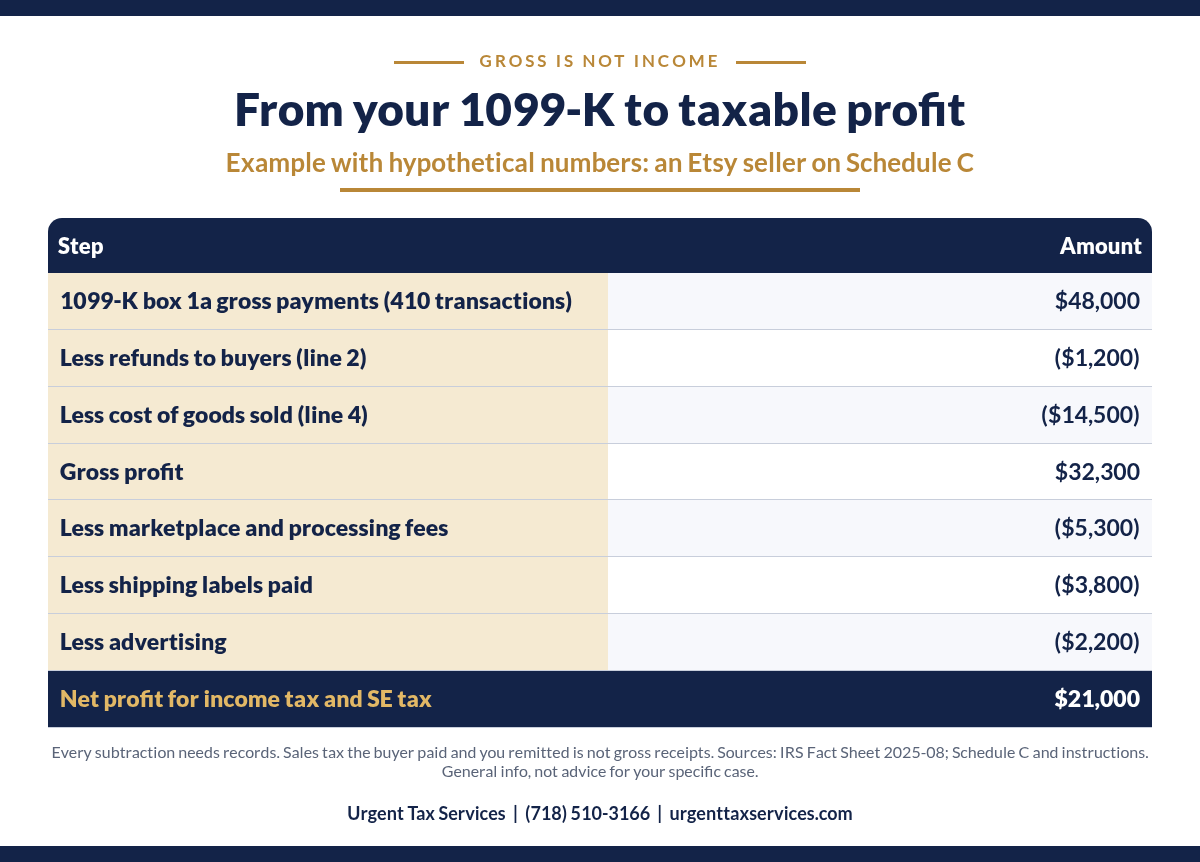
Dana sells handmade jewelry on Etsy as a sole proprietor. For 2026 her 1099-K shows $48,000 in box 1a over 410 transactions. Her records show $1,200 of refunds, $14,500 cost of goods sold, $5,300 of Etsy and payment processing fees, $3,800 of shipping labels she paid, and $2,200 of advertising.
| Line | Amount |
|---|---|
| Gross receipts (Schedule C line 1) | $48,000 |
| Less refunds (line 2) | ($1,200) |
| Less cost of goods sold (line 4) | ($14,500) |
| Gross profit | $32,300 |
| Less fees, shipping and advertising | ($11,300) |
| Net profit | $21,000 |
Dana pays income tax and self-employment tax on $21,000, not on $48,000. But she only gets there if she can back up each subtraction with records. If she reported nothing, the IRS would see a $48,000 form with no matching income on her return.
Business, hobby or decluttering: where online sales go on your return
Where you report depends on what you're actually doing. The IRS gives this breakdown:
| Your situation | Where it goes | What to know |
|---|---|---|
| You sell goods as a business (sole proprietor or single-member LLC taxed as one) | Schedule C | Report gross receipts and deduct cost of goods sold and expenses. Net profit is subject to income tax and self-employment tax. |
| You sold personal items at a loss (old furniture, used clothes) | Entry space at the top of Schedule 1, with an offsetting adjustment | A loss on personal items isn't deductible, but it isn't income either. Combined 1099-K amounts go in the entry space. |
| You sold personal items at a gain | Form 8949 and Schedule D | Gain is taxable. Holding period decides short-term or long-term. |
| It's a hobby, not a business | Other income on Schedule 1 | Hobby income is taxable and the expense rules are much less favorable. See my article on hobby loss audits. |
If you buy items to resell, that's generally a business, even if you started by cleaning out your closet. My upcoming article on bank deposits and personal item sales goes deeper on the decluttering side.
Self-employment tax and estimated taxes for online sellers
If your selling is a business, your profit is subject to self-employment tax as well as income tax. According to the IRS:
- You must pay self-employment tax and file Schedule SE if your net earnings from self-employment are $400 or more.
- The self-employment tax rate is 15.3%: 12.4% for Social Security and 2.9% for Medicare. For 2026, the Social Security part applies to the first $184,500 of combined wages and self-employment earnings.
- You can deduct the employer-equivalent portion of your self-employment tax when figuring adjusted gross income.
- Individuals generally have to make estimated tax payments if they expect to owe $1,000 or more when they file.
Marketplaces don't withhold income tax from your payouts in the normal course. If your shop grows, the tax bill can surprise you in April. Setting aside part of each payout and making quarterly estimated payments is the usual fix.
Your Schedule C profit may also qualify for the qualified business income deduction. Whether it does, and how much, depends on your income and other factors.
Wrong or duplicate 1099-K: what to do
Mistakes happen: a 1099-K that includes payments from friends splitting a bill, a form under the wrong person's taxpayer ID, or the same sales reported twice. The IRS says:
- Contact the filer listed in the upper left corner of the form and ask for a corrected Form 1099-K if needed.
- The IRS can't correct the form for you.
- If you can't get a corrected form, don't wait to file. You can zero out the error on Schedule 1 when you file, and keep the form and your correspondence with your records.
Ignoring a 1099-K is the expensive option. When the amount on a 1099-K doesn't show up on your return, the usual result is an IRS letter proposing tax on the full gross amount. Answering that letter with good records is much easier than rebuilding a year of sales after the fact.
Backup withholding: why your W-9 matters
Marketplaces ask for your taxpayer identification number (your Social Security number or EIN) for a reason. If the TIN is missing or incorrect, the payer may have to withhold backup withholding, which the IRS lists at 24%. That money shows up in box 4 of your 1099-K. You claim it as federal income tax withheld on your return. And as noted above, if a marketplace backup-withheld, it has to send you a 1099-K even if you were under the $20,000 and 200-transaction threshold.
Records online sellers should keep
- Monthly or annual sales reports from each marketplace and payment app, including refunds, fees and sales tax collected.
- Receipts and invoices for inventory and materials, so you can show cost of goods sold.
- Shipping label and postage reports.
- Advertising and subscription invoices.
- A record of which deposits were business sales and which were personal transfers, gifts or reimbursements.
- Copies of every 1099-K and any corrected forms or correspondence.
For more on what the IRS expects to see, read my articles on keeping records for deductions and who has the burden of proof in an IRS dispute, and my record retention guide.
1099-K for online sellers in New York, New Jersey, Connecticut and Pennsylvania
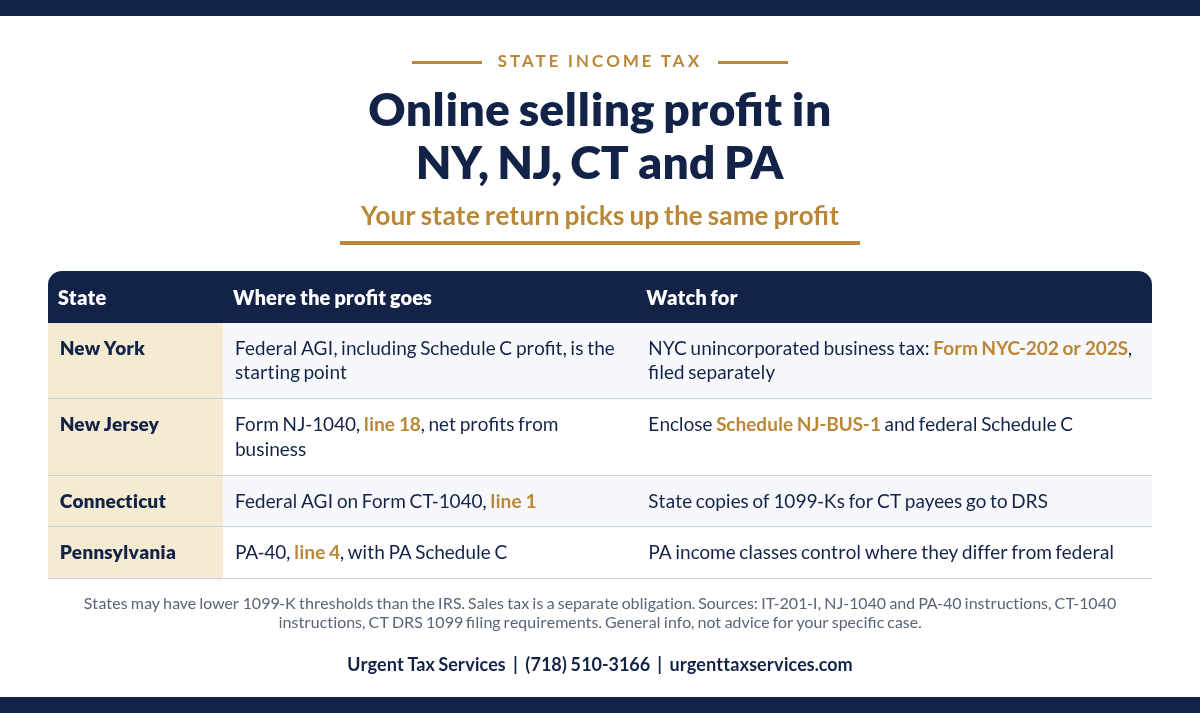
Your state income tax return generally picks up the same online selling profit. Here is what I could confirm from each state's own forms and guidance:
| State | How online selling profit is taxed | Notes |
|---|---|---|
| New York | Your federal Schedule C profit flows into federal adjusted gross income, which is the starting point for your New York return. | If you are self-employed and do business in New York City, you may also have to file NYC Form NYC-202 or NYC-202S for the unincorporated business tax. New York State doesn't administer it, so it's filed separately. |
| New Jersey | Net profits from business go on line 18 of Form NJ-1040. | Enclose Schedule NJ-BUS-1 and a copy of your federal Schedule C for each business. New Jersey's own withholding guide says payers must give the state copies of federal 1099s when $1,000 or more is paid or New Jersey tax was withheld. |
| Connecticut | Your federal adjusted gross income is the starting point on Form CT-1040, line 1. | Connecticut DRS requires state copies of federal Forms 1099-K for payees located in Connecticut to be filed with DRS. |
| Pennsylvania | Net income from operating a business goes on line 4 of the PA-40, with PA Schedule C. | Pennsylvania uses its own income classes, and federal classifications don't control where they differ from Pennsylvania's. |
Remember that the IRS says states may have lower 1099-K thresholds than the federal rule, so you could get a 1099-K for state purposes even below $20,000 and 200 transactions. Treat that as a reporting matter. Your income is taxable either way.
Sales tax is a separate question from income tax. Selling into other states can create sales tax obligations long before you have an income tax issue there. An upcoming article of mine on economic nexus will cover the New York, New Jersey, Connecticut and Pennsylvania sales tax thresholds and how marketplace facilitator rules work.
1099-K checklist for online sellers
- Make sure every marketplace and payment app has your correct name and TIN on file to avoid 24% backup withholding.
- Download each platform's annual sales, refund, fee and tax report in January.
- Match each 1099-K to your records. Report all sales on Schedule C line 1, including sales without a 1099-K.
- Subtract refunds, cost of goods sold and expenses only with records to back them up.
- Separate personal item sales and personal transfers from business sales.
- Request a corrected 1099-K for any error; if it doesn't arrive, zero out the error on Schedule 1 and keep your proof.
- Check whether you owe self-employment tax ($400 net earnings) and estimated tax ($1,000 expected balance).
- Check your state return and, if you're in New York City, the unincorporated business tax.
- Check your sales tax registration in every state where you may have nexus.
FAQ: 1099-K for online sellers
What is the 1099-K threshold for 2026?
For payment apps and online marketplaces, more than $20,000 in gross payments and more than 200 transactions. The One Big Beautiful Bill Act reinstated that rule retroactively in 2025. Payment card transactions have no threshold.
I sold less than $20,000 on Etsy. Do I still have to report it?
Yes, if it's income. The threshold only decides whether the marketplace files a form. All income is taxable unless the law says otherwise, even without a 1099-K.
Is the amount on my 1099-K what I pay tax on?
No. Box 1a is gross payments. It doesn't subtract fees, refunds, shipping or what you paid for the items. Business sellers subtract returns, cost of goods sold and expenses on Schedule C.
Amazon sent me a 1099-K even though I was under the threshold. Is that a mistake?
Not necessarily. The IRS says a marketplace may send a 1099-K below the threshold, and some states have lower thresholds. If the amounts are correct, report them. If they're wrong, ask for a correction.
What if my 1099-K includes money that wasn't from sales?
Ask the filer for a corrected form. If you can't get one, don't wait to file. You can zero out the error on Schedule 1 and keep records showing why.
Do I pay self-employment tax on online sales?
If selling is a business and your net earnings from self-employment are $400 or more, yes. The rate is 15.3%, and you deduct the employer-equivalent half when figuring AGI.
Why was 24% withheld from my payouts?
That's backup withholding, usually because your TIN was missing or didn't match. Fix the TIN with the platform, and claim the withheld amount on your return.
I sold my old couch on Facebook Marketplace at a loss. Is that taxable?
A loss on a personal item isn't taxable income and isn't deductible. If you got a 1099-K for it, the IRS says to report it at the top of Schedule 1 with an offsetting entry.
Related: 2026 tax guide · Tax planning · Hobby loss audits · How long to keep tax records · Amended returns
If you sell online and got a 1099-K that doesn't match your records, or a letter about one, message me, call (718) 510-3166, or book a free consultation.
I help with IRS, New York, New Jersey, Connecticut and Pennsylvania tax problems.
General info, not advice for your specific case.