Every year, parents ask me the same question in a slightly different way. "My son had a summer job, does he file?" "My daughter has a bank account from her grandparents, does she file?" "We claim her on our return, so she doesn't need her own, right?" The answer is often yes, sometimes no, and the rules are stricter than most people expect.
I'm Solomon Grosinger, an IRS Enrolled Agent in Brooklyn. This guide walks through when a dependent child has to file a 2026 federal return, the actual dollar amounts, why a child sometimes should file even when it isn't required, how the kiddie tax works, and what New York, New Jersey, Connecticut and Pennsylvania require. I use real 2026 IRS figures and five worked examples.
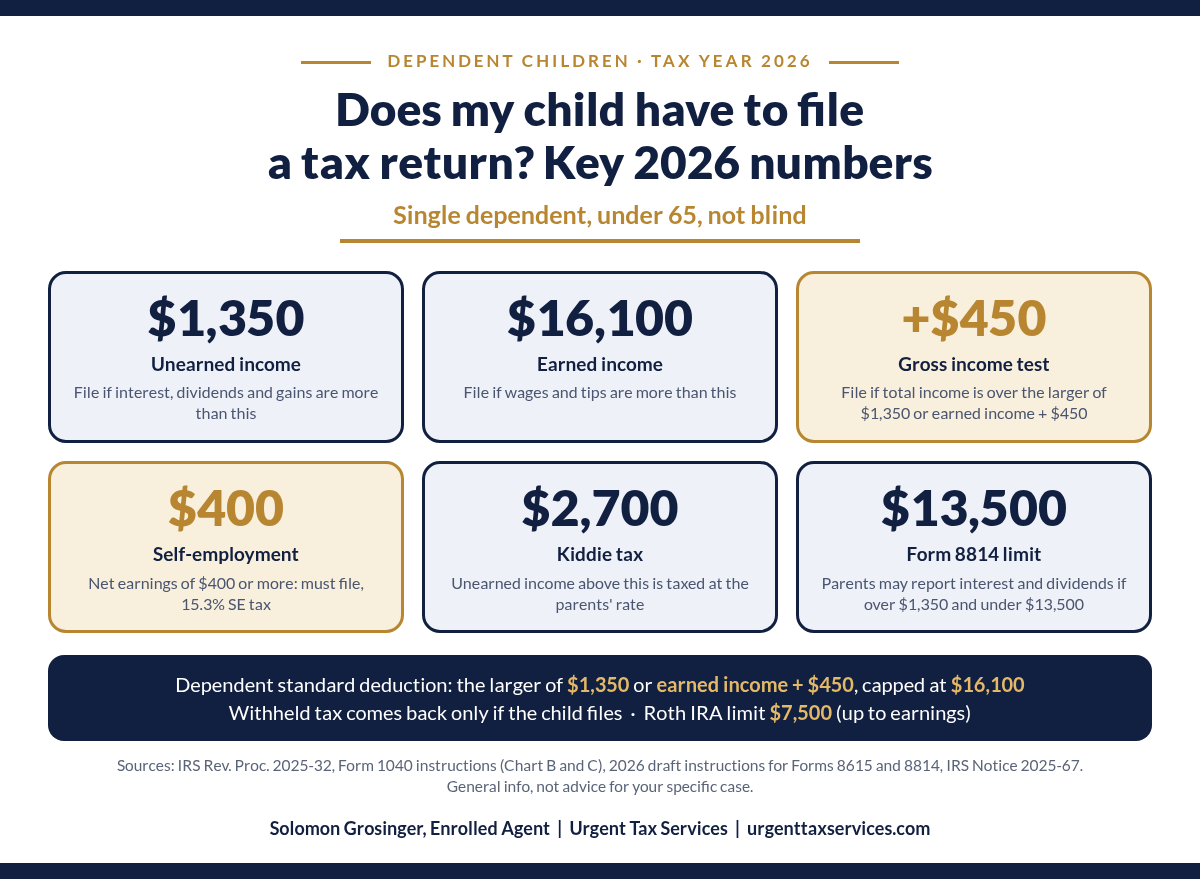
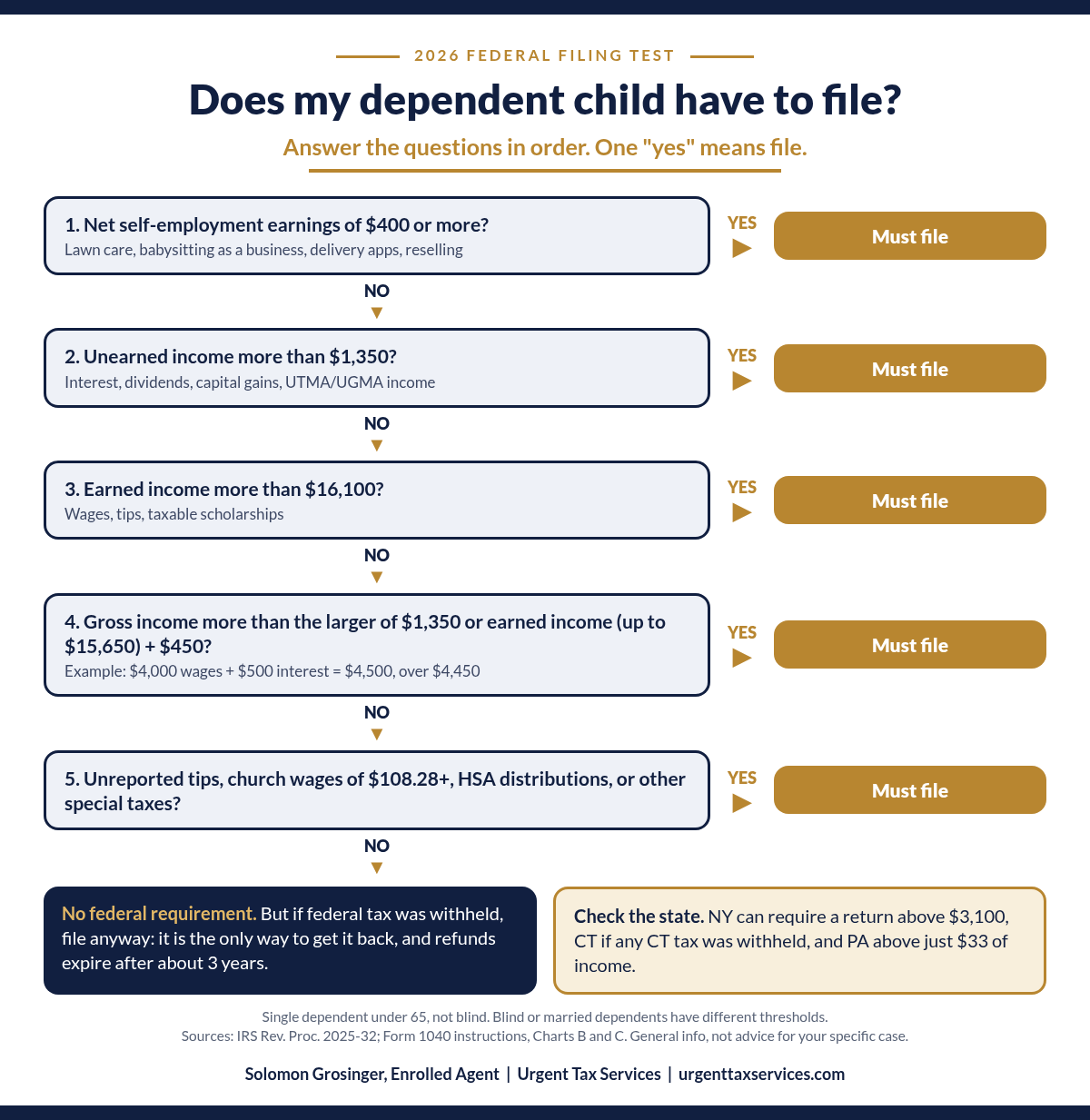
The short version: for 2026, a single dependent child who isn't blind generally must file a federal return if any of these is true: unearned income (interest, dividends, capital gains) over $1,350, earned income (wages, tips) over $16,100, or gross income over the larger of $1,350 or earned income plus $450. A child with $400 or more of net self-employment earnings must file no matter what. Claiming a child as your dependent does not cover the child's own filing requirement. And even when no return is required, a child who had tax withheld has to file to get it back. State rules are different, and Pennsylvania's is the strictest: more than $33 of income.
First, is your child a dependent at all?
Everything in this article assumes someone can claim the child as a dependent. Most parents claim their children as a qualifying child. In general, that means the child:
- Is your son, daughter, stepchild, foster child, sibling, or a descendant of one of them (a grandchild, niece or nephew)
- Is under 19 at the end of the year, or under 24 and a full-time student, or any age if permanently and totally disabled
- Lived with you for more than half the year (temporary absences for school count as time at home)
- Didn't provide more than half of their own support
- Doesn't file a joint return, other than only to claim a refund
The test is whether someone can claim the child, not whether anyone actually does. If you could claim your 20-year-old college student but you skip it, the student still files as someone who can be claimed as a dependent. That matters because a dependent gets a much smaller standard deduction.
Earned income vs unearned income
The filing rules for dependents turn on what kind of income the child had. The IRS splits it this way:
- Earned income: wages, salaries, tips, professional fees, net self-employment earnings, and taxable scholarship or fellowship grants (for the filing test).
- Unearned income: taxable interest, ordinary dividends, capital gain distributions, capital gains from selling stock, unemployment compensation, the taxable part of Social Security benefits, pensions and annuities, and distributions of unearned income from a trust.
- Gross income: earned and unearned income added together.
Custodial accounts under UTMA or UGMA belong to the child. The interest, dividends and gains in those accounts are the child's unearned income, even if a parent or grandparent opened the account and makes the investment decisions. The same goes for Social Security benefits paid for a child: the benefits are the child's income, not the parent's. They are usually not taxable unless the child has a good amount of other income.
2026 federal filing thresholds for a dependent child
These are the numbers for a single dependent who is under 65 and not blind. They come from the 2026 inflation adjustments in IRS Revenue Procedure 2025-32 and follow the same formula the IRS uses in its filing chart for dependents.
| Test | 2026 threshold | What it catches |
|---|---|---|
| Unearned income | More than $1,350 | A child with $1,400 of interest and dividends and no job |
| Earned income | More than $16,100 | A full-time summer and after-school worker |
| Gross income | More than the larger of $1,350, or earned income (up to $15,650) plus $450 | A child with a job and some investment income, even if each piece is small |
| Self-employment | $400 or more of net earnings | Lawn mowing, babysitting as a business, reselling, freelance gigs |
| Church employee | $108.28 or more of wages from an exempt church | A child working for a church that is exempt from employer FICA |
A child who is blind gets higher thresholds because of the extra standard deduction ($2,050 for 2026 for an unmarried person). For example, the unearned income test becomes more than $3,400 instead of $1,350. Married dependents have their own chart, and one rule that surprises people: a married dependent whose spouse files separately and itemizes has to file with gross income of just $5.
The gross income test is the one people miss. It means a child can have a filing requirement even though the job alone and the interest alone are both under their limits. I'll show that in Example 2 below.
Other reasons a child must file
Apart from the income tests, the IRS requires a return in several other situations. The ones I actually see with children and young adults are:
- Self-employment of $400 or more. The IRS treats a lot of what people call "gig work" as self-employment: delivery apps, selling online, tutoring, lawn care, dog walking or babysitting run as a little business. At $400 of net earnings, self-employment tax applies, and the only way to pay it is on a return.
- Unreported tips. A restaurant worker who received tips subject to Social Security and Medicare tax and didn't report them to the employer has to file to pay that tax.
- Wages from an employer that didn't withhold Social Security and Medicare. This shows up when an employer paid wages but never withheld those taxes.
- Church wages of $108.28 or more from a church or church-controlled organization that is exempt from employer FICA.
- Health savings account distributions, or certain additional taxes on an IRA or other tax-favored account.
When your child should file even if it isn't required
A filing requirement and a reason to file are two different things.
Withheld tax. The most common reason is a summer or part-time job. A teenager fills out a W-4, the payroll system withholds federal income tax, and the teenager ends the year owing nothing. The only way to get the withholding back is to file. If you don't file, the IRS keeps it.
The refund clock. A refund claim generally has to be made within three years of the return's due date. A child who had withholding in 2023 and never filed generally has until April 15, 2027 to file the 2023 return and claim that refund. After that, the money is usually gone for good.
The earned income tax credit, with a caution. Many articles say a dependent child may be able to claim the earned income tax credit. In practice, most dependent children can't. A worker without a qualifying child of their own generally has to be at least 25 and under 65, and can't be the qualifying child of another taxpayer. So a 17-year-old with a part-time job generally does not get the credit, and you should be careful with any software that suggests otherwise.
Retirement savings. A child with earned income can contribute to a Roth IRA, up to the lesser of $7,500 for 2026 or the child's taxable compensation. A Roth contribution isn't reported on the return, but you need a clean record of the earnings, and a W-2 or a filed return is the easiest proof. Babysitting money paid in cash still counts as compensation if it was really earned, but keep records.
Good habits. A first tax return is a good time to show a child how a pay stub, a W-2 and a refund connect. It also builds the habit of keeping records.
The dependent standard deduction is not the one on the form
Most people know the 2026 standard deduction for a single filer is $16,100. A dependent child usually doesn't get that. For 2026, a dependent's standard deduction is the larger of:
- $1,350, or
- earned income plus $450,
but never more than the regular $16,100. A child with no job and $3,000 of interest gets $1,350. A child who earned $3,000 at a summer job gets $3,450. A child who earned $20,000 gets the full $16,100.
The mistake I see is a teenager filing their own return with a free app, not checking the box that says "someone can claim you as a dependent," and taking the full $16,100. That understates the child's tax when there is investment income. The IRS can bill the difference with interest, and an accuracy-related penalty of 20% of the underpayment may apply. When the box is checked, the software figures the smaller deduction automatically. Checking it does not hurt the parents, and the parents still claim the child.
Five 2026 examples
These are made-up families with numbers I picked to show how the rules work. Each child is single, not blind, and can be claimed as a dependent by the parents.
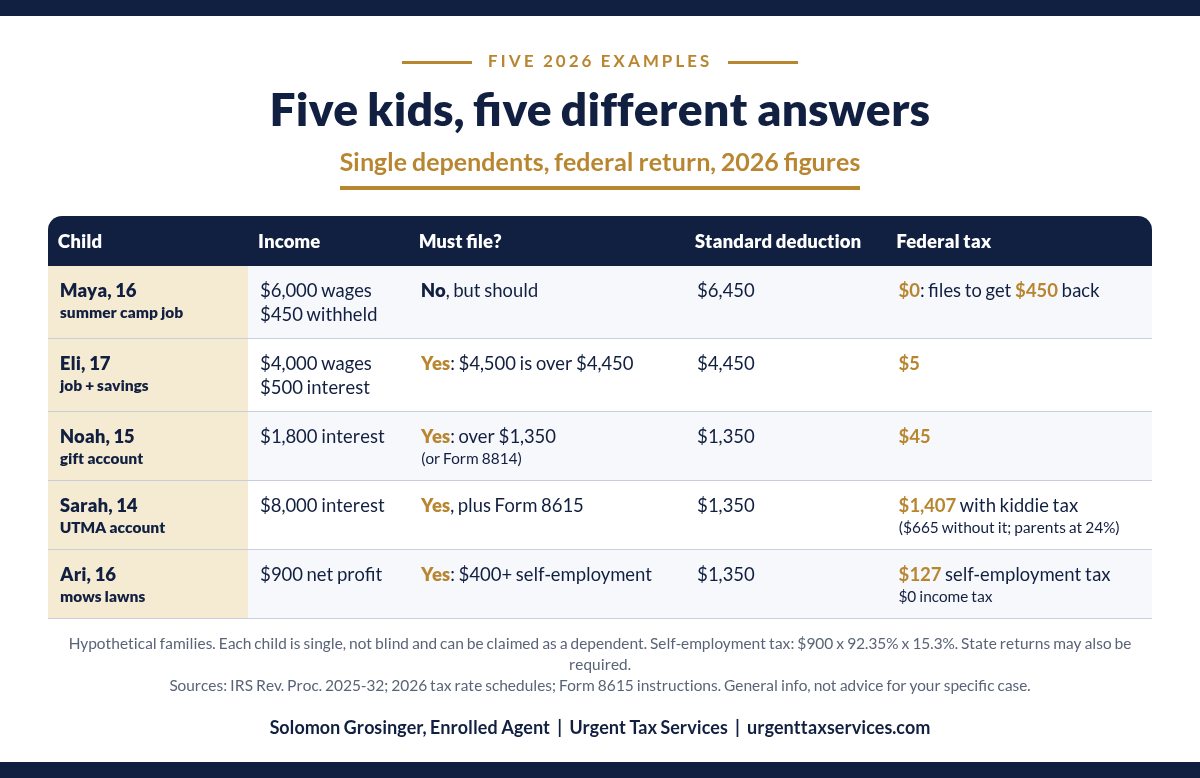
Example 1: summer job with withholding. Maya is 16 and earned $6,000 at a summer camp. Her employer withheld $450 of federal income tax. She has no other income. Her earned income is under $16,100 and she has no unearned income, so she doesn't have to file a federal return. Her standard deduction would be $6,450 ($6,000 plus $450), so her taxable income is zero. If she files, she gets the full $450 back. If she doesn't, she loses it.
Example 2: a job plus a little interest. Eli is 17 and earned $4,000 at a pizza shop. He also had $500 of interest in a savings account. Neither amount is over its own threshold. But his gross income of $4,500 is more than the larger of $1,350 or his earned income plus $450, which is $4,450. So Eli must file. His standard deduction is $4,450, his taxable income is $50, and his federal tax is $5. The tax is tiny. The filing requirement is still real.
Example 3: interest only. Noah is 15 and had $1,800 of interest from an account his grandparents set up. That is over $1,350, so he must file (unless his parents use the election described below). His standard deduction is $1,350, his taxable income is $450, and his tax at 10% is $45. Because his unearned income is not over $2,700, the kiddie tax doesn't apply.
Example 4: a custodial account with real income. Sarah is 14 and had $8,000 of taxable interest in an UTMA account. She must file, and the kiddie tax applies. I walk through her numbers in the next section. Her total federal tax comes to $1,407 if her parents are in the 24% bracket, compared with $665 if all of it were taxed at her own rates.
Example 5: lawn mowing. Ari is 16 and mowed lawns in the neighborhood. After gas and equipment costs, his net profit was $900. That is $400 or more of self-employment earnings, so Ari must file. His self-employment tax is about $127 ($900 times 92.35% times 15.3%). His income tax is zero because his standard deduction covers what is left. The self-employment tax also counts toward his future Social Security record.
The kiddie tax for 2026
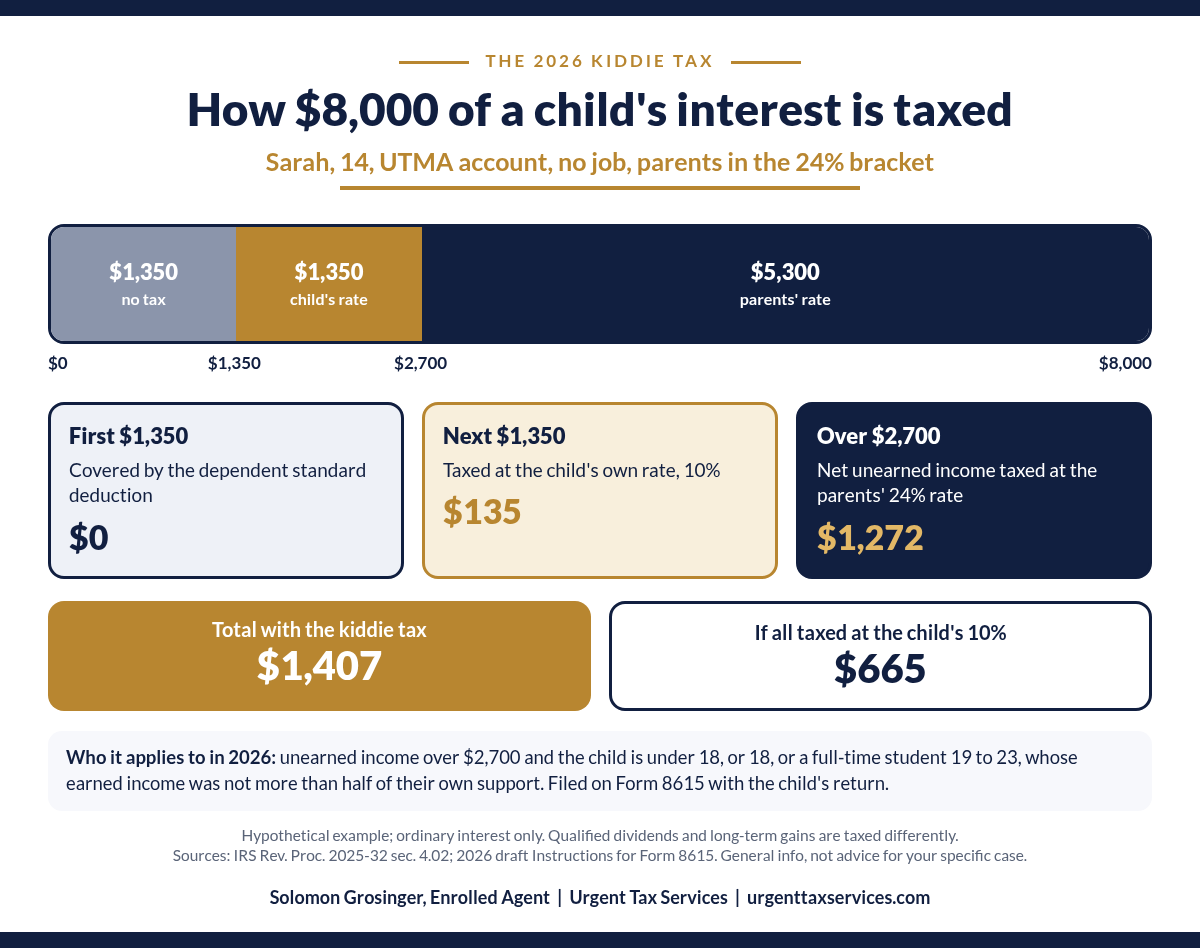
The kiddie tax stops families from shifting investment income to a child just to use the child's lower brackets. For 2026, it applies when the child's unearned income is more than $2,700 and the child is:
- under 18 at the end of 2026, or
- 18 and didn't have earned income of more than half of their own support, or
- a full-time student age 19 to 23 who didn't have earned income of more than half of their own support.
At least one parent has to be alive, and the child must be required to file and not file a joint return. The child's return then includes Form 8615.
The way it works for a child who doesn't itemize:
| Slice of the child's unearned income | 2026 treatment |
|---|---|
| First $1,350 | Covered by the dependent standard deduction. No tax. |
| Next $1,350 (up to $2,700) | Taxed at the child's own rates, generally 10% for ordinary income |
| Everything over $2,700 | Taxed at the parents' rate, if that is higher than the child's |
Back to Sarah. Of her $8,000 of interest, $1,350 is covered by the standard deduction. The next $1,350 is taxed at her rate: $135. The remaining $5,300 is net unearned income taxed at her parents' rate. If her parents are in the 24% bracket for that whole amount, that's $1,272. Her total is $1,407. Without the kiddie tax, her $6,650 of taxable income would have been taxed at 10%, which is $665.
A few points that come up in practice:
- The kiddie tax only reaches unearned income. Wages from a real job are taxed at the child's own rates.
- Qualified dividends and long-term capital gains keep their lower rates on the kiddie tax computation, so the numbers are different from an all-interest account.
- For the kiddie tax, a taxable scholarship that isn't reported on a W-2 is treated as unearned income, even though it counts as earned income for the filing test. College students with scholarships that cover room and board should check this.
- Form 8615 needs the parents' taxable income. If the parents are divorced or file separately, there are rules for which parent's return to use, and it may be the custodial parent's.
Reporting your child's income on your return instead: Form 8814
Parents can sometimes skip the child's return by electing to report the child's interest and dividends on their own return with Form 8814. For 2026, the election is available only if:
- the child was under 19 at the end of 2026, or under 24 if a full-time student,
- the child's only income was interest and dividends (including capital gain distributions),
- the child's gross income was more than $1,350 and less than $13,500,
- there was no federal income tax withheld from the child's income and no estimated tax paid for the child, and
- the child doesn't file a joint return.
Under the election, the first $1,350 isn't taxed, the next $1,350 is taxed at a flat 10% (at most $135), and anything over $2,700 is added to the parents' income.
It saves a return, but it isn't always cheaper. Adding the child's income raises the parents' AGI, which can reduce credits and deductions that phase out with income. If the child had qualified dividends or capital gain distributions, the IRS says the election can cost up to $135 more than a separate return, because those could be taxed as low as 0% on the child's return. I usually run it both ways. Noah from Example 3 qualifies for the election, and his tax would be the same $45 either way.
Paying your child through your business
If you own a business and your child actually works in it, wages are earned income for the child, which raises their standard deduction up to $16,100 and can fund a Roth IRA. Two IRS rules make this worth a look:
- Wages paid to your child under 18 aren't subject to Social Security and Medicare taxes if the business is a sole proprietorship, or a partnership where each partner is a parent of the child.
- Wages paid to your child under 21 aren't subject to federal unemployment (FUTA) tax in the same setup.
Those exemptions do not apply when the business is a corporation, including an S corporation. The work has to be real, the pay has to be reasonable for what the child does, and you need time records and payroll filings like any other employee. If you run a family business, I wrote about other planning moves in my guide to year-end small business deductions.
Can you still claim your child if they file their own return?
Yes. A child filing a return doesn't stop you from claiming them, as long as they still qualify as your dependent. The child checks the box on their Form 1040 saying someone can claim them, and you claim them on yours. For 2026, the child tax credit is up to $2,200 per qualifying child under 17 (up to $1,700 of it refundable), and the credit for other dependents is up to $500.
A child who can be claimed as a dependent can't claim those credits for themselves. And if you claim your college student as a dependent, only you, not the student, can claim an education credit like the American opportunity credit for their tuition.
Who signs a child's return?
If a dependent child has to file but can't because of age or any other reason, a parent, guardian or other legally responsible person must file it for the child. If the child can't sign, the parent or guardian signs the child's name followed by "By (your signature), parent for minor child." A tax preparer can also prepare and e-file the child's return.
New York, New Jersey, Connecticut and Pennsylvania
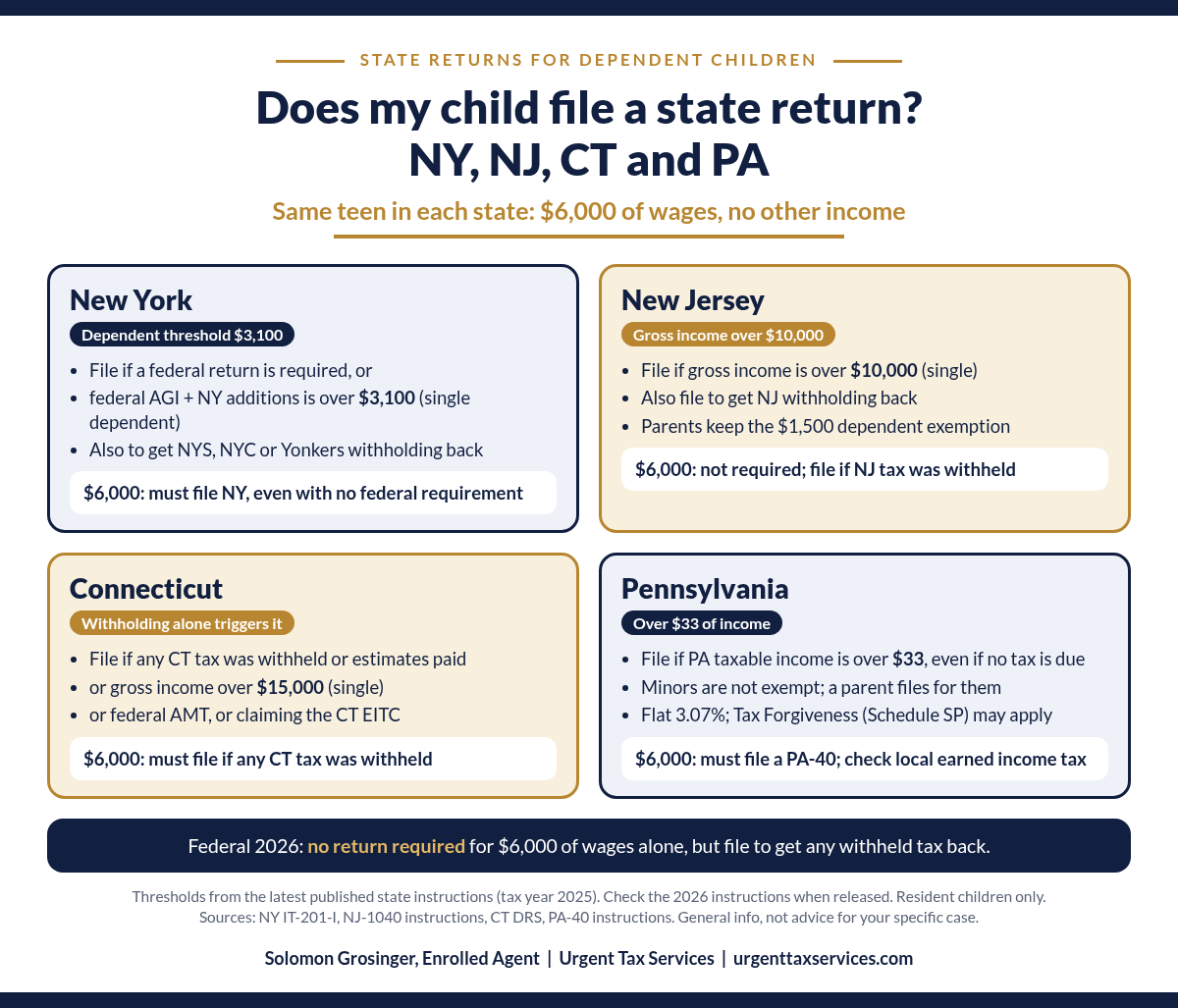
Each state has its own filing rule, and none of them simply follows the federal dependent chart. The amounts below are from each state's most recent published instructions (tax year 2025, filed in 2026). Check the 2026 instructions when they come out.
| State | A resident child must file if... | Maya: $6,000 of wages, no other income |
|---|---|---|
| New York | Required to file federal, or federal AGI plus NY additions is over $3,100 for a single filer who can be claimed as a dependent, or to claim a refund of NYS, NYC or Yonkers withholding | Must file NY, even with no federal requirement, because $6,000 is over $3,100 |
| New Jersey | Gross income over $10,000 (single), or to get a refund of NJ withholding or estimated tax, or to claim a refundable credit | Not required, but should file if NJ tax was withheld |
| Connecticut | CT tax was withheld, estimated tax was paid, gross income over $15,000 (single), federal AMT, or claiming the CT EITC | Must file if any CT tax was withheld; otherwise not required |
| Pennsylvania | PA gross taxable income over $33, even if no tax is due. Minors are not exempt | Must file a PA-40 |
New York. A New York dependent's standard deduction is $3,100, much less than the federal one, which is why New York can require a return when the IRS doesn't. If you live in New York City, the NYC resident tax is figured on the same Form IT-201.
New Jersey. New Jersey taxes gross income in categories and doesn't use a standard deduction. Parents generally get a $1,500 exemption for each dependent child on their own NJ-1040, plus an extra $1,000 for each dependent attending college if the requirements are met. The child filing their own return doesn't take that away.
Connecticut. Connecticut's instructions say plainly that withholding alone creates a filing requirement. If a teenager's paycheck had Connecticut tax withheld, a return is required, and it is also how they get the money back.
Pennsylvania. The Pennsylvania personal income tax is a flat 3.07% with no standard deduction, and a resident with more than $33 of PA taxable income has to file, including minors claimed as dependents. A parent or guardian files for a minor who can't. Pennsylvania's Tax Forgiveness credit (Schedule SP) can reduce or erase the tax for a dependent child, but only if the child is claimed on a parent's, grandparent's or foster parent's Schedule SP and that adult qualifies. The child still has to file a PA-40 and a Schedule SP. Many Pennsylvania municipalities also have a local earned income tax, so a child with wages may have a local return as well. Ask your local tax collector.
What to gather for a child's return
- W-2s from every job, including summer and holiday jobs
- 1099-INT, 1099-DIV and 1099-B forms from bank, UTMA, UGMA and brokerage accounts in the child's name or Social Security number
- 1099-NEC, 1099-K or simple records of self-employment income and expenses (lawn care, babysitting, online selling)
- Form 1098-T and scholarship award letters for college students
- SSA-1099 if the child received Social Security benefits
- The parents' taxable income and filing status, if Form 8615 or Form 8814 may apply
- Prior-year returns, if the child filed before, and any state tax withheld
If your child had unfiled years with withholding, those returns can still be filed. I wrote about why it's worth filing even when money is tight in File even if you can't pay, and you can see more on catching up in my unfiled tax returns page.
FAQ: dependent children and tax returns
Does my child have to file a tax return if I claim them as a dependent?
Possibly. Claiming your child doesn't cover the child's own filing requirement. For 2026, a single dependent generally must file with unearned income over $1,350, earned income over $16,100, gross income over the larger of $1,350 or earned income plus $450, or $400 or more of self-employment earnings.
How much can a dependent child earn before filing a tax return in 2026?
With wages only, up to $16,100 without a federal filing requirement. With any interest or dividends added, the limit can be much lower because of the gross income test.
What is the standard deduction for a dependent in 2026?
The larger of $1,350 or earned income plus $450, but not more than $16,100.
What is the kiddie tax threshold for 2026?
$2,700 of unearned income. Above that, the excess is generally taxed at the parents' rate.
Can I put my child's interest on my return?
If the child's only income is interest and dividends, between $1,350 and $13,500 for 2026, with no withholding or estimated tax, you can elect to use Form 8814. Compare it to a separate return first.
My teenager made $3,000 and had tax withheld. Should they file?
Usually yes. There is no federal requirement, but filing is the only way to get the withholding back. In New York, $3,000 of wages is under $3,100, so no New York return is required either, but a refund of New York withholding needs one. In Pennsylvania, a PA-40 is required.
Can my dependent child get the earned income tax credit?
Usually not. Without a qualifying child of their own, a worker generally must be at least 25, and a person who is someone else's qualifying child can't claim it.
Who signs a return for a young child?
The parent or guardian signs the child's name, followed by "By (your signature), parent for minor child."
Related: 2026 tax guide · Married filing jointly vs separately · 1099-K for online sellers · Tax checklists · Tax glossary · Tax planning
If you're not sure whether your child needs a return, or you want help with a child's federal, New York, New Jersey, Connecticut or Pennsylvania return, message me or book a free consultation.
I help with IRS, New York, New Jersey, Connecticut and Pennsylvania tax problems.
General info, not advice for your specific case.