Lowering your taxes is legal. A sham real estate deal isn’t.
The tax code doesn't stop you from lowering your taxes. It stops you from doing deals whose only purpose is lowering your taxes.
Clients ask me where that line is, and real estate is where it comes up most. Property moves easily between family members and companies you control, and each move can change the tax. Here's how the IRS and the courts tell the legal moves from the shams.
Lowering your taxes is legal
The Supreme Court said it plainly in Gregory v. Helvering (1935): a taxpayer's right to reduce or avoid taxes "by means which the law permits, cannot be doubted." The year before, Judge Learned Hand wrote in the same case that anyone "may so arrange his affairs that his taxes shall be as low as possible."
So a 1031 exchange done by the rules is fine. So is a cost segregation study on a building you bought, a retirement plan contribution, or waiting until January to close a sale.
But here's the half people forget. Mrs. Gregory lost. She ran stock through a brand-new corporation that existed for a few days and did nothing. The Court called it "an operation having no business or corporate purpose," a disguise, and refused to give her the tax-free treatment she claimed.
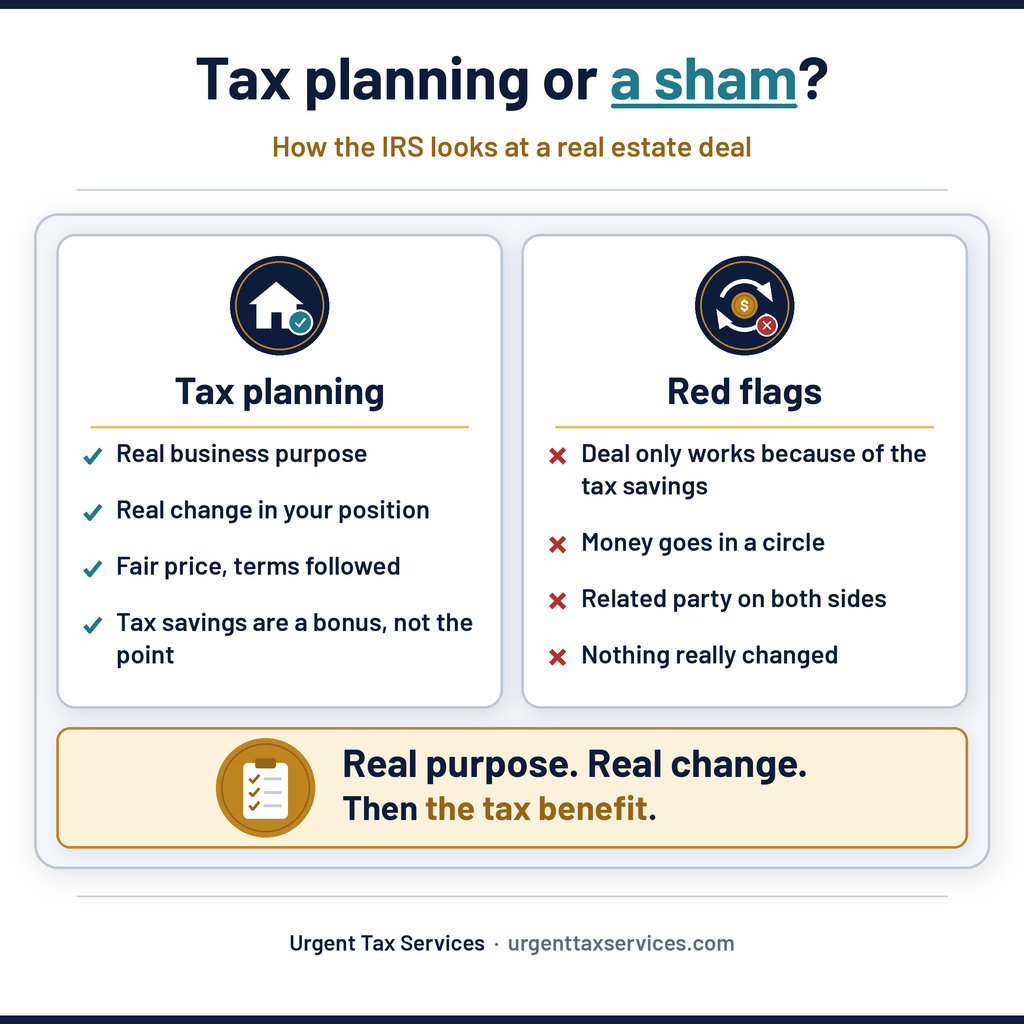
That's the real rule. Lowering your tax isn't the problem. A deal that has nothing to it except the lower tax is.
The two-part test in Section 7701(o)
In 2010, Congress wrote the economic substance doctrine into the tax code. When the doctrine applies, a transaction counts only if both of these are true:
It changes your economic position in a meaningful way, apart from federal income tax.
You have a substantial purpose for it apart from federal income tax.
Both, not one or the other. A few details matter:
Profit counts only if it's real. If you point to profit potential, the expected pre-tax profit has to be substantial compared to the tax benefit. Fees and transaction costs come out first.
State tax savings don't help. State or local tax savings tied to the federal savings count as tax benefits, not as a business purpose.
A series of steps is judged as one deal. In Liberty Global (10th Cir. 2026), the court refused to let ordinary-looking steps save a plan whose first steps the company admitted had no substance.
For individuals, it applies to business and investment deals, not personal ones. Rental and investment property is covered.
Sham in fact vs. sham in substance
Courts describe two kinds of shams.
A factual sham is a deal that didn't happen, didn't happen the way it was reported, or ignored basic arm's-length terms. The deed was never recorded. The rent was never paid. The price had nothing to do with the property.
An economic sham, or sham in substance, is a deal that really happened but has no meaning apart from the tax.
Two related ideas come up with real estate too. Substance over form: in Commissioner v. Court Holding Co. (1945), a corporation negotiated the sale of an apartment building, then tried to run the sale through its shareholders. The Supreme Court taxed the corporation anyway, saying "the incidence of taxation depends upon the substance of a transaction." And the step transaction doctrine: planned steps that only make sense together get treated as one transaction.
Real estate deals that draw questions
None of these is automatically bad. They're where I'd want the paperwork and the business reason nailed down first.
Selling a building to your own company to start fresh depreciation. Gain on a sale of depreciable property to an entity you control is generally ordinary income under Section 1239. You can't use the installment method on that kind of sale either (Section 453(g)).
A 1031 exchange with a relative or your own company. If either side disposes of the property within two years, the deferral is generally lost, with narrow exceptions (Section 1031(f)).
An installment sale to a relative who quickly resells. If they sell within two years, generally, you're treated as receiving their sale proceeds, up to what they still owe you (Section 453(e)).
A "sale" to family that's really a gift. The IRS's position (Rev. Rul. 77-299) is that a sale for notes you plan to forgive is a gift of the property. In Estate of Maxwell (2d Cir. 1993), a mother "sold" her home to her son, forgave the payments each year and kept living there. The court said it wasn't a real sale and included the house in her estate.
A sale-leaseback where nothing changes. These can be respected. In Frank Lyon Co. (1978), the Supreme Court honored one with real money at risk and real business and regulatory reasons behind it. Sell to a related company and keep acting as the owner, and you invite a different result.
Syndicated conservation easements. Investors buy into a partnership that donates an easement and claim deductions several times their investment. Regulations issued in October 2024 make them listed transactions that have to be disclosed. That came after the Eleventh Circuit, in Green Rock (2024), set aside the earlier IRS notice for skipping public comment. Since 2023, a partnership's easement deduction is generally disallowed if it exceeds 2.5 times the partners' basis. And in 2026, the Tax Court cut the $180 million deduction in Hancock County Land Acquisitions to about $2.2 million and imposed a 40% penalty.
Related parties aren't automatically a sham
In Parkway Gravel (2024), two companies had the same owners. One gave the other an option to buy a gravel pit, and the second company spent years getting the land rezoned. When the land sold, the IRS wanted to tax the whole $11.1 million sale to the first company. The Tax Court said no. The option was written, both sides performed, and the second company took real risk and did real work. Same owners, real deal.
The penalty is the scary part
If a tax benefit is denied because the deal lacks economic substance, the penalty is 20% of the underpayment. It's 40% if the facts weren't adequately disclosed on the return or a statement attached to it. An amended return filed after the IRS contacts you about an exam doesn't count.
And the usual defense, reasonable cause, doesn't apply to this penalty at all. "My advisor said it was fine" won't get it removed.
What I tell clients before a real estate deal
Write down the business reason before you sign, not after the audit letter.
Ask whether the deal still makes sense if the tax benefit disappears.
Use a fair price, backed by an appraisal, especially with family or your own companies.
Follow the terms. Collect the rent. Make the payments. Record the deed.
If the position is aggressive, talk with whoever prepares your return about disclosing it.
Short FAQ
Does a deal with a family member count as a sham? Not automatically. It gets a closer look. A fair price, real terms and actually following them matter most.
Can I get the economic substance penalty removed for reasonable cause? No. Reasonable cause doesn't apply to this penalty. Disclosure on the return is what keeps it at 20% instead of 40%.
General info, not advice for your specific case.
Related: Shifting the burden of proof to the IRS: why messy books don't qualify · Audited over a low S corp salary? · Is the IRS forced to accept an amended tax return? No.
Planning a real estate deal, or got an IRS letter about one?
Book a free consultation to go over your deal or your letter. For a quick question, you can call (718) 510-3166. I’ll tell you honestly where you stand.